
 Sign In
 (817) 503-2334
 Contact Us





 By:
By:
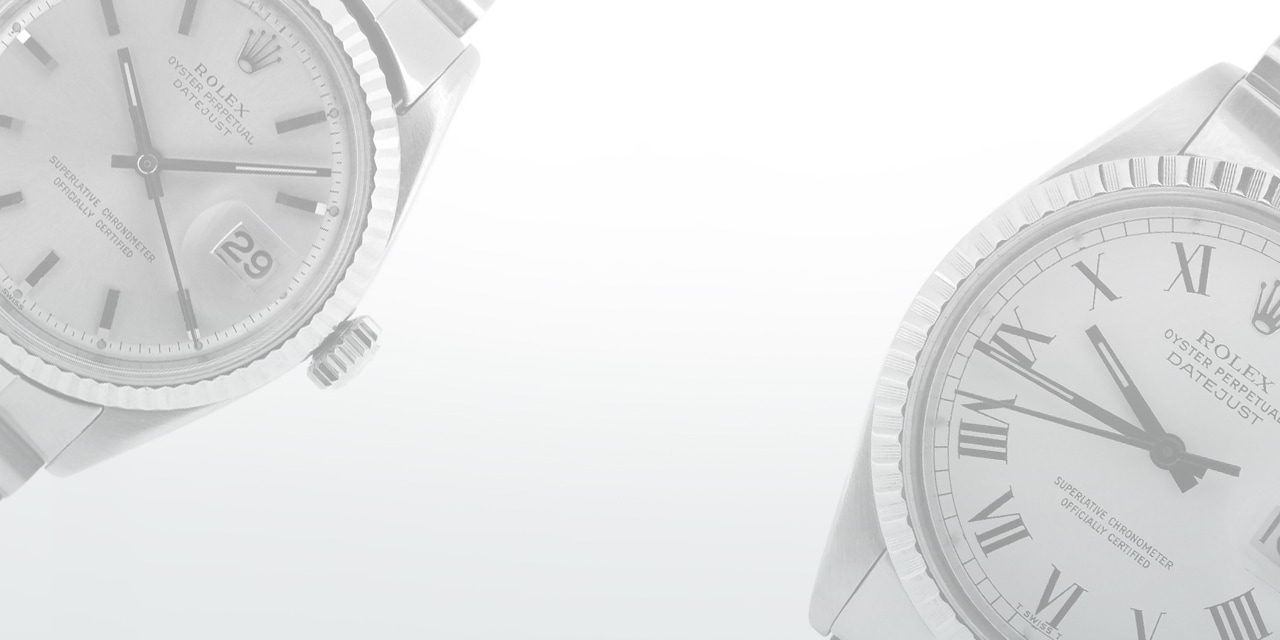
Rolex Decades: The ‘60s Datejust Versus the ‘70s Datejust
The last Rolex Datejust of the 1950s, the ref. 6604, stayed in production for a mere three years.
While that seems a conspicuously short run by today’s standards, it was actually pretty average for most of the watch’s earliest references. There had been about a dozen by this point, starting in 1945, as the brand struggled to amalgamate all that was good with each attempt into one whole.
The debut ref. 4467 had by far the longest term with 14 years, while the longest of the others topped out with the ref. 6309 and its four-year tenure.
So it was clear Rolex had been busy, but that hard work paid off in 1959 with the release of the ref. 160X series.
Here, at last, was an enduring design married to a perfectly reliable engine, with all the aesthetic and engineering details finally worked out and combined into one of Rolex’s first truly classic creations.
The ref. 160X Datejust is something of a legend in horology circles and remains to this day one of the most accessible gateways into vintage luxury watch collecting. It would take the collection all the way through the 1960s and almost the entire ‘70s as well.
Below we explore this timeless reference, discover how it differed from what had come before and see what eventually replaced it.
The ‘60s Datejust Versus the ‘70s Datejust: The Long-Running Classic
Datejust Ref. 160X
Key Features:
Production: 1959-1977
Case Size: 36mm
Materials: Steel. Rolesor. 18K Yellow/Pink/White Gold. 14K Yellow Gold
Movements: Cal. 1565/Cal. 1575
Bezel: Fixed. Fluted/Smooth/Engine-Turned
Crown Guards: No
Dials: White/Black/Silver/Champagne/Blue/Pink/Orange/Green/Textured/Stone
Crystal: Plexiglass
If you had three examples of the Datejust lined up in front of you: one of the current 36mm pieces, a ref. 160X model and the reference which preceded it, the ref. 6604, it would be very easy to see that the middle watch is where the Datejust found its contemporary form.
The basic shape is there, with the flat case back having taken over from the earlier convex, or Bubbleback style. The hour markers had, by this time, morphed into the plain batons we recognize today and while the very first run examples still used the sharp Alpha hands, they were very quickly swapped for the simple stick hands of modern Datejusts.
Inside, all had come up to date as well. The reference kicked off with the Cal. 1565, from the first family of movements Rolex had made in-house, before upgrading in 1965 with the Cal. 1575—ostensibly the same but with a boost in balance frequency from 18,000vph to 19,800vph. That latter caliber was improved on again in 1972 with the introduction of a hacking function, allowing wearers to stop the seconds hand by pulling out the crown and so make setting the time easier.
What’s more, the ref. 160X series is where Rolex really began to commit to the Datejust’s ‘everyman’ persona. Released in all flavors of gold, there were also full steel and Rolesor options as well as one in 14K yellow gold for a taste of less pricey luxury. And the dials hit on a rich vein of variety too. The standard black, white and champagne faces were supplemented by some vibrant shades of orange, blue, green and even pink, while the first taste of some exotic materials made an appearance, such as semiprecious stones like lapis lazuli.
The most popular combination was the one released first, the ref. 1601—a stainless steel case topped with a solid yellow gold fluted bezel. That bezel, too, was one we would recognize today, having left behind the coin-edged finish and graduated to the wider undulations of the current type. The ref. 1600 and ref. 1603, unveiled at the same time, were in all steel, with smooth and engine-turned bezels respectively.
In all, the Datejust had truly arrived and there was little Rolex could do to improve on it. Aside from the lume changing from radium to tritium in 1963 or thereabouts, the ref. 160X took the model up to the end of the ‘70s with practically no interference.
The ‘60s Datejust Versus the ‘70s Datejust: Big Changes Ahead
Datejust Ref. 160XX
Key Features:
Production: 1977-1988
Case Size: 36mm
Materials: Steel. Rolesor. 18K Yellow/Pink/White Gold.
Movements: Cal. 3035
Bezel: Fixed. Fluted/Smooth/Engine-Turned
Crown Guards: No
Dials: White/Black/Silver/Champagne/Blue/Pink/Orange/Green/Textured/Stone
Crystal: Acrylic
By 1977, Rolex was ready to release its latest generation mechanical movement, the Cal. 3035, into the Datejust. As well as upping the frequency again, this time from 19,800vph to the now standard 28,800vph, it also brought with it a Quickset function for setting the date.
Elsewhere, the dials dispensed with the vintage pie pan style and went flat for the first time, while the lume stuck with tritium for the duration.
However, the introduction of the five-digit Datejusts was overshadowed somewhat by Rolex going in, or rather being forced to go in, a new direction entirely.
The quartz crisis was busy decimating the traditional watch industry in Switzerland, cutting a swathe of destruction which would bankrupt around two-thirds of the country’s maisons before it petered out towards the end of the ‘80s. In response, many brands were compelled, somewhat begrudgingly, to engage with the new technology and unveil quartz-powered watches of their own. Rolex was no exception.
The manufacture had already launched a quartz watch by this time, in the shape of the ref. 5100 Beta 21 in 1970. Nicknamed the Texan, it had been little more than a prototype, fitted with an ensemble movement made in partnership with the Centre Electronique Horologer (CEH). Comprising 20 different brands, with Patek Philippe, Omega and Piaget among them, the CEH had formed in 1962 with the aim of competing with the best from Japan and the States and, in the process, saving themselves from annihilation. By 1969 they had come up with the Beta 21, an extraordinary movement accurate to around five seconds a month. The group produced about 6,000 of the calibers and divided them up between the contributing brands, with Rolex’s going into the ref. 5100. It debuted at the 1970 Baselworld with all 1,000 units sold before the doors even opened; a big, brash, all-gold model which could boast of being not only the first Rolex watch with a hacking function but also the first with a sapphire crystal.
It had its problems though. One of the most severe was the fact the movement was so large it wouldn’t fit into any of Rolex’s Oyster cases and so the Texan was not waterproof. Secondly, the relatively rudimentary technology meant it ran out of power fairly quickly, but possibly more importantly than all that, the Beta 21 was being used by more than a dozen of Rolex’s main competitors which, for a brand which has prized its exclusivity above all else, was something of an abomination.
As a result, Rolex withdrew from the CEH in 1972 and set to work on a quartz movement of its own. Five years later, the Cal. 5035 and the Cal. 5055 debuted inside the Oysterquartz versions of the Datejust and Day-Date.
The ‘60s Datejust Versus the ‘70s Datejust: The Oysterquartz Datejust
Oysterquartz Datejust Ref. 170XX
Key Features:
Production: 1977-2001
Case Size: 36mm
Materials: Steel. White/Yellow Rolesor.
Movements: Cal. 5035
Bezel: Fixed. Fluted/Smooth
Crown Guards: No
Dials: White/Black/Champagne/Blue/Grey
Crystal: Sapphire
As impressive and forward-thinking as they were, the Oysterquartz watches represent Rolex at its most reluctant. Evidence of this can be found in the numbers. Both models stayed in production from 1977 up to 2001, and in all that time only 25,000 rolled off the production line. Not annually; in total. This from a brand which now makes upwards of a million traditional watches every year.
Furthermore, the design was unlike anything we have seen from the company before or since. Catching the wave started by the Genta-designed Royal Oak for Audemars Piguet, the Oysterquartz were large, sharply-angled pieces with integrated bracelets, a world away from the conservative styling and flowing lines which have long defined the brand.
Those visuals would serve two purposes. Firstly they met the ‘futuristic’ zeitgeist prevalent at the time, with quartz being the stuff of space-age comic books. And secondly, it meant there was little chance of confusing them with Rolex’s much preferred conventional models—something one presumes the higher-ups at the brand had insisted on.
Inside though, both the Cal. 5035 and Cal. 5055 had more in common with the new wave of mechanical movements than you might think. In fact, with the exception of the power supply and pulse motor, there were more similarities than differences. The gear train, pallet assembly and escapement were all identical to those found in the Cal. 3000 calibers, for example. They were also roughly the same size, meaning Rolex could use Oyster cases again and keep the watches waterproof.
The calibers were among the first thermocompensated examples of quartz mechanisms at the time as well, and after adjusting the shape of the crystal in the oscillator about 18 months into production, they were submitted to the COSC for endorsement. Both were certified accurate to an astonishing +/- 0.07 seconds a day.
Yet, although the incredible precision and lower cost saw the Oysterquartz models become excellent sellers, Rolex continued its association halfheartedly. The Datejust version came in just three guises; the all-steel ref. 17000 with smooth bezel, the yellow Rolesor ref. 17013 and the white Rolesor ref. 17014, both with fluted surrounds.
Dial selection was similarly unenthusiastic, with only a handful of the usual colors available, although some were given diamond indexes.
The ‘60s Datejust Versus the ‘70s Datejust: The End of the ‘70s
Where the Oysterquartz were something of an anomaly, the ref. 160XX became virtually a transitional series, given a respectable 11-year run. Then, like just about everything Rolex fitted with a Cal. 30XX engine, they were replaced with the next in line to allow for the updated Cal. 31XX calibers to come in.
There were enough differences in those two movement families, just, to validate the change and the ref. 160XX was displaced by the ref. 162XX series in 1988. That takes it outside our time period, so we’ll take a look at that in a separate article. Check back in with us to learn about the Datejust between the ‘80s and ‘90s.
Featured Photo: BeckerTime’s Archive.