
 Sign In
 (817) 503-2334
 Contact Us





 By:
By:
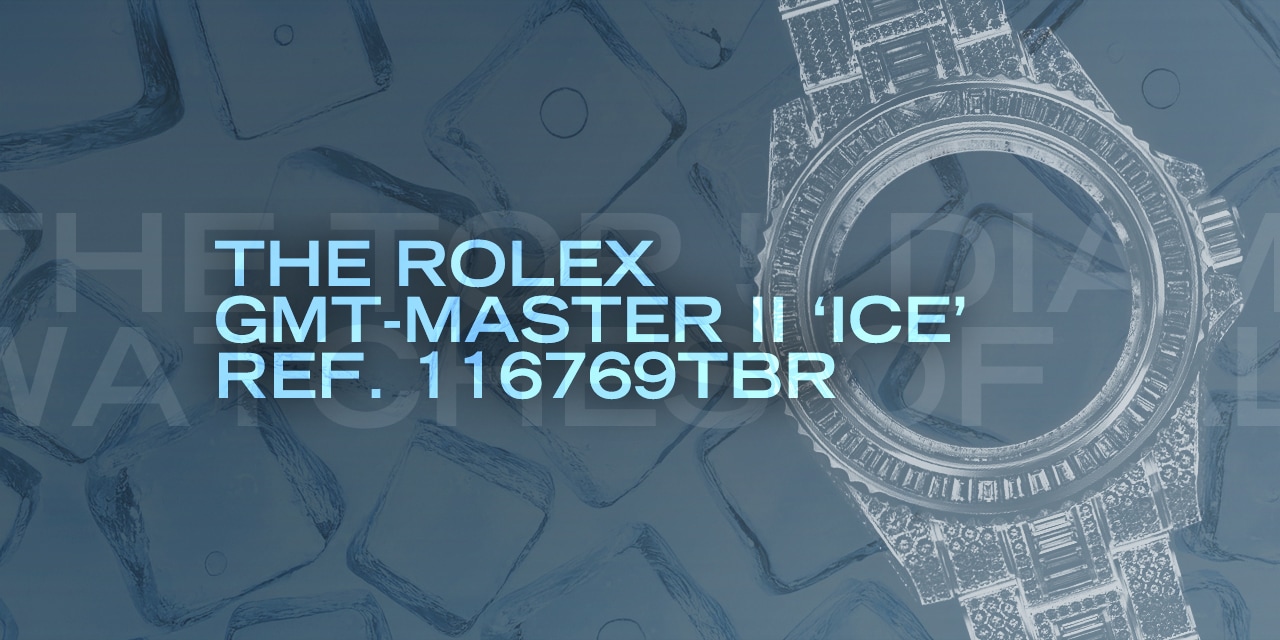
The Top 5 Diamond Watches of all Time: The Rolex GMT-Master II ‘Ice’ ref. 116769TBR
Many of Rolex’s earliest creations were outfitted with diamonds and other gemstones.
As far back as the 1920s, the manufacture produced ladies cocktail watches—small and elegant, usually cast from gold or platinum, and often with precious stones studding the cases, bezels and lugs.
As the brand’s focus and personality shifted in the mid-20th century more towards their own invented genre of the men’s tool watch, these augmented pieces played less of a role in the Rolex story. Perhaps a few rare Datejust models would emerge with diamond indexes or the occasional accent around the bezel.
But, one of the main reasons the manufacture has continued to lead from way out in front is their ability to move with the times.
By the late ‘50s and early ‘60s, tastes began to embrace a more flamboyant style. Collections such as the Lady-Datejust and Cellini series were introduced, habitually featuring jewels to one degree or another.
However, it wasn’t until the hedonistic decade of the 1980s that Rolex unleashed the full force of their gemology department. Soon, once rugged sports models for serious professionals started clocking in bedecked with arm-aching levels of precious stones, painstakingly selected and set by the absolute best in the business.
And one of the most frequent flyers into this new world of over-the-top opulence and excess was the legendary GMT-Master.
The Sparkly GMTs
Among the first of these enhanced references was the ref. 16758SARU.
From the penultimate generation of the original GMT-Master before it evolved into the II, this massively striking watch was built on a yellow gold case and featured a bezel set with 18 baguette-cut rubies to represent the red half of the traditional Pepsi surround, another 18 sapphires for the blue half (hence the SApphire and RUby in the reference number) and had 11 brilliant-cut diamonds marking the hour divisions in-between. If that wasn’t enough, the watch contained 11 sapphires of various shapes—round, triangular and baton— as hour markers, and could even be specified with a full diamond pavé dial. And to top it off, the central links of the gold Oyster bracelet were also set with eight diamonds per link across 12 links, for a total of 96 brilliant-cut stones.
The model was the first major experiment Rolex performed with outfitting their iconic tool watches with gemstones and, although the SARU was only released in extremely limited quantities, it was successful enough to pave the way for further releases.
Before long, other blinged up references emerged. The stunning ref. 116758SA was an almost subtle take on the theme, with a pleasing blend of sapphires and diamonds on the bezel, with the latter stone regaling the lugs as well.
The ref. 116758SANR came with a mix of diamonds and black sapphires in the surround for a more monochromatic look.
And, with only 20 or so believed to have been produced, the vanishingly scarce ref. 116749SABLNR was a lavish twist on the Batman, with a bezel coated in blue and black sapphires.
All of these watches were designed to make sure the wearer got noticed, to a greater or lesser degree.
However, in the pantheon of GMT-Master peacockery, there is one reference which stands alone; 2007’s ref. 116769TBR, more commonly known amongst collectors as the Ice.
What’s Cooler Than Being Cool?
Several of the previous bejeweled GMTs were presented in the regular Rolex catalog, albeit on a very select basis.
The ref. 116769TBR never was.
Reserved only for the toppermost of top tier clients (think billionaires, A-list celebs, heads of state), this particular reference was to the watch world what magic wands are to the wizards of the Potterverse, i.e., the watch chooses the wearer. As one source put it; it is not a watch you shop for—it is a watch Rolex invites you to own.
Peek under its frock and the model is a white gold version of the initial Super case generation of the GMT-Master II. But you would be forgiven for missing that. With the exception of the serrated bezel edge, every millimeter of exposed surface is covered in some 30 carats of diamonds, lending it the look of a timekeeping glacier.
To give you a quick rundown of the numbers: the bezel accounts for 48 baguette-cut diamonds. Nothing too out of the ordinary there. Then there’s the dial, which has between 200 and 250 minute stones set into a unique wave pattern. On the case and lugs, a further 500 or so diamonds, with a similar amount festooning the entire Oyster bracelet. In all, somewhere in the region of 1,200-1,300 gems go into the ‘Ice’, represented by its ‘TBR’ designation. Standing for Tesselatte Brillants, it translates from the English word tessellate, meaning to completely fill an area with multiple copies of a single shape; in this case, brilliant-cut diamonds.
And not just any diamonds. In typical Rolex fashion, the manufacture does not depend on any outside concern to encrust its watches. That all goes on in-house at the Chéne-Bourg compound in Geneva, where the huge gemological department inspects, tests, selects and sets every stone used.
Each one is passed through an X-ray machine to ensure authenticity. Reports suggest that upwards of two million gems have passed through Rolex’s hands to date, and of that number, only two have ever been found to be fake.
Once confirmed genuine, traditional jewelers carefully select which stones they want to use according to strictly enforced guidelines. Clarity must be no less than IF, standing for Internally Flawless. That means no blemishes can be detected under 10x magnification. Likewise, color can only be within the four purist grades, D-G. By all accounts, somewhere around 99% of the precious stones are rejected.
After that, each individual gem is cut to the desired shape and size, where tolerances must be kept within 0.02mm. That’s about one quarter the width of a human hair.
Every stone then gets its own custom setting, painstakingly sculpted by the firm’s gem-setters. It is the gem-setters’ responsibility to choose the best method for seating the jewels (and Rolex’s artisans have invented several proprietary techniques) that not only holds them securely but also doesn’t take away from the amount of light allowed to pass through them. Glue is never used; each setting must do the work all by itself.
Even the likes of Cartier and Jacob & Co. acknowledge Rolex’s gemologists as amongst the very best in the world and it is only when you understand the skill and effort which goes into every gem-accented watch that you realize why completing each one can take several months. As for the likes of the ref. 116769TBR, estimates of somewhere around 400-hours of work went into every example.
Dancing on Ice
It also goes some way to explaining the cost too. When it was launched, the GMT-Master II ‘Ice’ was Rolex’s most expensive watch ever. Its retail price, the one none of us got to see, was $485,000.
I don’t know about you, but to me, that sounds like a lot of money. In truth though, the brand could have literally picked any number they fancied (maybe they did).
The kind of folk queuing up to buy themselves this pinnacle of brash overconsumption were probably not the sort of customers who actually look at price tags. When you get to that level, numbers have lost all meaning where money is concerned. Chances are Rolex would have sold exactly the same amount of ‘Ice’ if they’d rounded up to a tidy half mill, or stuck on an extra hundred grand or even more just for the hell of it.
What we do know is that if you or I had managed to secure one at ‘retail’ we would be quids in right now. It is a strange phenomenon that gem-encrusted Rolex watches are some of the only pieces which regularly fall in value. Because they have such a high premium on them at the AD, when it comes time to sell on the preowned market, the original buyer tends to lose money.
There are some famous exceptions, of course. Perhaps the strongest is the Rainbow Daytona, a model which retailed at around $100,000 back in 2018 and now can’t be had for less than four times that.
The ref. 116769TBR is another. At worst, selling one as a secondary will net you what you paid. At best, you can expect to rake in around $700,000, giving a tasty profit.
There are only a handful of people in the world with the buying power to get themselves one of these controversial beasts, and even fewer who actually would if they could. Very much an acquired taste, they are not the preserve of the introvert or those lacking in confidence. What they are is a spectacular achievement and a jaw-droppingly remarkable timepiece.
Featured Photo: Mixed art by Oriol Mendivil for BKT Archive.