
 Sign In
 (817) 503-2334
 Contact Us





 By:
By:
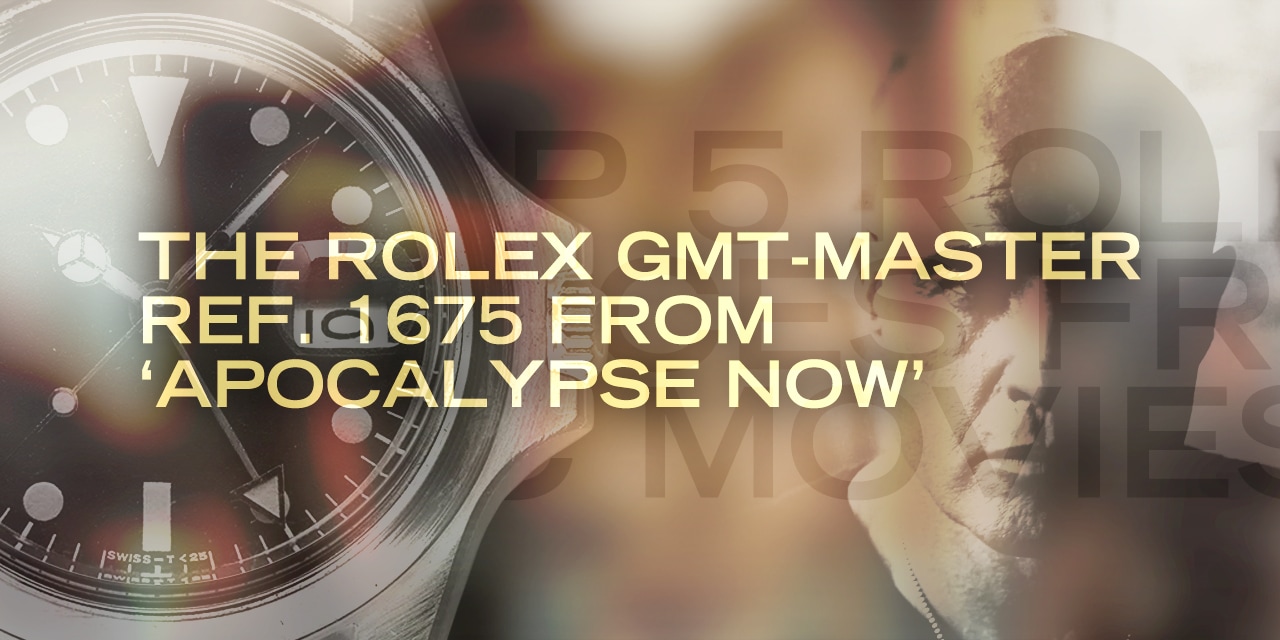
The Top 5 Rolex References From Iconic Movies: The Rolex GMT-Master ref. 1675 from Apocalypse Now
‘Frankly, my dear, I don’t give a damn.’
‘Here’s looking at you, kid.’
‘Go ahead, make my day.’
‘If Fate sent me here to save Earth, then Howard the Duck is ready to fight!’
Some movies are just endlessly quotable, their most famous lines taking root in the public consciousness and staying there forever.
But the true greats have more than one. The all-time classics are often shot through with so many celebrated phrases they become as legendary than the film itself. And one such movie is Apocalypse Now.
Probably the most cursed and ill-fated production of all time, everything that could have gone wrong on set did go wrong, and kept on going wrong long after it could be thought of as the usual shooting headaches. In fact, the chaos behind-the-scenes was so intense it became its own documentary: Hearts of Darkness: A Filmmaker’s Apocalypse.
Originally planned as a 16 week shoot in the Philippines, with a $12M budget, by the end the movie took over 16 months to complete and cost more than $30M—much of which was put up by director Francis Ford Coppola who mortgaged his home and assets to finance the picture.
Main star Martin Sheen, suffering at the time from alcoholism, had a nervous breakdown and a near-fatal heart attack during filming. Typhoons destroyed most of the sets and monsoon rains continually plagued the production, ruining continuity and damaging equipment. Much of the cast and crew were either high, stoned or drunk (sometimes all three) throughout and the helicopters lent to Coppola by the Philippine Air Force would be continually pulled out mid-shot to deal with real-life insurgencies. On top of all that, the script was in a constant state of flux, with rewrites galore, an improvised ending and a glut of ad-libbed dialogue.
But, by far the biggest problem was Marlon Brando.
Brando and His Method
If you were feeling charitable, you might describe the titanic Marlon Brando as ‘complex’.
One of, if not the, greatest actors in movie history, Brando was a graduate of New York’s Actors Studio, and was among the earliest exponents of Lee Strasberg’s method acting. His dedication to the craft left his performances raw, natural and emotionally truthful—on a good day.
Unfortunately, by the time he turned up on the set of Apocalypse Now, Brando was not only grossly overweight for the role he had been charged with, he was also regularly late and completely unprepared, having read neither the source novel, Heart of Darkness by Joseph Conrad, nor even the script. However, he made amends by being extremely difficult to work with and incredibly demanding, refusing to perform in ways that fit Coppola’s vision.
Because he was supposed to be playing the part of a rogue colonel-turned-dictator, with the sort of battle hardened and combat ready physique of a professional soldier, the director was forced to film him in close-up and deep shadow to hide his unsightly bulk.
Yet, despite it all, the movie which emerged is an incontestable masterpiece of cinema, where the madness behind the camera is perfectly matched to the insanity on the screen.
Kurtz’s Rolex
Any film can be made or broken by the tiniest detail. Especially when it comes to the players. For a character to draw us in, they have to look and act completely consistently with what the audience would expect that character to look and act like in each of their situations. The valiant protagonist suddenly becoming a sniveling coward for no apparent reason takes us out of the movie altogether and makes us aware we’re watching make believe—exactly the opposite of what directors want.
Some of the heroes most unsung in getting these things right work in the costume department. What a character wears does a huge amount of the heavy lifting, development-wise. Where would Indiana Jones be without his fedora or Neo without his long, black trench coat?
The choice of watch, for male characters especially, becomes very important in these situations. Getting the type and brand right is vital in order to maintain the illusion and, in keeping with the rest of the shoot, Brando even managed to make that a headache for Coppola.
In the movie, Brando is seen wearing his personal 1972 Rolex GMT-Master ref. 1675. Only the second generation of the world’s most famous traveler’s watch, the ref. 1675 came out in 1959 and ran for over 20-years. It was launched in the same year as the ref. 5512 Submariner and the two became the first of their respective breeds to be given larger 40mm cases as well as crown guards as befit ostensible tool watches.
During its long production, the ref. 1675 was fitted with several different types of bezel; you could have an all-black surround, or the brown and gold known as the ‘Root Beer’. If you were incredibly lucky, you might find the all-blue bezel inventively nicknamed the ‘Blueberry’. But by far the most prevalent was the original ‘Pepsi’ colorway, and that is the one which had formerly been on Brando’s model.
Yet, while that look is one of the most recognizable in all of horology, Coppola found the blue and red on the watch too jarring with Kurtz’s character so asked Brando to change watches. And, Brando being Brando, he refused.
But he did relent enough to remove the offending bezel and swap the Oyster bracelet for a rubber strap, leaving the watch a perfect reflection of the crazed officer—workmanlike, tough and efficient.
A Movie Icon
Filming on Apocalypse Now officially wrapped in May of 1977, and Brando’s customized ref. 1675 stayed out of the spotlight for nearly 20-years thereafter.
In 1995, though, the great actor gifted the watch to his adopted daughter, Petra Brando-Fischer at her graduation, rather than one of the 11 biological children he was known to have had.
Hand engraved on the back with ‘M Brando’ by the actor himself, in an accompanying note, he wrote, ‘This watch is like a tank. You can do anything you want to it and it will keep on going.’
Petra in turn handed the watch to her husband, producer Russell Fischer, as a wedding gift. But he refused to wear what he described as a ‘sacred object’ and left the piece in storage. Then, in 2017, shortly after Paul Newman’s Daytona sold for an ungodly amount, the Fischers got in touch with Phillips auction house, the upshot being Brando’s GMT sold in 2019 for $1,952,000, leaving it among the pantheon of iconic movie Rolexes—an irreplaceable artefact from an unforgettable exploration of madness, morality and psychological decay.
Featured Photo: Mixed art by Oriol Mendivil for BKT Archive.