
 Sign In
 (817) 503-2334
 Contact Us





 By:
By:
The Collaborations: The Omega X Swatch MoonSwatch
I’ve been in and around the world of watches for about 15-years now, give or take.
That means I was there when the Apple Watch looked in danger of reawakening the old Quartz Crisis hysteria, when Baselworld imploded, when Rolex’s steel and Cerachrom Daytona went from steel sports watch into genuine financial asset and when Covid brought everything to a shuddering halt.
And throughout all of that, nothing came close to the paradigm-shifting lunacy that accompanied the launch of a $260 quartz chronograph.
When the behemoth that is the Swatch Group conglomerate met up with legendary Swiss manufacture Omega to bring a new, fun take on one of horology’s most iconic forms, it was met with equal parts horrified outrage and levels of rapaciousness which bordered on utter insanity. In fact, the only thing which has come close over the last decade and a half was the phenomenal sensationalism which surrounded the auction of Paul Newman’s Paul Newman—and even that didn’t cause rioting in the streets.
For a good long while there in 2022, the Omega X Swatch MoonSwatch became not just one of the most hyped watches of all time, but one of the most hyped products of any kind.
But then, 2022 was a pretty weird year all round for the luxury watch industry.
What is/was the MoonSwatch?
Well, before we jump ahead, let’s go to the source so we can see exactly why the idea of a plastic revamp of this particular model might have been so controversial.
The Omega Professional Speedmaster Moonwatch was, is and will always be one of the most important watches of all time. Not only is it the blueprint for modern mechanical chronographs, it also has the most unimpeachable credentials of just about any tool watch ever made. This was the only model built well enough to satisfy the buzzcuts at NASA as they searched for an official timepiece for their Apollo missions in the ‘60s. That’s right, there’s a reason these are known as Moonwatches and that’s because they have literally been on the lunar surface—not that Omega like to make a big thing about it.
So, in the red corner, we have a near mythological being in the horology pantheon, a design classic which has needed virtually no tinkering in the last 60-years or so and a bona fide out-of-this-world presence looked up to and desired by just about every enthusiast who ever drew breath.
And in the blue corner, we have the makers of cheap, plastic throwaway quartz watches no serious collector would ever dream of wearing. At some point, some bright spark decided getting these two entities to work together would be advantageous! What. An. Idiot!
The Omega X Swatch MoonSwatch
You have to wonder if this collaboration would have happened but for the not inconsequential fact Omega has been owned by the Swatch Group since 1983 (technically, it was originally acquired by SSIH which later merged with ASUAG which later became Swatch but let’s not get bogged down on specifics).
Because Omega was under the conglomerate’s umbrella the first big headache in any partnership like this, licensing agreements, could be avoided completely. After that, looked at dispassionately, the idea of merging the two was actually brilliant from a commercial perspective.
Any business wanting to stay in operation knows it needs to keep appealing to younger generations. That keeps the conveyor belt of customers rolling on perpetually. And while the older ones knew exactly what a Moonwatch was, the up and comers not only did not know, they probably weren’t that interested. Similarly with Swatch. During the ‘80s and ‘90s, their quirky, colorful and inexpensive watches were all the rage. Cut to more recent times, and they were losing out big time to the aforementioned Apple Watch.
So a matchup between the two brands was able to tap into many of the aspects which most appeal to young people; namely collectability, cultural relevance, internet virality and lower entry prices. That was the attraction for Swatch. But what about Omega? Surely having a cheap plastic knockoff of your most famous creation was going to cheapen the brand as a whole?
Actually, not at all. For a start, no one was going to mistake the Swatch Speedy for the real thing. With its steel case, mechanical movement and lavish finishing, the genuine Moonwatch occupied a different sphere of the industry altogether. But what the MoonSwatch would do was awaken an interest in those who were out of the loop on this whole luxury timepiece idea; i.e. young people who were perhaps not in a position to drop several thousand on a watch which couldn’t even track your run or measure your heartbeat.
The Start of the Madness
Part of the whole genius surrounding the marketing of the MoonSwatch was just how little buildup there was before launch day.
In fact, the time between those first full-page teaser ads with their cryptic ‘It’s time to change your Swatch’ slogans and the watches going live was a matter of just over a week.
The ads appeared on 17th March 2022 and the following day selected journalists and insiders were quietly shown what was in store.
On the 21st March, some more explicitly solar-system themed advertising came out, with the official press release and reveal of all 11 models coming 24-hours later.
Of course, by then, things had gone absolutely nuts. Social media talked about little else, essentially doing the marketing for both brand simultaneously. Many didn’t actually believe the rumors, not wanting to admit to themselves Omega would allow such a thing to happen, and that in itself created a shockwave of publicity.
The vastly shortened timeline meant there was no chance for anyone to get used to the idea, but plenty of time for feelings of FOMO to take root.
Finally, when the watches dropped on the 26th March, all hell broke loose.
Desperate would-be customers (and more than a few flippers) had been camping outside boutiques for days by then and the frenzy once the doors opened called for police intervention on more than a few occasions.
The initial policy of only two per person was quickly reduced to one, but even then stocks ran dry in record time. Even when it was announced this was not going to be a limited edition release and the watches would be available on the Swatch website in a few weeks it did little to quench the madness.
Before long, the $260 models were changing hands on the preowned market for dozens of times their retail price with it all coming to a head in 2024 when the one millionth example sold for—and I am not making this up—$78,555.
What Were They Buying?
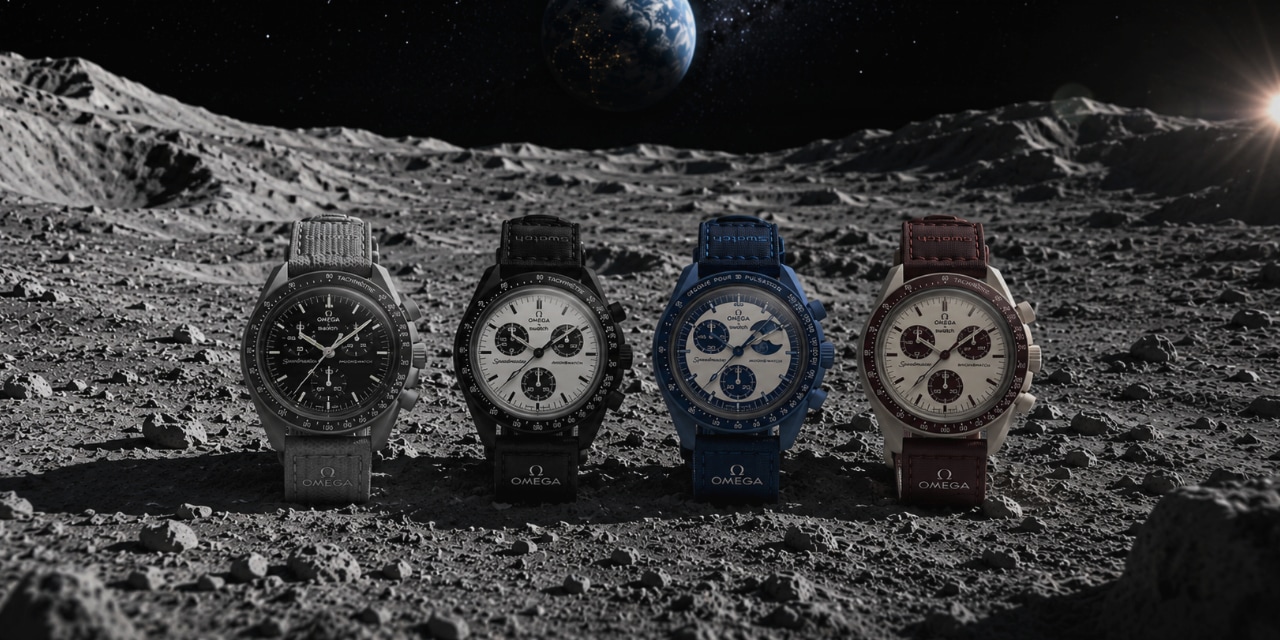
Those 11 original watches were all based on the planets of the solar system plus the sun and the moon.
Each was appropriately color coded; so, the Mission to the Sun came with a golden case and dial, the Mission to Mars was given red detailing, etc. Fittingly, the Mission to the Moon was the most closely adapted to the full-throated Moonwatch, coming in black and grey.
All measured in at the correct 42mm and were forged in Bioceramic, a type of sustainable plastic material, and had the same tricompax setup as the classic, although the sub dials here were placed a little differently than normal—specifically at 2-6-10 o’clock rather than 3-6-9 to further separate the two.
Inside was a G10.212 quartz movement from ETA (also owned by Swatch), which ran the central chrono hand, the running seconds sub dial and the 60-minute and 1/10th counters. Crucially, the battery in the MoonSwatch was replaceable. So, unlike the later collaborations with Blancpain and AP which used non-serviceable mechanical movements, the MoonSwatch should last a great deal longer.
The Later Editions
It is fair to say the MoonSwatch was a success. And as with all successes, it led to an expansion of the collection in later years. The 11 originals have since been joined by others, some of which are quite special. The Mission to Earthphase includes a moonphase complication, with the moons coated in Omega’s Moonshine Gold and every astronaut’s best pal Snoopy at the nine o’clock. Mission to the Pink Moonphase is similar, minus the beagle, but cast in a shocking cerise.
A personal favorite is the 1965, referencing the year the Speedmaster started its life with NASA. Here, the MoonSwatch has two unique totalizers; the one at 10 o’clock counts up to 19-hours instead of 12 and the one at 2 o’clock counts up to 65-minutes. All told, there are over 30 models in the family now, if you count all the special variants.
It is impossible to underestimate the cultural significance of the MoonSwatch. It was undoubtedly one of the defining product launches of the 2020s and dragged what could be thought of as quite a serious institution into the pop mainstream.
Before, Swiss watches were thought of amongst teenagers as old fashioned and corporate. Youngsters may have queued up for the latest sneaker drop or gig tickets—but it was the first time young people ever waited in line, sometimes for days, for a watch. All of a sudden, we had Speedmasters being discussed on TikTok and non-watch folk knowing what a Moonwatch was.
It also proved collaborations could work, even at the two opposing levels as Swatch and Omega. The triumph of the MoonSwatch and to a lesser degree the Blancpain Scuba Fifty Fathoms, opened the doors to the latest collab with Audemars Piguet, the first non-Swatch-owned manufacture.
But it was with the MoonSwatch that the Swiss watch industry fully entered the internet era, turning traditional timepieces from luxury goods to cultural events. And it took a plastic quartz model pretending to be something else to do it.
Featured Photo: Mixed art by Oriol Mendivil for BKT Archive.