
 Sign In
 (817) 503-2334
 Contact Us





 By:
Understanding the Rolex Sea-Dweller Part 2: The Modern Era
We left the ‘vintage’ part of this two-part article on the Sea-Dweller with just one reference highlighted—the ref. 1665—for the simple reason it was the only generation of the watch recognized as truly vintage.
Officially created in 1967, released to the public in ’71, the initial offering was dubbed the Double Red Sea-Dweller (DRSD) thanks to the twin lines of red text on its dial. A few years later in 1977, Rolex kept the reference number but switched up the dial script for reasons known only to themselves, getting rid of any red and substituting it with all white lettering, giving us what collectors refer to as the Great White.
That iteration, the last of the Sea-Dwellers with an acrylic crystal, carried on until 1983 when it was discontinued. But its replacement was already on the scene by then, and had been for a while.
The Triple Six
The first modern Sea-Dweller emerged just a year after the Double Red became the Great White. The ref. 16660, better known as the Triple Six, came out in 1978 and, even though it introduced a whole host of significant changes to its predecessor, it and the ref. 1665 ran alongside each other for years.
But they were very different beasts. Starting from the top, the Triple Six came with an even thicker case than the ref. 1665; recorded as around 14.6mm against the former 14mm. That, together with the fitting of the series’ first sapphire crystal and the brought over Triplock crown gave a water resistance rating of a ludicrous 4,000ft or 1,220m.
The extra heft to the case profile, the flat crystal and an enlarged HEV meant the ref. 16660 gained a heaping of added wrist presence, far more than an increase in thickness of less than a millimeter would suggest on paper.
Other changes were no less noteworthy. The bezel became unidirectional for the first time, an absolute priority for those saturation divers working in the most difficult circumstances imaginable. And the new caliber, the Cal. 3035, came with a Quickset feature to set the date independently with just the crown.
If you’ve made a bit of a study of Rolex’s shenanigans from the late ‘70s/early ‘80s, that mention of the Cal. 3035 movement will likely tell you what’s coming next. The ill-fated Cal. 3000 series of movements from Rolex, although upping the balance frequency from the previous 19,800vph to the now-collection wide 28,800vph, and excellent calibers in their own right, were not around for long. A few short years after their first appearance they were superseded by the massively successful and long-running Cal. 31XX range. That means most of the references into which the brand fitted the Cal. 3035 and its offshoots are now thought of as transitional models—meaning they brought in plenty of modern touches but were quickly replaced.
So it was with the Triple Six. It hung around until 1989—a relatively fleeting 11-year run but one which encompassed a couple of important changeovers.
The first was the switch from the older matte finished dials (another ‘vintage’ yardstick) to the more contemporary glossy style. That also led to a change in indexes, with those on the matte dials being painted on and those on the gloss dials applied and with white gold surrounds. As you might expect, it is the more retro version which now commands higher prices on the pre-owned market.
More importantly, from 1985 onwards, Rolex brought in an all-new type of stainless steel. As with the rest of the industry and still now, Rolex had always relied on 316L steel for its watches. But, when they discovered older models, particularly their dive stalwarts, had started to experience erosion and pitting around the screwheads, they went looking for an alternative.
904L was the answer, but it was not a cheap one. Used heavily in the marine industry, where it is deployed in such unforgiving arenas as commercial diving bells and seawater cooling devices, the main attraction of the metal is its incredible resistance to corrosion. Perfect for a professional dive watch and with the bonus of holding a unique shine when polished, something which would make Rolex’s models stand out even more.
Its downsides, however, were not insignificant. It is an especially difficult metal to machine, and expensive. It meant all of the brand’s machinery had to be replaced at enormous cost—but as this was at a time when Rolex was pivoting comprehensively away from their former role as makers of robust tool watches and towards a more luxury-focused mission—brought on by the popularization of the quartz watch—passing that extra expense onto the consumer in the form of higher prices actually worked in their favor. As all elite watch buyers know: more expensive equals better!
The Enduring ref. 16600
The next in line after the Triple Six followed in the footsteps of all of Rolex’s sequels to their transitional models and hung around for decades.
The ref. 16600 launched in 1989 and did not get retired until 2009. Visually, it was very close to the outgoing model, with every example now made from 904L. The big difference was inside where the Cal. 3135 set up shop, a truly outstanding mass-produced movement on which even Rolex could not improve for many many years.
Over its two decade lifespan, the longest of any Sea-Dweller reference so far, the ref. 16600 went through minimal changes, the most notable concerning its luminescence.
The earliest examples were still using tritium, a radioactive substance which had replaced the far more dangerous radium in the 1960s. That saw the ref. 16600 through its T and U serial era, with the tritium dials marked with ‘SWISS – T<25’ below the 6 o’clock index. That was replaced, very briefly, in 1998 during the A series with LumiNova, a photoluminescent ceramic compound (and so not radioactive at all) for just one year. These dials are marked simply ‘SWISS’.
Finally, from 1999 up until the reference was discontinued, Rolex switched to Super-LumiNova from the P/K era onward. These have ‘SWISS MADE’ at the bottom.
Weird Decision
To prove that even a company as successful and well-respected as Rolex is not immune to the occasional odd choice, the brand decided to withdraw the Sea-Dweller from sale in 2008.
It came on the back of the release of the steroid-infused Deepsea, a watch enormous in both size and abilities, measuring 44mm across and good down to a staggering 12,800ft. But, while it may have said Sea-Dweller on the dial underneath the DEEPSEA (in the same way as the original ref. 1665 was designated the Sea-Dweller Submariner 2000) it was a far more acquired taste and measurably less versatile than the real Sea-Dweller. It’s worth noting, of course, that today’s Deepsea no longer mentions the Sea-Dweller on its dial and lives in its own collection in the portfolio.
Fortunately, following a five-year absence, 2014 saw the return of the Sea-Dweller in its own right with the extremely short-lived ref. 116600.
One of those references which should, by rights, be a fierce target for those interested in watches as potential investments, the ref. 116600 is still something of a sleeper. Sticking with the time-honored 40mm steel case (for the last time), the model graduated to a Cerachrom bezel, with minute markings all the way around rather than just the first 15-minutes, reminiscent to the hyper-valuable MilSub Submariners. It also added a Maxi dial, with fatter indexes and wider handset, along with a Glidelock on the bracelet clasp and Rolex’s new Chromalight lume glowing a pleasant blue color.
The Current Range
The ref. 116600 was here and gone in a flash, discontinued after just three years, making it the shortest run of any of the Sea-Dweller generations.
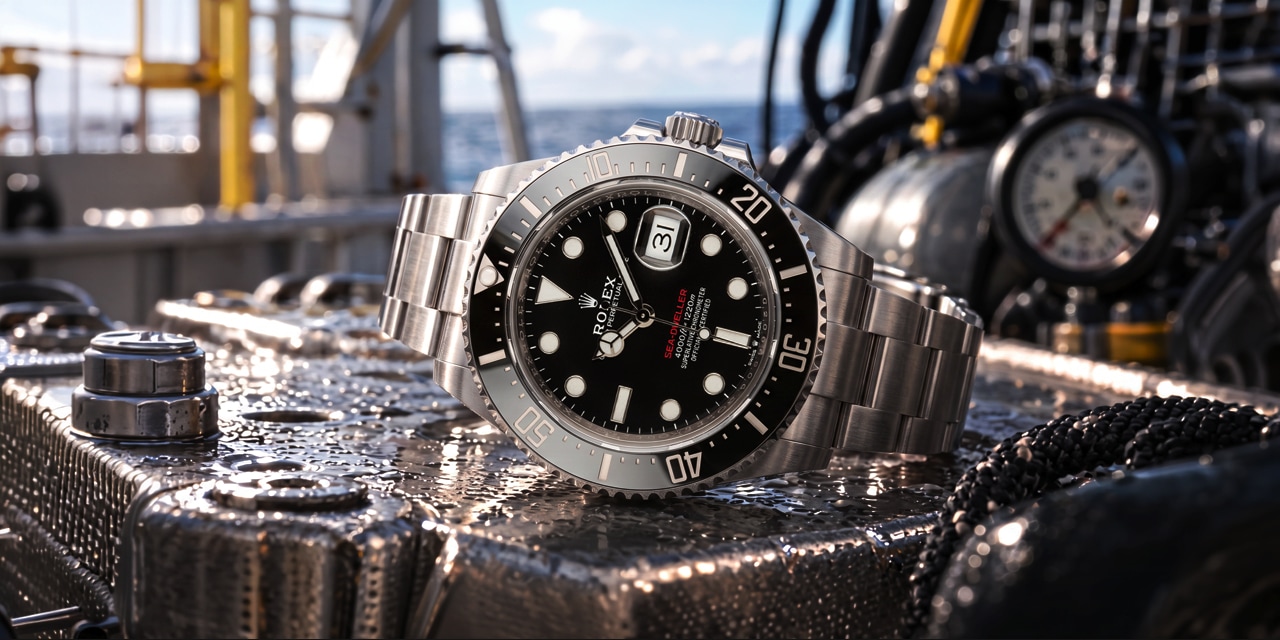
The heir to its throne, 2017’s ref. 126600, shook up the tried-and-tested formula in a big way. Firstly, it expanded to 43mm, putting it close behind the Deepsea, although nowhere near as heavy. It also included a Cyclops for the very first time. The main reason the Sea-Dweller had never had the magnifying lens over its date window previously is that they are glued to the crystal, and at the sorts of depths at which the watch was rated to operate, no glue existed strong enough to keep it in place. That, apparently, has now changed although Rolex don’t give details of what adhesive they use.
Another little detail Rolex brought in was a lovely throwback to yesteryear—the reinstatement of the Sea-Dweller name picked out in red; a Single Red for a new era.
Inside, the faultless Cal. 3135 was finally replaced by the brand new Cal. 3235, complete with its Chronergy escapement and 70-hour power reserve.
And to prove they were still capable of making weird decisions, 2019 saw Rolex come out with—of all things—a Rolesor Sea-Dweller. That’s right, the manliest of tool watches suddenly had solid yellow gold on its bezel edging, its winding crown and inner bracelet links.
I have absolutely no opinion on that. None whatsoever 😡 But I would say that, as the Deepsea range was given a full yellow gold model at around the same time, things could have been worse.
The Sea-Dweller is now into its fifth iteration and remains the perfect compromise for those looking for the toughest possible luxury dive watch that is still adaptable enough to accompany suits ranging from wet to dinner.
Arguably not as all-round wearable as a Sub, but a whole lot more than a Deepsea, it is something of a best-of-all-worlds choice. Even in Rolesor.
Featured Photo: Mixed art by Oriol Mendivil for BKT Archive.