
 Sign In
 (817) 503-2334
 Contact Us





 By:
By:
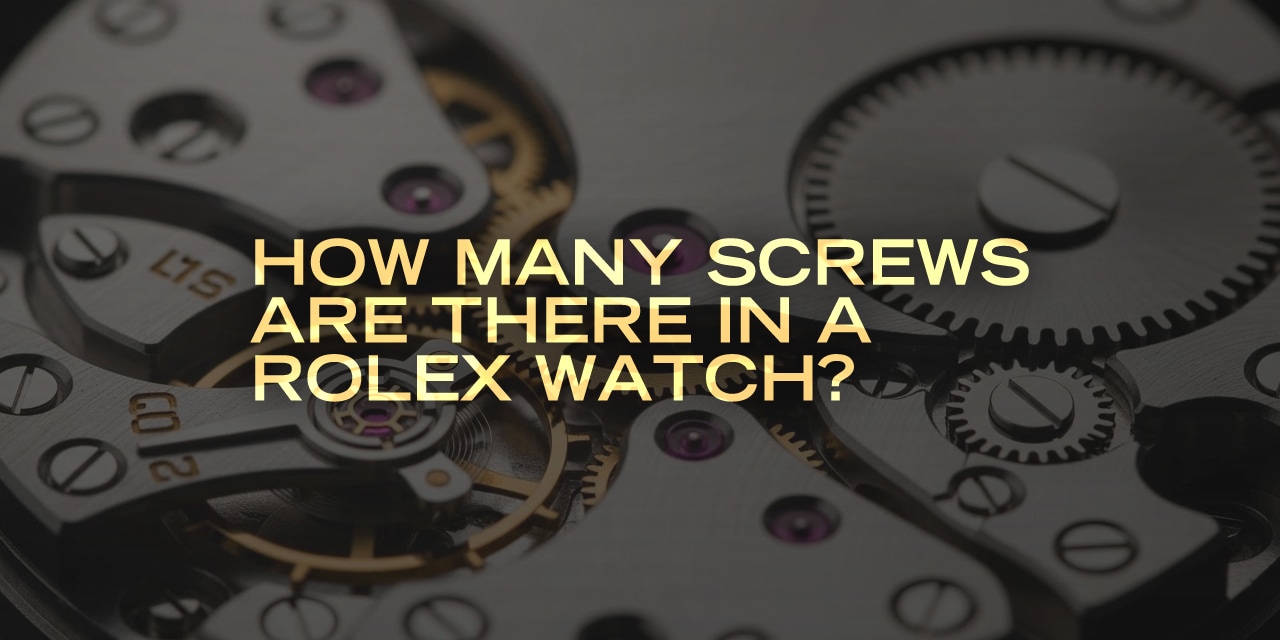
How Many Screws are There in a Rolex Watch?
Get ready for two wild generalizations, one after another!
Number one: Rolex watches appeal mainly to men, and number two: men love knowing how things work.
Now, as oversimplified as both those statements may be, there are at least kernels of truth in each one.
You only have to look at the Rolex collection to see most of the models in there have an undeniable masculine energy; the fact that more and more women now wear these historically male-focused watches notwithstanding.
But there is something about grasping the mechanics of a thing, its cause-and-effect (Y happens because X happened) that speaks to the male brain.
Mostly (and again, I know this isn’t exclusive to men) we tend to get nudged in that direction from a young age. I remember as a kid being dragged away from many-a Saturday morning cartoon by my dad to come stand in the rain and watch him fix my mum’s clapped out car. In fact, as it was a Morris Marina (any Gen X from the UK will sympathize) it used to happen just about every weekend.
That follows us through our entire lives. We seem to have a need to understand systems and processes, from bikes to engines to markets. And, of course, watches.
Tiny Miracles
As engineering feats go, the beauty of a fine mechanical watch is hard to beat. Partly that is down to the myriad parts which all have to intertwine, one feeding off the other in perfect synchronicity. But mostly it is down to the scale.
Many of the components, and certainly their tolerances, are often measured in microns. Yet despite their size, they must be able to withstand completely disproportionate amounts of abuse, shocks and wear and tear without it affecting their performance. When you add it all up, you start to understand why an elite level watch is such an investment.
We’re going to be covering some of the constituents which go into a mechanical watch in later articles, but for now, we’re going to begin with what are frequently the smallest and most overlooked; the screws.
Rolex Screws
Like literally everything else on a Rolex watch, the materials used for their screws are the end result of a mass of planning and experimentation; all to get the best one for each application.
On the whole, Rolex uses steel. But that is often merely a starting point. Those screws used in the movement will generally be carbon steel alloys. Carbon steel is tougher than regular stainless, meaning it holds threads better at tiny sizes and resists deforming no matter how many times they are removed and reinstalled throughout the watch’s lifetime by service center technicians.
Some movement screws are thermally blued, as in, given an oxide layer through controlled heating. It improves corrosion resistance and also allows a watchmaker to instantly identify which screw belongs where.
Elsewhere, 904L Oystersteel screws will be used for the case on steel models, and 18k gold on the precious metal pieces. Very occasionally, Rolex will use titanium screws (RLX) on its rare titanium watches, such as the 42mm Yacht-Master. The same metal-matching applies for those screws holding the bracelets together.
Every screw Rolex uses is machined rather than stamped and is designed to be reused indefinitely. They are first and foremost functional items rather than decorative.
But How Many Are There?
The number of screws in any Rolex watch depends entirely on the watch itself. Basically, the more complicated the movement, the more screws it generally requires.
Now, Rolex being Rolex, they don’t actually publish full schematics or component counts to the general public, and so the exact number is known only to certified Rolex watchmakers, of one I am not. So the following is going to take some educated guesswork.
The Rolex Oyster Perpetual
We’ll kick off with their most basic watch, obviously powered by the most basic movement. That would be the entry level offering, the Oyster Perpetual.
Available in five sizes, the smallest three (28mm, 31mm and 34mm) all contain the Cal. 2232.
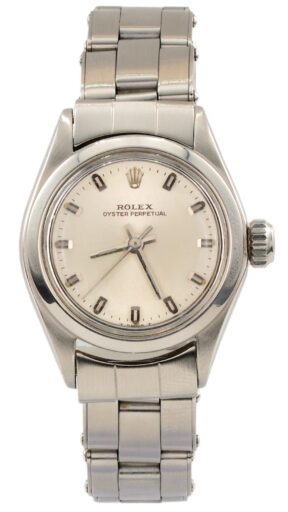
Time only, with no date function to worry about, even so you can’t really call it a ‘simple’ movement. You still get a free-sprung balance, Paraflex shock absorbers, Syloxi silicon hairspring and chronometer-grade regulation.
All told, between the bridge and plate screws (40-50), gear train retention screws (10-15), those in the automatic winding module (8-10), the balance assembly (4-6) and shock systems (10-15), and all the other various functional fasteners, the Cal. 2232 holds around 90 to 100 screws, all precisely torque-controlled.
For comparison, older movements of the same type from the mid-20th century might have around 60-70. As the calibers have modernized, upping the reliability and shock resistance, sometimes requiring more bridges, the screw count has increased.
But what about the rest of the watch? Well, the Oyster Perpetual comes on the Oyster bracelet as standard, the band with the smallest number of links—in this case, about 12. That translates to between 6-9 removable screws for sizing (3-4 on each side). As for the case itself, the bezel is friction fitted so nothing there. The crown tube assembly inside the watch is held in by 1 or 2 screws and, I suppose, the caseback is technically a screw as its threaded, so we can add another on for that.
In total, that gives us between 98 and 112 screws in the Oyster Perpetual.
The Rolex Day-Date
Let’s click it up a couple of notches and have a go at one of the more complicated entries in the portfolio.
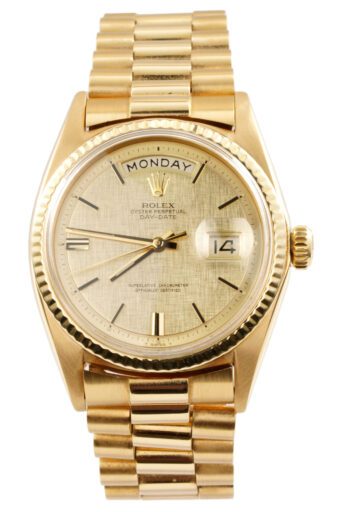
The Day-Date, or President if you like, houses both a day of the month and day of the week function. Those two features bump up the number of parts in the movement, so let’s see what that does to the screw count.
The caliber in question is the Cal. 3255, which serves inside both the 36mm and 40mm versions of the watch. It replaced the old Cal. 3155 in 2015 and, rather than being a gradual evolution of the previous movement—as is the typical Rolex way—it was, in fact, a top to bottom revamp designed to be lighter, more reliable and, crucially, more efficient.
Every component of the outgoing engine was analyzed and more than 90% of them replaced. Most significantly, Rolex’s newfangled escapement, the Chronergy, was installed, along with a completely revamped self-winding module, updated reversing wheels and reworked barrel.
Incredibly, thanks to the efficiency drive and even with the extra functionality, the Cal. 3255 uses roughly the same number of screws as the Cal. 2232. Somewhere around 90-97 is the number quoted by experts.
Where the Day-Date differs most is in the bracelet. Generally issued on its eponymous President bracelet, the 22 links use 11 removable screws for adjustment.
With the same crown tube and caseback, that brings us up to about 101-108 screws in total.
The Rolex Sky-Dweller
Stands to reason that Rolex’s most complicated watch has the most component-heavy movement and, therefore, the most screws.
The Sky-Dweller is the first annual calendar the manufacture has ever made and, not being content with just that, they added a GMT function too. Throw in the usual date display and the Cal. 9002 has a job to do.
The two main complications are modular, so the movement requires extra plates and bridges to hold them in place, equating to even more screws. As an estimate, the core timekeeping assembly (the main plate and gear train) accounts for around 30-37 screws. The winding module takes a further 8-10, the balance assembly another 4-6.
As for the complications, diagrams show the annual calendar module needs 15-20, the GMT about 8-10; and then there’s the ingenious Ring Command bezel. A vital analog switch rather than mere window dressing, this is held in place by some 5-6 hidden screws.
Add in the miscellaneous gubbins and we’re looking at somewhere in the region of 110-120 screws for the mechanical bits.
The Sky-Dweller is available on the Oyster and Oysterflex bracelets, or the one we haven’t covered yet, the Jubilee. Sort of halfway between the Oyster and President, its 17 links also house about 11 adjustment screws. That all amounts to something like 120-130 in total.
Some Vintage Outliers
The Rolex collection these days is a highly uniform one; there is a foundational style around which most of the portfolio is based.
It hasn’t always been that way, however. The mid-20th century saw some comparatively bizarre additions, constructed in atypical ways.
Take Elvis’s favorite, the King Midas, for example. This Gerald Genta-penned anomaly first saw the light of day in 1964; a solid gold jewelry piece with a peculiar asymmetrical case inspired by the Parthenon in Athens, Greece. Carved from a single block, it was said to be the heaviest gold watch on the market at the time and was certainly the most expensive Rolex in its day.
In keeping with later Genta designs, the King Midas featured an integrated bracelet made exclusively for the watch, with flat links which resembled tank tracks, fastened with either a double deployant clasp (on the first two references, the ref. 9630 and ref. 3580) or a single fold-over clasp.
From about the third series onwards (1977—), that bracelet is seen to be held to the case with screws on the end links as opposed to the spring bars we are used to today. Similarly, the case back on the original series up until the mid-1970s is attached with four screws, one in each corner rather than the modern screw down system.
Likewise, many of the older Cellini series, Rolex’s collection of out-and-out dress watches, had screws in their bracelets. Those from the ‘70s and ‘80s frequently attached bands to cases and held clasps together with screws, giving them the same sort of retro air as vintage Oyster bracelets with their riveted links. Take a look at the likes of the ref. 4360 or the ref. 6621 for examples of what I mean.
The mechanics behind Rolex is an endlessly fascinating subject and in our next post, we’ll study the jewels present both inside and outside these beautiful watches.
Featured Photo: Mixed art by Oriol Mendivil for BKT Archive.