
 Sign In
 (817) 503-2334
 Contact Us





 By:
By:
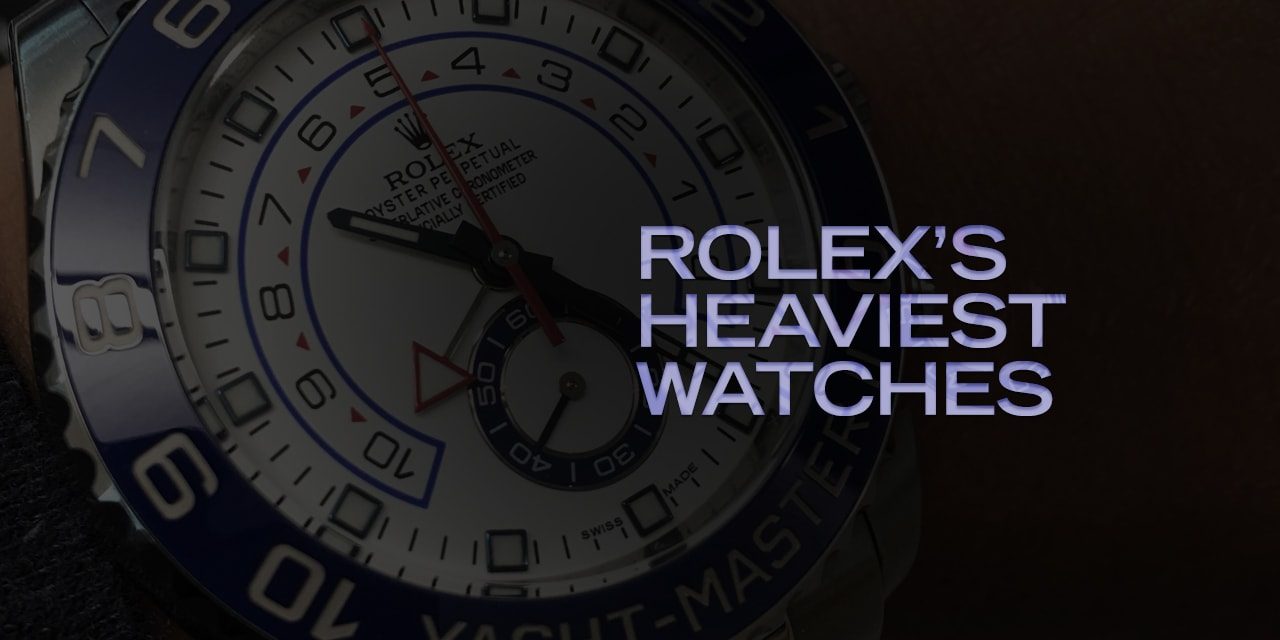
Rolex’s Heaviest Watches
It is not a topic which gets talked about a whole lot, but it is an important one nonetheless when it comes to the overall enjoyment of a particular watch—how heavy it is.
For many elite brands, it can be a strangely tricky one to get right. Customers have been conditioned over many years to equate perceptions of luxury with a certain amount of weight; basically, we tend to think of heavy things as being more expensive. However, there is obviously a limit to how far one can go down that road before a piece becomes unwearable, negating the entire purpose of the exercise in the first place.
There are a number of factors which affect the weight of a watch. The material from which it is made is the most significant one, along with the size of the case, type of bracelet, the number of complications and whether or not precious stones are used.
Rolex, until very recently, have used only traditional metals in their creations; going up in weight, those would be steel, gold and platinum. While all around them, other manufactures have been investing in lightweight materials, even going so far as to formulate alloys of their own all in a bid to reduce weight, Rolex stuck to their established guns until this year when they finally jumped aboard and released their first all-titanium models, the ref. 226627 Yacht-Master and the Deepsea Challenge ref. 126067.
Even so, those pieces are outliers, at least for the moment. The vast majority of their offerings are still forged from the conventional metals, albeit created in-house in the marque’s own foundry.
So, the question then is, which are Rolex’s heaviest watches? Now, notoriously secretive as the brand is, they tend not to publish official figures so these are unendorsed numbers, taken with all the links in the bracelet present.
Rolex Deepsea Sea-Dweller ref. 136660 (About 212 grams)
No real surprise to see a 44mm steel dive watch capable of surviving a plunge to 12,800ft on the list somewhere. The actual surprise is that it is only in fifth place.
The Deepsea originated in 2008 as the ultimate extension of the work Rolex started in the 1950s with the Submariner. A triumph of engineering, the reason a watch with such prodigious abilities has been kept to any sort of vaguely wearable size and weight is Rolex’s use of breakthrough construction methods. The manufacture’s own Oystersteel makes up the main case, the bezel is their proprietary Cerachrom ceramic and the case back is Grade 5 titanium. Even so, it takes the innovative Ringlock system, where a nitrogen-alloyed steel central ring redistributes the crushing pressures for which the model is designed away from the main surface areas, as well as a two-piece flexible back, to absorb the incredible forces.
Nevertheless, this is a big watch. Top to bottom it measures 17.7mm, with the sapphire crystal alone some 5.5mm.
A difficult one to hide under a shirtsleeve, the Deepsea is still a superbly constructed behemoth.
Rolex Submariner ref. 126619LB (About 241.3 grams)
This one, I have to admit, was a bit of a revelation.
At 41mm, the modern Submariner is not particularly large, it has only the simplest complication in the shape of a date display, and it wears the same Cerachrom bezel as the Deepsea above.
The unusual weight comes from only one place then; its solid white gold construction. By contrast, the steel model tips the scale at just 157.8 grams or thereabouts, over 80 grams less.
You get the feeling Rolex could make the watch lighter if they felt like it, but it comes back to the point we made earlier. Gold is the quintessential luxury material and those who buy a solid gold watch want to feel some real heft on their wrist.
Another interesting factor to note is that the yellow gold Sub, the ref. 126618, comes in at around 236 grams. The discrepancy is down to the additions Rolex makes to give the white metal its color. Although not published by the brand (obviously) it is believed the alloy consists of 78% gold, 8% palladium, 5% platinum, 9% copper, and traces of silver. All those add-ons add up, contributing to the extra weight.
But in order to hold your interest, I’m not going to include the yellow gold version in this list.

Rolex Sky-Dweller ref. 336935 (About 248.9 grams)
It’s the same story with the Sky-Dweller. There are two solid gold examples of the model, one in yellow gold and a marginally heavier one in Everose. In truth, there is even less in it here than with the Sub, roughly around 0.6 grams. This time the difference in weight is down to the inclusion of copper to give the Everose metal its pink hue and a hint of platinum to prevent tarnishing.
At 248.9g on the wrist, the ref. 326935 is a substantial piece of kit, due to both its relatively large size—for a Rolex—at 42mm in diameter and 14mm in thickness, as well as its movement, the Cal. 9002.
That caliber, with its 380 parts, is the most component-heavy mechanism Rolex has ever put forth, driving the most complicated watch in their history. Together with a time and date display, the Sky-Dweller also offers a dual time zone readout and their first annual calendar, controlled ingeniously by the patented Ring Command bezel which in itself is responsible for 60 of those movement components.
Released in 2012, the model had a shaky start to life thanks to its unorthodox visuals and excruciating price tag. However, the styling has been delicately altered over the years to widen its appeal and the inclusion of steel models into the collection has tamed the costs as well. Today, while it may not rival that other Rolex travel companion, the GMT-Master II, in the popularity stakes, it still holds its place as an impressive alternative.
Rolex Yacht-Master II ref. 116688 (About 249.2 grams)
Just pipping the Sky-Dweller, Rolex’s other highly complicated watch is also a weighty affair.
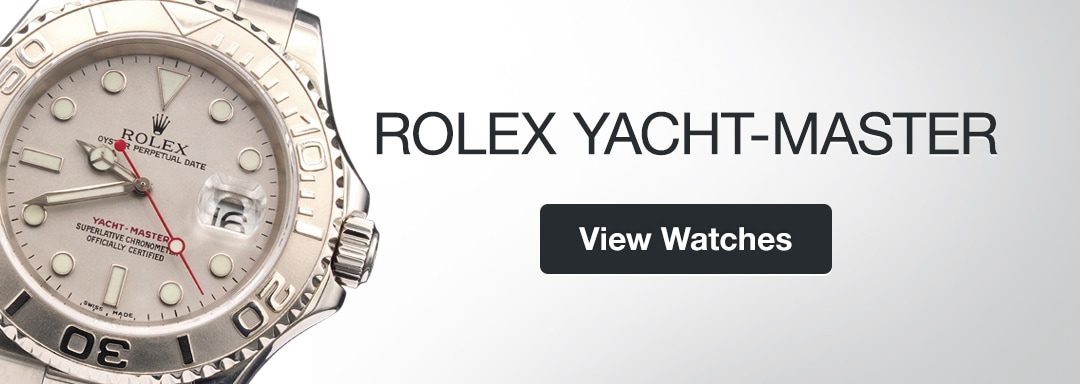
The Yacht-Master II is similar to the original Yacht-Master in no way whatsoever. Where the latter is simply a more luxurious take on the Submariner, the sequel broke boundaries as the first watch to offer a programmable regatta countdown with a mechanical memory.
Launched in 2007, the design was a shock to the brand faithful and a world away from the usually rather buttoned-down, conservative look of conventional Rolex. A huge 44mm model, its dial was a mishmash of sub dials, extra hands and confusing numerals, while the bezel screamed the watch’s name in a style a long way from subtle.
To be fair, unlike the Sky-Dweller, the YMII’s looks are still something of a challenge even now, particularly in its full yellow gold getup and the watch doesn’t rank alongside Rolex’s most desirable. But that shouldn’t take away from the brilliance of its abilities, with the Cal. 4161 linked directly to the first generation of the Ring Command bezel controlling all the remarkable functions.
And even if the style isn’t to your tastes, it’s good to know it would still make a very effective knuckleduster.
Rolex Daytona ref. 126506 (About 282 grams)
Topping out our list is the world’s favorite chronograph cast in the undisputed king of metals.
Does it get any better than a Rolex Daytona in platinum? Not only does the watch’s case and bracelet shimmer like no other, the exclusive use of the ice blue dial and chestnut brown bezel leaves it in a league entirely its own.
The Daytona was granted an update this year for the first time since 2000, with a redesigned case and a new movement, the Cal. 4131. In comes the Chronergy escapement and a ‘Perpetual’ rotor and, crucially, Rolex Côtes de Genève decoration on the bridges. Why is that important? Because in a huge break from the norm, the brand has fitted a display case back to the Daytona so lucky and wealthy owners can see the caliber in action.
But the biggest draw will always be the material. Platinum is among the heaviest and densest metals on Earth, extremely expensive and fabulously difficult to work with. Rolex reserve it for the toppest of their top-line models, with only the Daytona and Day-Date seen in its silvery white glory. It is the reason the crowning Cosmograph retails at around $75,000 and why you won’t find this year’s version on the preowned market for less than $100,000.
Coming in at an arm-aching 282g, the ref. 126506 is the weightiest Rolex you can currently buy.
Featured Photo: Pixabay (cc) Archive, mixed by Oriol Mendivil.