
 Sign In
 (817) 503-2334
 Contact Us





 By:
By:
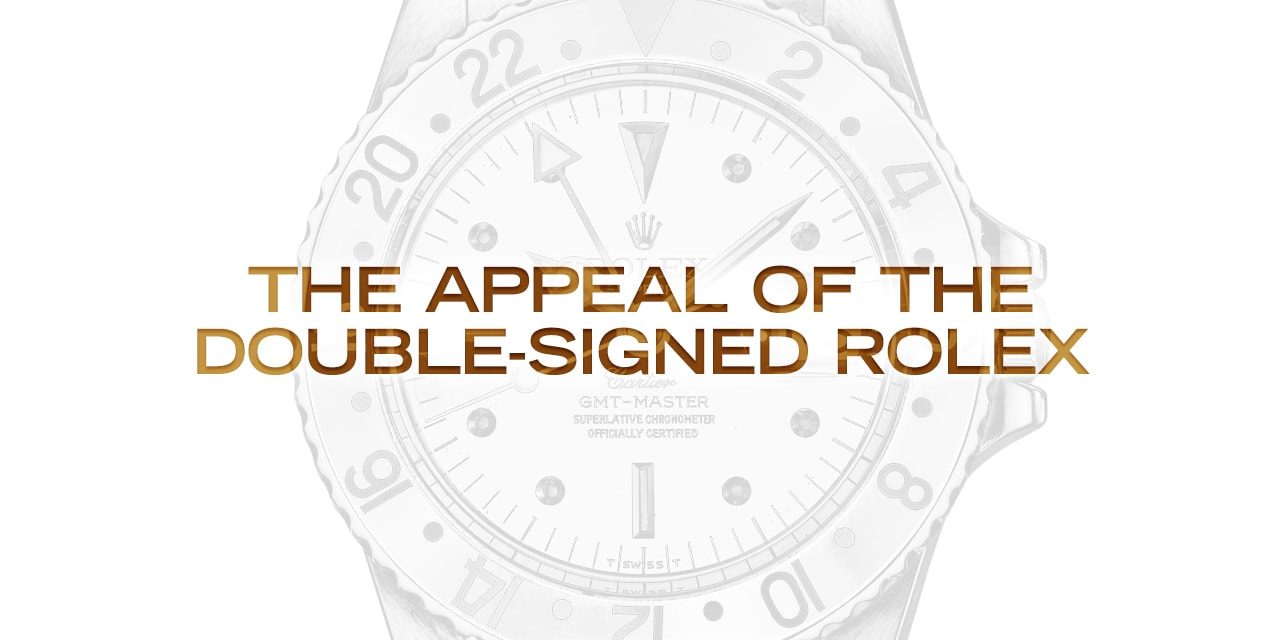
The Appeal of the Double-Signed Rolex
There are innumerable little subsections in the world of vintage watch collecting. Dedicated collectors, once they have reached a certain level of attainment and experience, often go on the search for some unifying theme among their purchases; little details common to each watch that gives them a unique appeal.
Some stick to models made in their own birth year, others are enamored of a particular style, such as Art Deco, still others lean on a specific complication, such as chronographs.
In the last 15 or 20-years however, one other feature, often easy to miss, has become massively popular—a simple addition to the dial which, all on its own, speaks volumes about that individual watch’s provenance and history, and in so doing, adds enormous premiums on to its asking price.
I’m talking, of course, about the double-signed dial.
What is a Double-Signed Dial?
In its simplest form, a double-signed dial is exactly what is sounds like. The watch face holds the name of the manufacturer, as you would expect. But somewhere else on there you will come across a second name, more often than not that of a highly select retailer from where the piece was bought by its first owner.
Why is that a good thing? Well, there are a number of reasons, the first being arguably the most important to any self-respecting vintage watch collector; scarcity.
Double-signed dials are rare, and nothing makes the enthusiast’s eyes light up more than the knowledge their example of what might have been a relatively mass-produced timepiece is in some way different to its run-of-the-mill compatriots.
But more than that, there is something highly romantic about each of these special models. Seeing the name of an exclusive department store from some far-flung exotic port in the tropics of South America on your wrist, you can’t help but let your mind run free on its journey from there to here, and what might have taken place on the way.
Rolex and the Double-Signed Dial
It is difficult to imagine these days, but the behemoth that is Rolex was once a struggling, fledgling company.
In fact, in its earliest years, the brand merely assembled watches from parts gleaned from all over Europe, sending the finished product off to retailers to sell, who would stamp their own signature, and theirs alone, on the dials or case backs.
The slow climb towards autonomy began with founder, Hans Wilsdorf negotiating with these vendors to include ‘Rolex’ on one in every six watches he supplied. Then, over the next two decades, that increased to two in every six, then three. But it wasn’t until his invention of the Oyster case in 1926 revolutionized the entire industry that Wilsdorf was able to insist every watch that left his premises would carry the Rolex name.
Even so, at that time, these independent retailers were often the only places customers could buy a Rolex, with the manufacture still some years off having a global network of boutiques.
Therefore, they entered into widespread co-branding agreements with watch sellers all over the world, allowing them to gain a bricks-and-mortar foothold in countries and territories which would have otherwise remained closed.
And it is the names of some of these establishments which give collectors the kind of evocative butterflies only a lot of money can buy.
The Retailers
Among the oldest relationships Rolex enjoyed was with Bucherer, based originally in Lucerne, Switzerland.
Ernst Bucherer, son of the founder, entered a protracted deal with Wilsdorf in 1924, and it remains the jeweler’s most important partnership to this day.
Almost as long, Rolex’s connection with another Swiss firm goes back to 1932. Beyer is recognized as the oldest continually-operating watch store in the world. Although not well known outside of enthusiast circles, the Beyer family has had a huge influence on horology. The Beyer museum, situated below the main store in Zurich, holds over 300 exhibits dating back to 1400BC. Among them is a gold Day-Date gifted to Theodore Beyer with an inscription on the back which reads, ‘To my friend Th. Beyer- to remember our most pleasant relationship since 1932 – Hans Wilsdorf.’
Further afield, across the border in Italy, Rolex were served by a number of retailers.
Here, the likes of Gobbi, established in 1842 in Modena before transferring to Milan during WWII, added their illustrious name to the brand’s watches during the middle part of the 20th century. So too did Astrua, once based in Turin but now sadly defunct.
It was two Italian migrants who set up another store, a long way from home, and managed to arrange exclusive rights to sell Rolex watches in the oil-rich promised land of Venezuela in the 1920s. The country experienced a massive surge in prosperity during the era, and Serpico Y Laino was on hand to cater to the new wealth with some of the country’s finest jewelry and watches. Business during this golden age was so good, in fact, they were soon able to expand their reach to other brands, in particular Patek Philippe. Sadly, it wasn’t to last and the dealer shut their doors in 1966.
Also in Latin America, Joyeria Riviera, the so-called Tiffany’s of Havana, founded in 1923 by Julio Abislaiman, constitutes many people’s favorite Rolex double-signers; not least because of the improbability of the watches surviving the Cuban government’s seizure of personal possessions during Castro’s rise to power.
And Africa was not forgotten either. Scotsman, Matthew Ewart Dobbie, a jeweler, watchmaker and silversmith, set up Dobbies in Nairobi in 1906 and sold Rolex watches until his death 20-years later, most of which were inscribed ‘Dobbies Ltd. Nairobi’.
However, two of the most famous establishments to co-brand Rolex dials were to be found in the States.
Today, Cartier double-signed Rolex watches are arguably the most sought-after type by collectors. However, the practice seems to have been confined only to the U.S. branch of the company, starting in the 1950s at a time when Cartier had actually been split into three separate entities; Cartier-Paris, Cartier-London and Cartier-New York. So, up until the 1970s, it was possible to purchase a Cartier-stamped Rolex from their Fifth Avenue boutique.
And the other, of course, is with Tiffany & Co. Another collaboration which began in the ‘50s, this one lasted right up until the 1990s when the two giants of commerce went through an ignominious split. Since then, Tiffany has withdrawn all Rolex watches from their stores. *It is important to note that what enthusiasts have referred to as the ‘Tiffany Rolex’ in recent years, an Oyster Perpetual with a turquoise dial, was not a new collaboration. It was merely a watch with a blue dial which resembled Tiffany’s signature color (nor was it, in any way WHATSOEVER, an attempt to cash in on the hysteria surrounding the limited-edition Patek Nautilus 5711 with turquoise dial, which definitely was produced in association with the jeweler. So put such cynical thoughts from your mind).
The Non-Retail Stamps
It wasn’t just retailers who added their own detailing to Rolex dials. Occasionally, various outfits around the world were moved to commission specific emblems to identify their watches.
Qaboos Bin Said Al Said, the Sultan of Oman, ordered a run of models which included the Omani national emblem, called the Khanjar, through famous English jewelers, Asprey. These were distributed to officials and good friends of the Sultan, but do crop up for sale fairly often.
Another organization will be familiar to all Rolex fans, French commercial diving specialists, COMEX. The group partly responsible for the creation of the Sea-Dweller, COMEX was issued a number of watches for the personal use of their divers. These days, the group logo on the dial of a Sub or Sea-Dweller is enough to add a zero onto its asking price.
And finally, one double-stamped example Rolex fans have long struggled to come to terms with. While we all enjoy fast food, teaming up with Dominos Pizza was a strange, brand-cheapening move for Rolex. Even more perplexing was them granting permission to include the Dominos logo at the six o’clock, the models (originally Air-Kings then Oyster Perpetuals) awarded to store managers who hit certain targets for a number of weeks in a row. Yet, these watches too have premiums on the preowned market—because exclusivity is exclusivity, no matter what form it takes.
Featured Photo: BeckerTime’s Archive.