
 Sign In
 (817) 503-2334
 Contact Us





 By:
By:
The Beckertime Guide To Watch Complications
You might look at a watch movement and think to yourself, quite rightly, this is complicated enough. However, in the world of horology when you see someone talking about ‘complications’ it refers to any function on a mechanical watch over and above merely telling the time.
There are numerous complications which can be added to a timepiece; some are extremely useful, others came about less for convenience’s sake and more to demonstrate exactly the level of mastery the artisan craftsmen have other their medium.
Below we are going to unravel many of the most popular and impressive complications you might come into contact with and explain precisely what they do.
The Basic Complications
The Date
That’s right. Believe it or not, the humble date display ranks as a watch complication. The information can be displayed in a number of ways, probably the most common being in an aperture window usually at the 3, 4:30 or 6 o’clock.
But you will find other approaches. Oris, for example, habitually use what’s known as a Pointer Date. With this system the days are printed on the outside edge of the dial and an extra hand points out the current one. The likes of A. Lange & Söhne and JLC have several models with this type too.
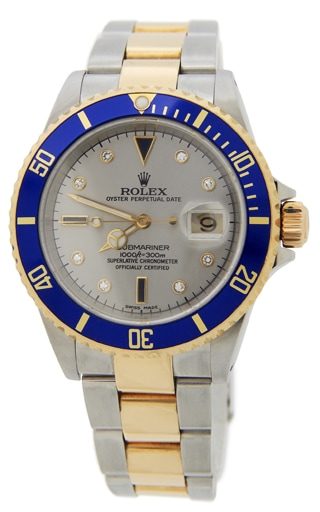
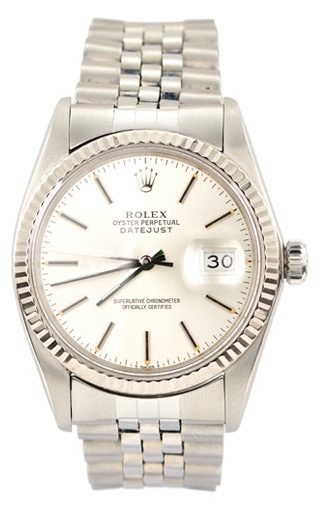
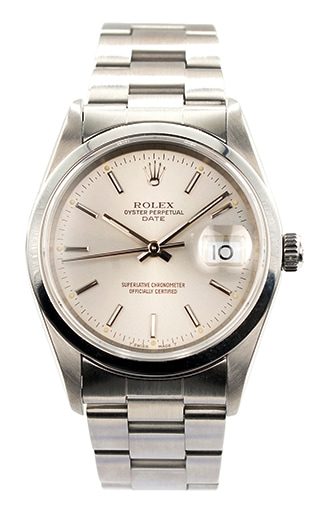
Lange are also famous for their Big Date models, otherwise called the grande date. With these, the date is shown across two windows, the first for the numbers 0-3 and the second for 0-9. The larger numerals make for easier reading.
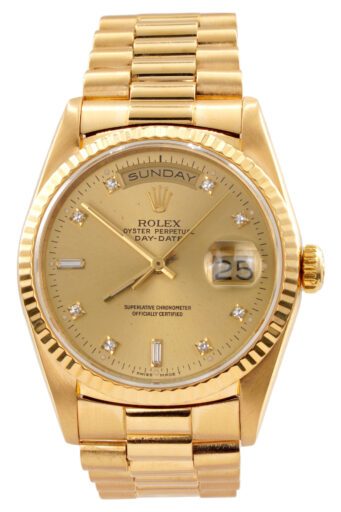
The Day-Date
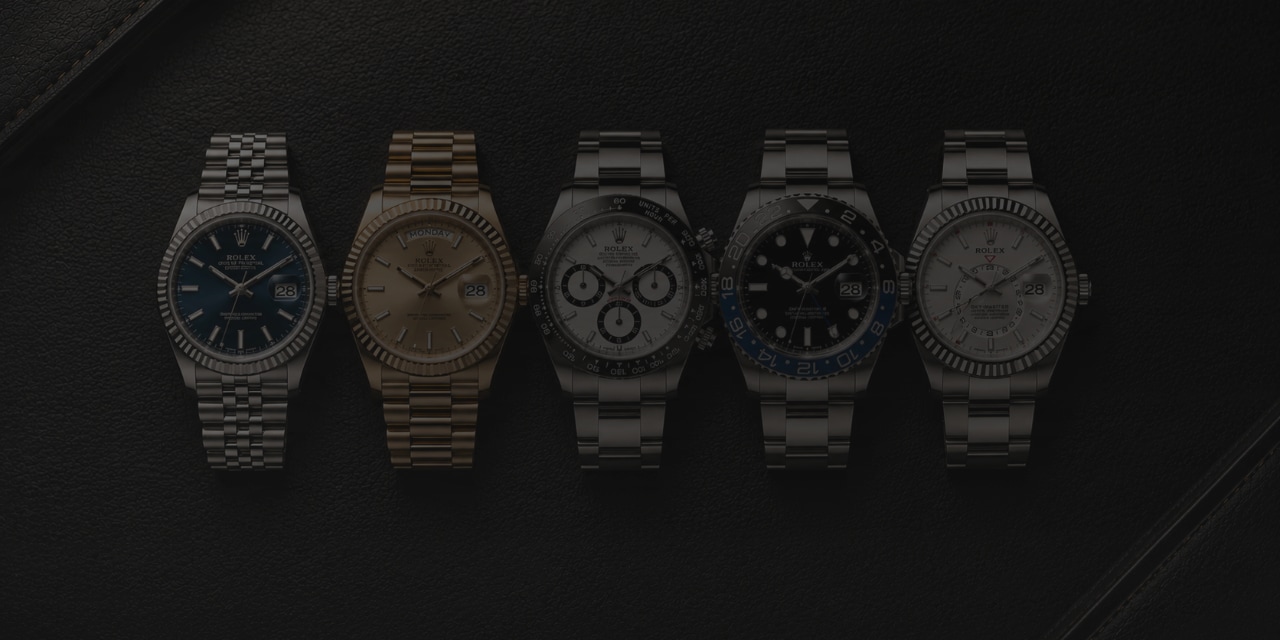
The logical progression from merely the day of the month, the day-date complication keeps you up to date on the day of the week too. Again, there are different ways to show the info; the day and the date can be displayed next to each other or, as seen in undoubtedly the most famous watch of this type, Rolex’s own Day-Date (the President) the date comes at the 3 o’clock and the day is spelled out in full at the 12.
The Calendar Complications
The Triple Calendar
Progressing in complexity, we reach the so-called calendar complications. The next step up from a day-date is obviously a triple calendar. These show the day, date and the month, typically in a mix of different methods. So you might have extra hands, sub dials and windows on one dial. It is not unusual for these models to also include a Moonphase as well.
Clearly highly useful functions, the one thing triple calendars don’t do is compensate for the differing numbers of days in each month. Which leads us on to…
The Perpetual Calendar
While they may not have invented it, Patek Philippe were the first manufacture to release a serially-produced wristwatch with a perpetual calendar complication. Considered one of the ‘grand complications’ (more on that later) a perpetual calendar is one which takes into account not only the different length months but also leap years and adjusts itself accordingly. Extremely complex and difficult to produce, perpetual calendar watches also have a reputation for a certain amount of fragility.
The Annual Calendar
Incredibly, the simpler version of the perpetual calendar, known as the annual calendar, did not come into existence until 1996—also invented by Patek but more than 50-years after the perpetual.
With this complication, the mechanism can compensate for the months with 30 and 31 days but needs to be adjusted manually every year at the end of February thanks to its 28 or 29 day length.
The Chronograph Complications
The Standard Chronograph
A chronograph is simply a mechanical timepiece’s stopwatch function.
Most typically it is set up with a central hand which counts the seconds and two or three sub dials which tally up the elapsed minutes and hours. If there is a third totalizer, it is for showing the running seconds in the standard time telling mode.
On a conventional chronograph, the start/stop action and the reset are controlled by pushers either side of the winding crown on the side of the case. The top button is for starting and stopping, the lower for resetting.
There are different types though, such as monopushers which have just one button controlling everything and which is sometimes embedded into the crown itself.
The Flyback Chronograph
A more involved type of chrono, the flyback system enables the user to stop, reset and restart the central elapsed seconds hand with just one push of a button rather than having to press the top pusher, then the bottom one then the top one again.
The Split-Seconds Chronograph
Alternatively called a rattrapante (French for ‘catch up’) a split-seconds chronograph has not one but two central chrono hands which lie one on top of the other when not in use.
When the wearer starts timing, a second pusher can be activated to separate the two hands and allowing the second one to record split times. It can then be instantly returned to its position underneath the first, still moving hand.
Highly complicated, rattrapante mechanisms are usually confined to elite level watches.
*Note
On most chronographs you will typically find a scale of some description either on the dial or on the bezel. Most commonly this scale is a tachymeter, used to help make speed and distance calculations in racing events. However, others, such as a Pulsimeter (used by doctors to gauge heartrate) or a Telemeter (for measuring distance from an event) can be found although they are far less common.
The Travel Complications
The GMT/Dual Time Zone
Often used interchangeably but not exactly the same, dual time zone and GMT complications do the same job in slightly different ways.
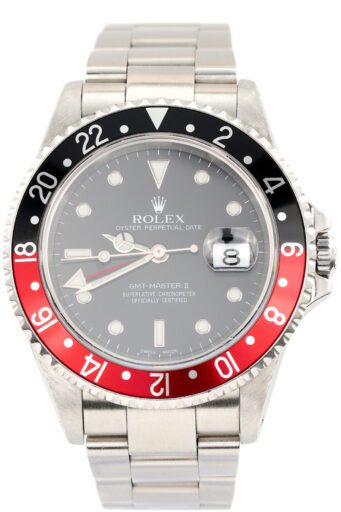
With the GMT, invented by Rolex in 1953 for their iconic GMT-Master models, the idea of being able to track two time zones simultaneously came about at the request of Pan-Am to help their pilots fight off jetlag.
Here, the watch displays a second time zone using a 24-hour scale. On the GMT-Master and the majority of models from other brands, the scale is engraved into the surrounding bezel and an additional hour hand is geared to go around the dial once a day rather than twice and points to the hour.
As for the dual time, these use a more conventional 12-hour display which is more intuitive to read. The second time zone might be displayed on a subdial, an aperture window or, like the GMT, with a second hour hand.
The World Time Zone
Where GMTs and dual times display two or three time zones, the next level up, the World Timer, shows the earth’s 24 different time zones all at once.
Usually consisting of a 24-hour scale which rotates around the inner edge of the dial once a day, the outer bezel will be inscribed with the names of 24 world cities, each corresponding to a different time zone.
The wearer can then set the city ring to his or her local time and read off the time at any other location.

The Others
The Minute Repeater
Getting into the heady and usually crushingly expensive world of high horology, we come to the minute repeater.
A minute repeater is a mechanism which chimes on demand and was first used on pocket watches in the 18th century. The era before the advent of electric lighting, it allowed wearers to know the time in the dark.
Today, obviously, it is completely unnecessary but still represents the pinnacle of the watchmaker’s art. They work by having two small internal hammers strike a gong which produces different tones for the hour, quarter hour and minutes and are usually triggered by a slide on the side of the case.
At the very top end we get what are known as the grande sonnerie and petite sonnerie, which strike every hour and quarter hour automatically.
*Another Note
The minute repeater, the perpetual calendar and the split-seconds chronograph are considered the classic grand complications. A model containing all three of these are generally called Grand Complication watches (see Patek for probably the best examples).
The Power Reserve Indicator
Mechanical watches get their energy from a mainspring. When fully wound, that spring can power the watch for anything from 36-hours up to several days depending on the watch.
On some models (normally manually wound) you might see a power reserve indicator. These are simply to let you know how much longer the movement will continue to run without additional winding.
The Regatta Timer
Extremely niche, the regatta timer is a variation on the chronograph which helps sailing skippers time the complicated starting procedures of a regatta.
Generally, these feature a 10-minute countdown function as well as some device to reset and restart the countdown on the fly.
The Equation of Time
Very rare, the equation of time function shows the difference between mean solar time (the time your watch shows) and apparent solar time (the actual position of the sun in the sky). Over the course of a year, that difference varies from about -14 minutes to +16 minutes.
Massively specialized and needed by virtually no one, it is still a highly impressive complication.
That’s our rundown of some of the most popular types of watch complication. There are others, of course, but they are generally so scarce and esoteric as to not need mentioning. As you can see, some of these functions are very practical, others not so much, but all require the dedication of highly skilled watchmakers.
Did we miss out your favorite complication? Tell us in the comments below.
Featured Photo: Mixed art by Oriol Mendivil for BKT Archive.