
 Sign In
 (817) 503-2334
 Contact Us





 By:
By:
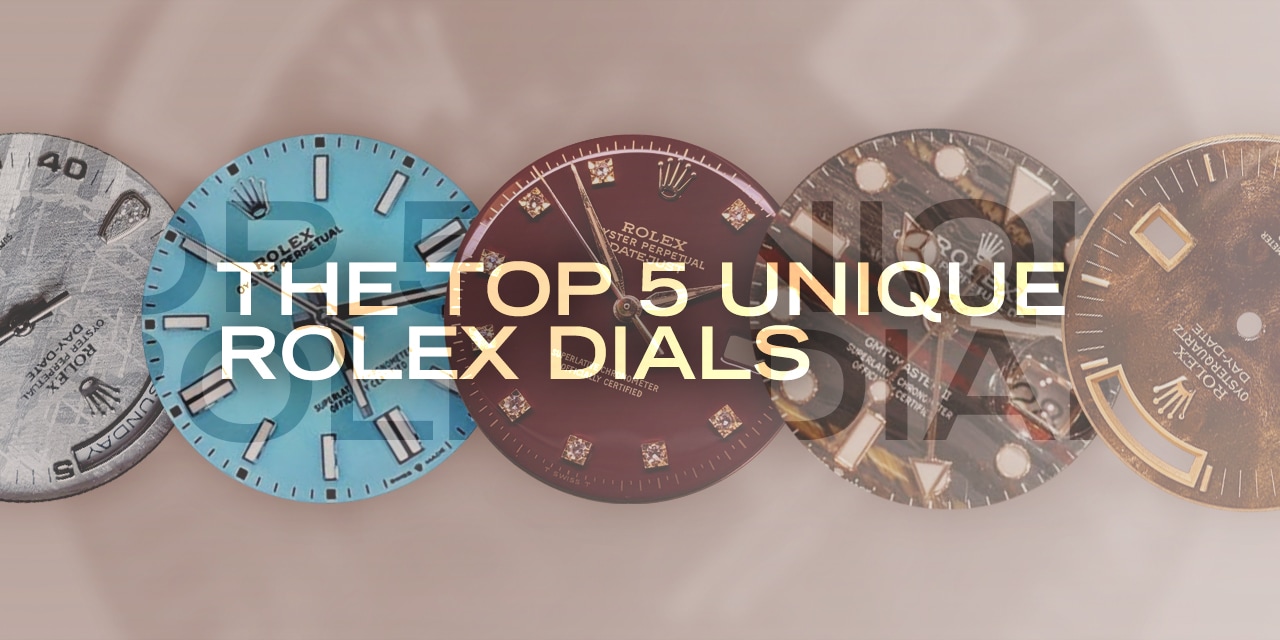
The Top 5 Unique Rolex Dials
In the world of watch collecting, nothing influences the appeal of a particular model more than its dial.
It’s easy to see why. The face of any watch is its most immediately noticeable feature; if there isn’t an instant attraction, there’s nothing to guarantee the viewer will even waste their time taking in the rest of the watch. We do the same with people—sadly.
If we take Rolex as an example, we can divide the dials they fit to their creations into four very broad categories: there’s the standard-issue type, generally residing at the more conservative end of the spectrum, with plain, single colors, often monochromatic, designed to entice as wide a cross-section of paying customers as possible.
After that we get the more adventurous style. These might take on more alarming shades, or have quirky little twists to them which set them apart from the herd. Rolex scored something of a minor hit recently with their effervescent Celebration dials for the Oyster Perpetual range—a playful, bubbly example which proved very popular amongst more lighthearted fans.
Then there’s the intentionally rare. These are the ones made in tiny quantities, often for some commemorative event or particularly special group. Think the Daytona ‘Chairman’, limited to just 12 pieces destined for Rolex business partners, with its beautiful sunburst blue dial, or the mythical Albino GMT-Master supposedly created for Pan Am executives in the 1950s.
But there are other types which offer that most sought-after indicator of outright luxury—uniqueness. These dials are peculiar in that they manage to be completely one-of-a-kind, and yet still find their way into the standard collection. In these instances, it is actually the material from which the dial is formed which makes them unrepeatable—fashioned as they are from natural substances, with no two samples being the same.
Below, we take a look at our five favorites, past and present.
The Meteorite Dials
It would be wildly inaccurate to call watches with meteorite dials commonplace, but when you consider just what we’re dealing with, there are certainly more in circulation than you might expect.
It all started with niche, avant-garde Swiss manufacture Corum. A pioneer in the use of exotic materials, they released what is thought to be the first meteorite dialed watch in 1986, part of their Toboggan range.
Although there have been a number of different space rocks used by luxury watch brands since then, by far the most widely utilized is the Gibeon meteorite. That is where Corum sourced their material, and it is also the one used by Rolex.
It was found in Namibia in 1836 by Scotsman, J.E. Alexander. The famed writer, traveler and British army captain sent samples back to England where they were identified as meteorite by none other than exalted polymath, mathematician, astronomer, chemist and inventor, Sir John Frederick William Herschel, 1st Baronet KH FRS (Johnny, to his mates. Prolly).
Herschel identified the rock’s composition as 91.8% iron and 7.7% nickel and gave an estimate of when it might have struck Earth. Quite a wide estimate, as it turns out. It is thought the Gibeon fell somewhere between 5,000 and 30,000 years ago; some 26 tons of material spread over an area around 242 miles long and 74 miles wide. The name came from the nearest village to where Alexander made his initial discovery.
So what makes meteorite such an ideal dial making material? Short answer; it isn’t. There are a number of technical challenges to crafting the iron-rich alloy. Firstly, it is extraordinarily hard yet incredibly brittle. Only diamond-tipped tools will cut through it, and even then, chances are the sort of wafer thin slivers watchmakers are interested in are prone to cracking. There is also a high oxidation risk, with the meteorite likely to rust if not sealed properly and given anti-corrosion treatments.
However, the benefits do outweigh the disadvantages. And the main one is what is known as the Widmanstätten pattern. Because of the makeup of the rock and the time it takes to form, the interior of a meteorite displays beautiful and visually arresting ribbon-like designs of long nickel-iron crystals. Sometimes called Thomson structures, these patterns are revealed during an acid wash process, and each slice is absolutely unique.
Rolex did not launch their first meteorite model until 2000, when they outfitted all four metal options of their 36mm Day-Date with them. Since then, they have expanded their use to other models. The Datejust, Daytona, Sky-Dweller and GMT-Master II have all been issued with meteorite faces—but for how much longer, no one knows. While massive, affecting the largest area by a single meteor known to science, the Gibeon is obviously finite. To that end, Namibian law now prevents any more being removed. Rolex is thought to have secured themselves a healthy chunk of it, but once that’s gone, they’ll be watching the night skies with fingers crossed.
The Turquoise Dials
Another rare mineral, although one originating on Earth, turquoise shares the same sort of unique properties as meteorite.
Known for its blue-green color, this hydrated phosphate of copper and aluminum has long been valued in jewelry-making for both its vivid color and its veining, elements which make every example a one-off.
Piaget were the first to use it in watchmaking, kicking off in the 1960s. That was an era when the brand became synonymous with stone dials; throughout the decade and into the ‘70s they launched pieces with onyx, lapis lazuli, jade, tiger’s eye and malachite faces as well.
However, another characteristic turquoise shares with meteorite is its fragility—this time due to its softness rather than hardness. It takes a great deal of care to work with turquoise without it cracking, leading to dials which are slightly thicker out of necessity. Fortunately, Piaget’s prowess in making ultra-thin movements meant there was room for the exotic stone.
As for Rolex, they came later to the turquoise game, not releasing their first watch with the material until the late 1970s. As before, only very select models were given the treatment.
The top of the line Day-Date, unsurprisingly, was the initial recipient. The yellow gold ref. 18038 could be had with either applied gold hour markers or diamond indices, neither of which were given any luminescence due to the fragility of the base. Turquoise has shown up in an extremely limited capacity across subsequent Day-Date generations, as well as on certain precious metal examples of the Datejust. There has never been a steel case turquoise Rolex watch.
As with all of its materials, the brand is highly discriminating on what turquoise it uses. They opt for minerals with a strong robin’s-egg blue color and subtle veining. Even so, as uniform as the watches with these dials might look laid out next to each other, no two are exactly alike.
At this point, it is worth making a couple of observations about Rolex turquoise. Firstly, you will often find either aftermarket or outright fake examples on the preowned circuit. True examples are rare and priced accordingly so, should you be interested in one, some strict due diligence is called for. And secondly, a Rolex watch with a dial made from turquoise is not necessarily the same thing as a Rolex watch with a turquoise dial. The brand has used the color for a number of wildly successful pieces in the last few years, absolutely NOT borrowing the concept from Patek’s collaboration with Tiffany’s. Those are merely standard flat dials painted turquoise—in no way unique but also really expensive.
The Bloodstone Dials
Unlike with meteorite and turquoise, there are no watches in the current Rolex lineup with bloodstone dials. In fact, they are amongst the rarest and most mysterious pieces in their entire hardstone dial catalog.
Also known as heliotrope, bloodstone is a variety of cryptocrystalline quartz called chalcedony. Naturally deep green in color, the stone contains flecks of iron oxide or hematite, tiny red inclusions which look like drops of blood—hence the name.
The material has been used throughout history, more recently for jewelry purposes, but in ancient times it was employed in blood-related rituals as it was thought to stop bleeding and was believed to have supernatural qualities. It was connected to religious symbolism in medieval Europe (sometimes called the ‘Martyr’s Stone’), and modern day mystics use it in crystal healing to promote strength, energy and health.
They originally appeared on Rolex’s models around the same time as the turquoise dials, and on the same collections. Again, the Day-Date was the first beneficiary, and again, the ref. 18038 was the debut reference.
It is likely the bloodstone dial Rolexes are the rarest of those we have covered so far due to the difficulty in finding attractive, cuttable stones. Opaque, smooth and with a slightly waxy finish in their raw state, they can be polished to a high shine. At first glance, they appear simply dark green, but when held to the light the minute red speckles become visible. But they are incredibly tricky to work with. The fine-grained quartz is very delicate and even the pressure of installing the handset can be enough to introduce stress fractures. Additionally, any impact on the finished watch is in danger of splintering the dial and there are plenty of instances of hairline cracks happening during servicing. And if Rolex technicians can’t prevent that sort of thing, what chance do the rest of us have?
As a result, buying a bloodstone Rolex is another exercise in caution. Many can be aftermarket redials and the genuine ones should be inspected meticulously for abrasions, especially if going vintage.
Genuine models with flawless dials command a significant premium over conventional pieces, so be prepared to both do your homework and pay over the odds.
The Tiger Iron Dials
Not to be confused with tiger’s eye, Tiger Iron dials only made their entrance into the Rolex collection this year with the latest GMT-Master II additions. The dials do, however, contain the tiger’s eye quartz, layered in amongst two other minerals (hematite and red jasper) to give a bold, banded pattern of gold, silver and deep red.
Found primarily in Western Australia, this naturally occurring composite is both rare and among the most visually striking gemstones used in watch dials. It has an earthy, metallic look and, of course, each dial segment has its own unique design.
Again, Piaget were the first in the industry to recognize the appeal of Tiger’s Iron, and they were the most consistent users of it during the 1970s and ‘80s. Corum and Cartier also released sporadic creations with the stone, but they were scarce to say the least.
Because of its striking pattern, this is arguably the most opinion-splitting entrant on our list. It is easy for the aesthetic—the shimmering golden brown tiger’s eye, the silvery-black sheen of the hematite and the deep red of the jasper—to drown a watch. To that end, it is usually reserved for larger pieces, where the extra millimeters ensures the dial enhances without overwhelming.
That was clearly Rolex’s opinion too. The yellow gold ref. 126718GRNR and its Everose sibling, the ref. 126715CHNR, both have Tiger’s Iron dial options now and case metals which complement one of the tones present on the face. That is all tempered by the selection of the two least flamboyant bezel color combinations; the ‘Bruce Wayne’ black and grey on the former and the black and brown ‘Root Beer’ for the latter, ensuring things don’t get too gaudy and out of hand.
As with all stone dial Rolex models, Tiger’s Iron is reserved for precious metal pieces. So far, only the GMT-Master II has them, but watch out for further additions in the future.
The Wood Dials
Proof that a unique dial doesn’t need to be made from some interstellar or otherwise extremely rare material, there have been a number of wooden dialed Rolexes in the past.
We’re back in the ‘70s and ‘80s again, a time in their history when Rolex was experimenting wildly, probably due to the impact of the Quartz Crisis; basically, the brand was trying everything to stand out in what was then a dying industry.
On the face of it, wood might seem a perfect source of unique watch dials. Their individual textures, grain patterns and color variations offer up nigh-on endless diversity, and their natural strength should mean they are easier to work with and more robust than some brittle gemstone.
Unfortunately, with the thickness of the average dial measuring less than a single millimeter, even wood throws up significant mechanical challenges.
First of all, wood is porous meaning it has to be stabilized before being installed so it doesn’t warp. Additionally, because it is so very thin, it also becomes fragile and must be laminated prior to mounting.
For those reasons, wood dial Rolex watches are actually among the rarest—even more so than the likes of malachite or lapis lazuli.
Never mass-produced, you will occasionally find them on Day-Dates or, even rarer, some vintage Datejust references. With both, Rolex usually continued the theme by fitting bark-effect bezels and/or bracelets with wood-effect center links.
So, which different woods were used for these special or custom order models? Burl wood was amongst the most prevalent, its swirled grain and irregular patterns proving highly popular. The smooth reddish-brown tones of mahogany were also greatly admired. After that, walnut’s tight grain and deep color made for attractive faces, as did, at the other end, the light, creamy tones of birch.
All were routinely issued with the bare minimum of dial furniture; baton indexes rather than Arabic or Roman numerals, for instance, or in some cases, no markers at all. In either case, this is another instance when no lume was used.
The wood dials have been habitually undervalued as collector pieces, but their appeal seems to be one the rise. With every trend eventually coming back into fashion, could we be entering into a new Wood Age?
Featured Photo: Art by Oriol Mendivil for BKT Archive.