
 Sign In
 (817) 503-2334
 Contact Us





 By:
By:
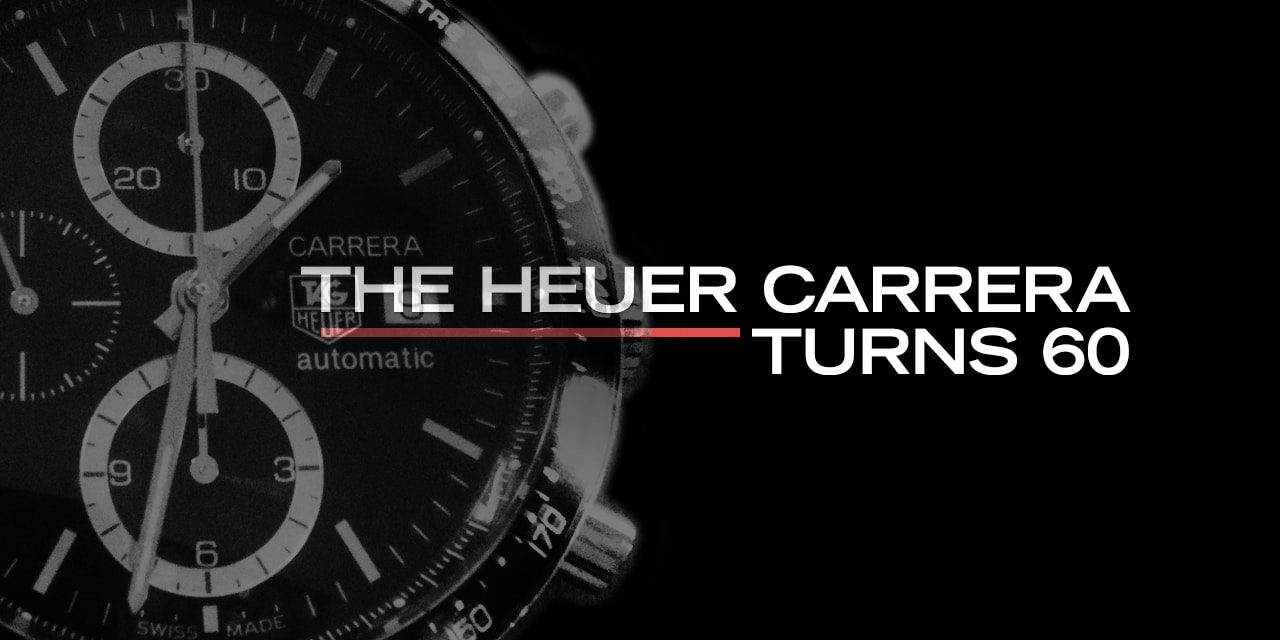
The Heuer Carrera Turns 60
Horology has never been short on iconic chronographs.
The majority of the truly great racing watches originated in the middle part of the 20th century and it is entirely fitting that among the very best is a model which shares not only its birth year with one of the world’s most famous automobiles, the Porsche 911, but also its name; the Carrera.
2023 marks the 60th anniversary of the Heuer Carrera, and TAG Heuer (as it is now) is celebrating the milestone with a slew of new versions, a whole string of congratulatory references to be released throughout the year.
Below, we take a look at what has made the Carrera so revered for six decades.
Heuer Carrera History
Watches and motorsport have been inextricably linked for many years. A number of timepieces have even borrowed names of famous racing circuits as a not-so-subtle implication that any wearer could also be part of that impossibly glamorous lifestyle.
Heuer were perhaps the biggest exponent of the practice, with models called the Monza and Monaco joining the line-up in the ‘60s and ‘70s, and Rolex, of course, giving flight to the Daytona the same year the Carrera debuted.
Heuer’s Carrera, however, as with the Porsche, was christened after a race which was only run five times, the last occasion almost 10-years before either watch or car saw the light of day.
The Carrera (from the Spanish for ‘race’) Panamericana was a contest of such dangerous brutality, with drivers competing over the 2,178-mile course between Mexico’s north and south borders, that it managed to rack up nearly 30 fatalities between 1950 and when it was cancelled in 1954.
But as with many historic events of that nature, it left such a legacy of romance and infamy that the race lived on long in the memory of fans across the globe.
The First Carrera
Jack Heuer, the great grandson of brand founder, Edouard, took over the reins of the family business in 1961 at the age of 28. Described as an aesthete, he was possessed with an all-consuming passion for many things, in particular modern design and, crucially, motor racing.
He created the first Carrera in 1963, with his vision for the watch being that it should have a clear and clean dial to make it as legible as possible in the pulsating confines of a race car cockpit. To that end, he took advantage of a new invention from a Swiss watch crystal manufacturer of an angled steel tension ring. It held the crystal in place so well that it greatly increased the water resistance. Heuer’s idea was to mark the ring with 1/5 second demarcations, so freeing up space on the dial as well as adding depth to the overall look.
That initial model, the ref. 2447, was given the same reference number Heuer had been using for many of its chronographs since the 1940s, those pieces sometimes called ‘pre-Carreras’ these days.
It was originally released as a bi-compax, with two sub dials, followed up soon after by tri-compax versions, but all with applied markers and slightly recessed chrono counters, housed in 36mm cases with sharply faceted lugs.
As Heuer was, at this time, a relatively small concern, it looked to third-party manufacturers for many components, and the ref. 2447 followed the Daytona by being powered by the manually-wound Valjoux 72 and having its dials supplied by Singer. In fact, if you look at a 1963 Carrera next to a Daytona and even an Omega Speedmaster from the same year, you will notice they all have identical hour markers and totalizer designs.

The Gentleman Racer
The ref. 2447 was produced, in a range of materials, colors and layouts, up until 1970.
That was when the revolutionary Caliber 11, Heuer’s contribution to the three-horse race for the first automatic chronograph movement, came into effect. The self-winding mechanism made its way inside a huge number of the brand’s watches, including the Autavia and the previously mentioned Monaco and Monza.
Sadly, however, when the Quartz Crisis hit, it hit Heuer particularly hard. Jack was forced to sell his family business in 1982 and, even though the buyers, a consortium of Piaget and Nouvelle Lemania, released several quartz-powered Carreras, they were not big sellers. Production on the watch was stopped completely in 1984.
That was not the end of the story though. The Piaget/Nouvelle Lemania syndicate was itself bought out in 1985 by Techniques d’Avant Garde, making the current TAG Heuer. And while they spent their first few years of ownership concentrating on getting some money in the bank with the relatively cheap Formula 1 and Diver collections, in 1996, the Carrera was reborn.
The 60th Anniversary
TAG Heuer have honored their gentleman’s racer this year with not just new models, but a whole new generation of the watch.
So far (and more may be to come) there have been 17 pieces launched, not all of them chronographs. TAG lent the Carrera name to a number of elegant three-hand references in the 2000s, and this latest collection has six refreshed examples. Four come in 36mm, all with beautifully brushed sunray dials in silver, blue, green and a shocking pink and powered by the new Calibre 7 automatic movement. The remaining two are 29mm, one in steel and gold, the other in steel with diamond indexes and bezel, both with mother-of-pearl dials and driven by the Calibre 9.
But it is the chronos people want to see, and TAG have offered up a truckload of diversity.
There are two 44mm limited edition pieces. One, the Porsche Special Edition, comes in DLC-coated steel with a ceramic bezel, its vibrant orange detailing inspired, apparently, by the color of the sparks of heat made by race cars on asphalt.
The other, limited to 500 units, has been made to mark the Chinese Year of the Rabbit. It too has a steel case and ceramic bezel, although no coating this time, with a striped motif running throughout.
Two further non-limited steel and ceramic models round out the 44mm range. Both come in lurid green, one on a steel bracelet, the other a rubber strap.
The rest of the collection harks back, in varying degrees, to the very beginning of the Carrera.
A pair of tastefully colorful, 42mm watches, with either a black or blue dial, feature an orange gradient ring and red accents on the chrono and sub dial hands. Both are fitted with the iconic Heuer Calibre 02, developed entirely in-house.
However, generating more buzz than all of those watches put together, TAG have created a trio of Carreras based very firmly on that faraway ref. 2447 from 1963.
One stays at 42mm, a very special model which swaps its six o’clock counter for a tourbillon, with another in-house engine, the TH200-09.
The remaining duo bring the dimensions back to a period-correct 39mm. We have an all blue-dialed bicompax with a small seconds sub dial, and a reverse panda tricompax, with silver totalizers against a black face and a perforated black leather strap.
These are the ones which have stuck closest to the vintage, and fans have been rejoicing over one detail in particular. In homage to the domed Hesalite crystals Heuer used on the Carrera in the ‘70s, these new models have what is known as a ‘glassbox’ sapphire crystal. These have been engineered beautifully to flow over the encircling tachymeter scale and into the case. It means that not only do they look amazing, but the tachy can be read from just about any angle.
Inside is the brand new TH20-00, an evolution on the Calibre Heuer 02 from 2016. It ups the power reserve from 56 to 80 hours and has improved accuracy along with faster and more reliable automatic winding.
There’s no doubt the Heuer Carrera has always been a legend in the world of fine chronographs. A watch built for a more sedate time but named after one of history’s most deadly races, it has shown itself resilient in the face of adversity and has come out the other side stronger and more illustrious than ever.
The latest chapter in its extended saga takes us back to the beginning in style, proving there’s still plenty of tread left on its tires.
Featured Photo: WikiMedia Commons (cc), BeckerTime’s Archive.