
 Sign In
 (817) 503-2334
 Contact Us





 By:
By:
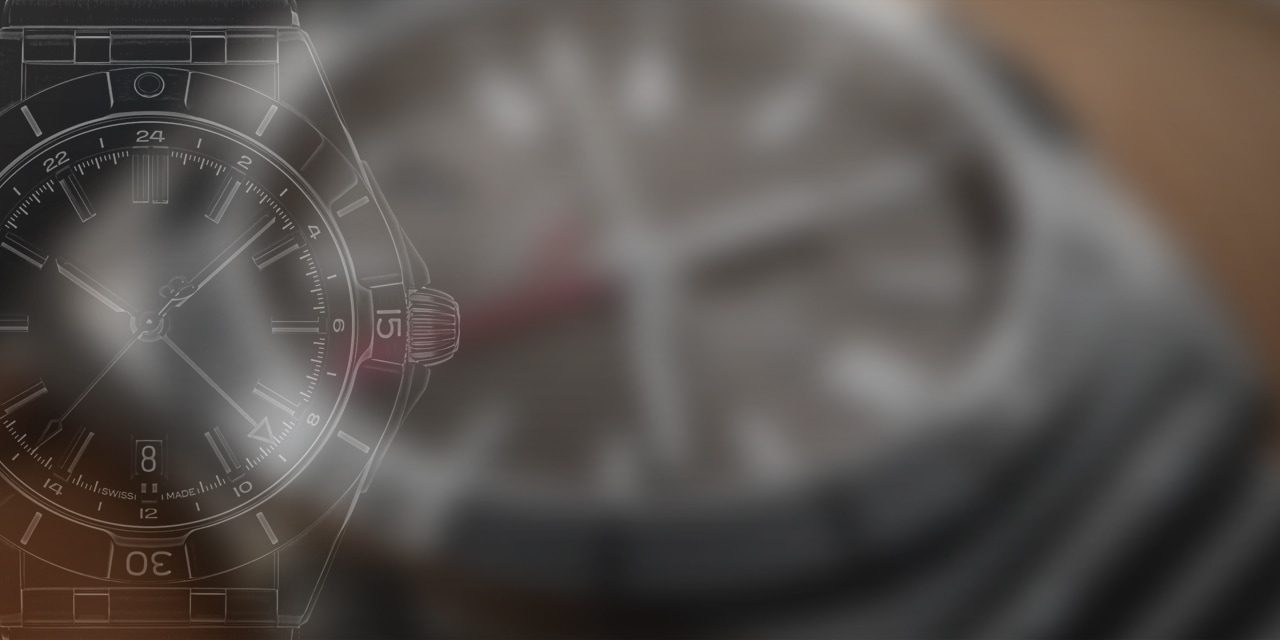
The Top 5 Watches to Take on Vacation: The Breitling Chronomat Automatic GMT 40
Breitling’s watchmaking history is a long and sometimes turbulent one.
A key innovator in chronograph technology, and the marque behind one of the first wrist worn versions as far back as 1915, the name has been synonymous with aviation since the 1930s.
In 1938, Willy Breitling, the third-generation of the family to take over at the helm, established the Huit Aviation Department, dedicated to making the most precise and resilient cockpit timers for military aircraft.
Many people believe the watch Breitling released just three years later on the back of that was intended as a pilot’s model. However, that is a case of very understandable mistaken identity, brought about by a later companion piece.
The 1941 launch of the original Chronomat was the first instance of a wristwatch equipped with a logarithmic scale on its rotating bezel. Based on Robert Marcel’s E6B slide rule, it meant the watch could be used to make a whole litany of calculations and conversions. And the fact the dial housed a tachymeter scale along with a pulsometer and telemeter certainly pointed to it being destined for a life in aviation. As well as being able to convert miles to kilometers or nautical miles, the bezel could be used in conjunction with the bicompax chronograph function to enable wearers to ascertain metrics such as fuel consumption, distance traveled or climb and descent rates.
But, even though Breitling was, at the time, the official supplier of timepieces to the RAF, the Chronomat (taking its name from Chronographe and Mathématique) was originally aimed at scientists, engineers and mathematicians.
It was the legendary Navitimer, arriving in 1952, which was specifically targeted at pilots; a watch which very much built on the Chronomat’s legacy, refining its slide rule and becoming the Breitling flagship in the process.
The Breitling Chronomat: A Brief History
There’s no disrespect in saying the Chronomat has rather lived in the shadow of the Navitimer since 1952; just about every other aviation-themed watch has too. An undoubted icon of the industry, the Navi is one of the all-time design classics.
Yet, that is not to say the Chronomat has not had an interesting time of it. That first iteration of the model, although altered in its aesthetics, refinement and mechanics over the years, took the name up to the 1980s.
The debut reference, the ref. 769, powered by a Valjoux 175 movement, set the benchmark; with its square pushers and dauphine-style handset and, of course, the distinctive bezel.
The 1950s into the 1960s saw the watch gain applied hour markers and baton-style hands and a general move towards a more elegant overall form. The 1970s witnessed a bolder approach, with case sizes increasing, lugs becoming chunkier and the introduction of greater color choice in the dials.
This was also the time when Breitling formed one faction of the Chronomatic Group in their race to develop the first automatic chronograph movement. Coming out with the famous Caliber 11 in 1969, the mechanism was shared amongst all the brands in the conglomerate (Breitling, Heuer, Hamilton-Buren, and Dubois-Dépraz) with Breitling opting to put their allocation inside a new Chronomat model, the ref. 7808.
Unfortunately, the late ‘70s saw the worst of the Quartz Crisis and, with Willy Breitling in failing health, he opted to sell his family’s business to Swiss army vet, watchmaker and amateur pilot, Ernest Schneider.
The Chronomat Reborn
Far from some soulless corporate entity, Schneider revived Breitling’s fortunes in just a few short years. Ordering a shutdown and complete retooling, the company’s relaunch ensued on their centenary year, 1984. And the first watch to usher in this new era was a revived Chronomat.
Sharing a name but little else with the originals, the ref. 81950 was a much changed entity for an entirely different generation. Designed in conjunction with the Italian Air Force’s aerobatic team, the Frecce Tricolori (Three-Colored Arrows), this rejuvenated watch did away with the emblematic slide rule bezel in favor of a far more toolish look. Although there was still a tachymeter printed on top of the rehaut and a 100ths scale on the side to convert minutes to decimal hours, the bezel was now engraved with 60-minute markings and had four rider tabs; a detail which would become a signature of the Chronomat range going forward. Part styling choice and part engineering requirement, the tabs, situated at the 15-minute marks, served as buffers to protect the sapphire crystal from the unavoidable knocks to which any professional pilot’s watch would be subjected on a normal work day. Ingeniously, the tabs at the 15 and 45 positions could even be swapped, turning the bezel into either a count-up or countdown timer.
There was also a unique bracelet created for the ref. 81950. Known as the Rouleaux bracelet (or sometimes the ‘bullet bracelet’) the narrow, cylindrical links helped the watch form smoothly about the wrist for excellent comfort. And the onion-style crown and pushers were a nice nod to the famed Flieger watches of WWII.
The ref. 81950 was initially released as a limited edition of 250, all of which went to the Frecce Tricolori, with the team’s logo on the dial and their case backs etched with an outline of the Aermacchi MB-339A aircraft used by the squadron.
The following year, the reference was made available to the general public, reintroducing the brand to the world—and the Chronomat became such a sales success that it is hailed as the watch that saved the company.
The Breitling Chronomat Automatic GMT 40
Breitling produced their first in-house movement, the B01, in 2009 and, again, it was the Chronomat chosen to debut it. They now manufacture nearly a dozen domestic calibers, with varying capabilities, not including a whole range of quartz engines.
The Chronomat collection continued to evolve, with different complications and materials until, in 2020, the range went through another redesign.
The current family has softened the edges of the ‘80s versions, introduced a touch more versatility and brought back the Rouleaux bracelet. There are now around 100 examples in the range, men’s and women’s models, and all with those trademark rider tabs.
However, while the line-up is heavy on chronographs, one of the most successful launches of recent times is a non-chrono, the Automatic GMT 40.
Stemming from 2022, the model hits the ideal unisex size and actually constitutes the only 40mm examples in the entire Chronomat range.
The styling is reflective, calling to mind some of the luxury sports watches of the 1970s. But while the GMT might look as if it has an integrated bracelet, take a second glance and you will see there are in fact lugs there, but the band’s second link extends to sit flush with them, giving the impression it is incorporated directly into the case.
There are seven pieces in the collection, six in all steel and a new model with a steel case topped with a platinum bezel. As for dials, you can choose between two flat matte faces in white or black, or four in sunray; blue, green or grey, plus a second olive green shade on the NBA’s Giannis Antetokounmpo Boutique limited edition, and a Rolex-esque ice blue on the platinum watch.
All examples run the Breitling 32 caliber, a non-in-house Caller GMT movement based on the ETA 2893-2. Sometimes called an Office GMT, a Caller is one with the 24-hour hand set independently of the other hands. But, third-party or not, the Breitling 32 is still chronometer-certified, offers a handy 42-hour reserve and drives the additional hand to point out a second time zone on the scale printed around the dial’s perimeter. Each watch sits on the iconic Rouleaux bracelet, even the top-of-the-line platinum model which has it as a rubber strap.
The Automatic GMT 40 is an intriguing proposition; not as obvious a vacation choice as some, but still one with plenty of plus points. The first, obviously, is its GMT function, arguably the most day-to-day useful complication this side of a date display. But it also manages to pull off the difficult trick of being elegantly stylish without being too conspicuous. Depending on where your holidays take you, a watch that doesn’t draw too much unwanted attention which can also be worn in smart surroundings without looking out of place is an ideal combination.
Breitling has managed it with this piece, and with prices starting at just over $6,000, it offers a lot of watch for the money too.
Featured Photo: Mixed art by Oriol Mendivil for BKT Archive.