
 Sign In
 (817) 503-2334
 Contact Us





 By:
By:
Rival Timepieces to Challenge Rolex’s Finest: Submariner vs. Oris Aquis Date Calibre 400
The Submariner & The Oris Aquis Date Calibre 400
And so we reach number 4 in our list of viable Rolex Submariner alternatives.
This one, from fellow Swiss compatriots, Oris, might seem a bit of a no-contest. After all, in terms of global reach, Rolex is figuratively light years ahead. Say their name to anybody, watch fan or no, and you will see their face light up with recognition. Mention the name Oris to anyone other than a dyed-in-the-wool watch fan and you’ll likely be met with blank expressions and changes of subject.
Similarly, the two entities operate in different spheres of the watch buying spectrum. Where Rolex is often cited as belonging to the ‘upper luxury’ sector in the brand hierarchy charts, Oris sits comfortably a couple of divisions down in the ‘entry level luxury’ band. The relative pricing structures reflect this positioning as well.
However, they do share a number of parallels.
Both were founded at almost exactly the same time—1904 and 1905—with Oris beating Rolex to market by a year.
Both are true Swiss watchmakers, designing and building all their models in Switzerland, and neither is owned by a conglomerate. That last is actually a more impressive feat for Oris. As a far smaller operation than Rolex, it would have been the easy route to fall under the LVMH/Swatch/Richemont umbrella as have so many of their mid-range peers. So far though, they have managed to remain independent.
Additionally, both brands have a strong mechanical-first philosophy, having abandoned quartz more than two decades ago, and each brand eschew, for the most part, the sort of top-end complications common to Patek and AP and the like. For both, robust tool watches make up the bulk of their sales—excellent, versatile models meant to be worn every day.
Lastly, they each have a strong identity at their core, having stuck with their own individual design language for generations. Basically, you know instantly what you are looking at when you see one.
In short, Rolex leads the way in brand prestige while Oris is the underdog respected by watch nerds everywhere.
So, is their Aquis Date Calibre 400 a match for the Rolex Submariner? Let’s dive in.
How It Started
Oris was founded in the Swiss town of Hölstein by two watchmakers, Paul Cattin and Georges Christian, who named their new company after a nearby brook.
With massive early expansion, by 1911 the brand had two additional factories (one in Como in Italy) and the original plant in Hölstein had become the town’s biggest employer with other 300 workers.
Success continued into the 1920s, with a further three production sites and the company had so many workers it built them dedicated housing.
Throughout the mid-20th century, Oris created a number of standout pieces and innovations. Their first pilot’s watch, the Big Crown, came out in 1938, while in 1949 they built an 8-day power reserve movement.
Their first dive watch debuted in 1965. That 36mm piece, called simply The Oris Diver, provided the inspiration for the brand’s current Divers Sixty-Five range, with their large indexes and luminous hands, unidirectional bezels and automatic movements.
When the 1970s hit, Oris, as with so much in Switzerland at the time, spent the decade trying merely to survive. The Quartz Crisis saw them subsumed into the ASUAG conglomerate, the forerunner of what is now the Swatch Group.
The company declined considerably during this period, with massive staff losses and the halting of production of their in-house movements.
Fortunately, in 1982, with the appeal of quartz on the wane, a management buyout by Dr. Rolf Portmann and Ulrich W. Herzog saw Oris return to independent ownership. More significantly, the brand made the strategic choice to abandon quartz and return to traditional movements.
That decision turned out to be the right one. Oris began rebuilding their reputation, emphasizing their heritage and quality and started building more complicated watches. The ‘90s brought Worldtimers and moon-phases and in 2003, the brand adopted the Red Rotor as its registered trademark.
In 2014 they released the Calibre 110, their first domestically-developed mechanical movement in 35-years. That engine, with its incredible 10-day power reserve, acted as the catalyst for a number of other homegrown movements.
In 2020, Oris brought out their hugely well-received Calibre 400. Representing a new standard at its price point, the 400 is manufactured to be extremely antimagnetic, surpassing ISO 764 criteria, and also beats COSC conditions, returning an accuracy of +3/-5 seconds a day. Coupled with that is a five-day reserve and, in a move which actually surpasses Rolex, comes with a 10-year warranty and servicing schedule.
A truly superb piece of engineering, it is the Caliber 400 we find inside the Submariner-challenging Aquis Date.
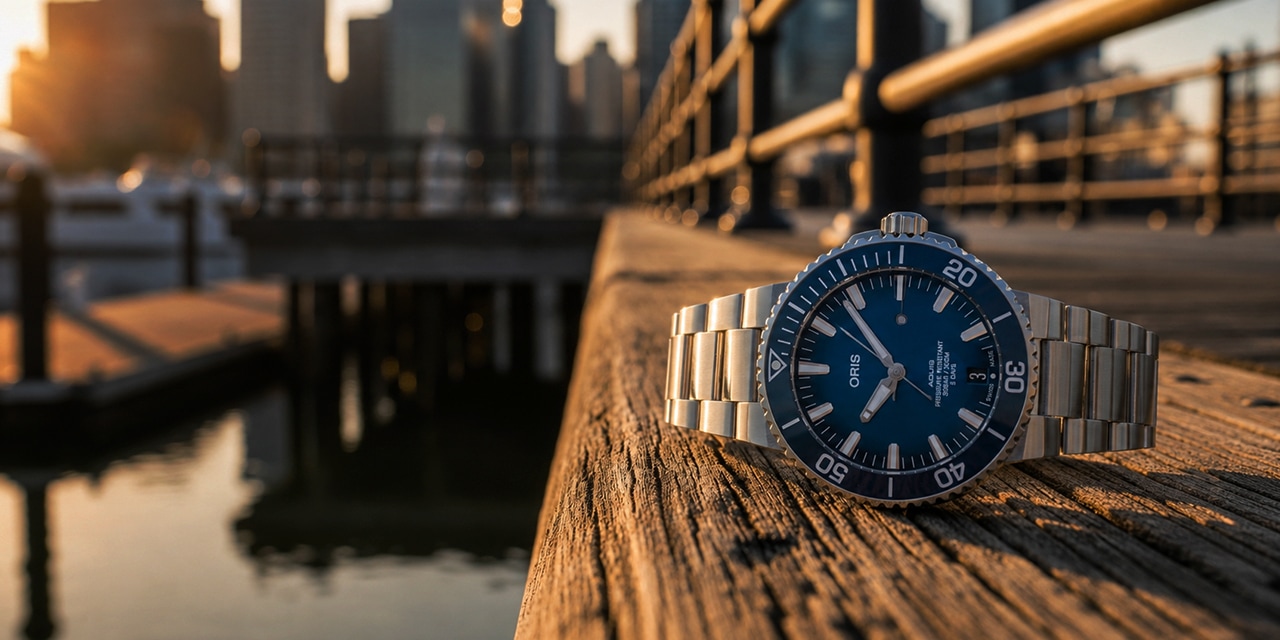
The Oris Aquis Date Calibre 400
Oris actually launched their Aquis Date range back in 2011. Powered initially by third-party ETA movements, the series marked a meaningful departure from the dive watches common to the era—in that they were designed from the ground up as modern pieces rather than a vintage homage of mid-century models.
The Aquis became the brand’s hottest seller, a stylish example of the breed and a tough one too thanks to its 43.5mm steel case. It was aimed at both those looking for a stylish al-day wearer and, with its 300m water resistance, serious divers as well.
Over subsequent years, Oris would continue to make modifications to the range, including introducing ceramic bezel inserts to replace the original aluminum and bringing out a collection of various dial colors.
But the biggest advance was, of course, the arrival of the Calibre 400 to the series in 2020.
Any brand, and in particular one the size of Oris, becoming a fully-fledged manufacture by creating their own movements is a monumental achievement. That the 400 is such an accomplished effort makes it all the more impressive. Beating at 4 Hz and with that 120-hour reserve, the engine also comes with a hacking function, instantaneous date change and a resistance to up to 2,250 gauss of magnetism.
The 30mm wide caliber fit easily inside the initial 43.5mm watches and also the new 41.5mm models Oris brought out to mark the occasion. As of now, there are 20 pieces in the collection powered by the Calibre 400 out of a total of just over 70. Mostly in steel, the top end contains a few two-tone editions with 18k gold bezel edges and nearly all come with attractive sunburst vignette dials in blue, green and black. There are a couple of limited editions too; The Great Barrier Reef watches go back 15-years and represent Oris’s work with reef conservation charities. The latest model, the Great Barrier Reef IV, houses a beautiful graduated blue dial to denote a dive beneath the waves.
Another outlier, although not a limited edition, is the ‘Upcycle’. The multicolored dials are made from recycled PET plastic ensuring each one is absolutely unique. They are also a nod to Oris’s sustainability pledge, one of the most robust in the industry.
The Submariner Beater?
Whether or not the Oris Aquis Date Caliber 400 is a better buy than a Rolex Submariner depends almost entirely on your own watch buying parameters.
On paper, there is less in it than you might think at first glance. Both are Swiss made, with 300m water resistance and high-performance in-house movements. Both have ceramic bezels and various dial choices. The Oris has a range of sizes, which the Rolex doesn’t so offers greater flexibility. The Aquis also has the option of a rubber strap as standard alongside the steel bracelet. The Rolex has only the Oyster.
Price-wise, Rolex can’t compete. The most expensive Aquis still costs less than $5,000. The least expensive Sub is around $10,400.
But, of course, one is an all-time icon, a substantial chapter in the history of watchmaking and quite possibly the most visible and influential timepiece ever made. The other is an excellent watch, with outstanding talents at a very reasonable price.
Chances are either one will last you a lifetime and both are versatile enough to fill that ‘one watch for any occasion’ niche.
If you’re on the fence, rest assured you can’t really make a wrong decision.
Featured Photo: Mixed art by Oriol Mendivil for BKT Archive.