
 Sign In
 (817) 503-2334
 Contact Us





 By:
By:
How Many Jewels are There in a Rolex Watch?
We’re running a short series of articles on the real minutiae of Rolex; literally, what makes them tick.
We’ve already looked at the number of screws in a few of the brand’s most popular models, and this time around we’re going to be concentrating on jewels.
Now jewels, when it comes to watchmaking, can be broken down into two main genres. There’s the functional and then there’s the decorative. Essentially, one makes the watch work, the other makes it look nice.
Let’s explore the functional type first.
Rolex Movement Jewels
If you own any decent mechanical watch, there’s a good chance that somewhere on it, it will tell you how many jewels it has. For those very new to this, it might be a cause of confusion. After all, the number likely won’t translate to how many you can see on the dial or bezel. No, in this instance, it relates to the quantity of jewels present in the movement.
Look at a watch caliber in action and you will see a lot of activity. Wheels are rotating, springs are whipping back and forth, rotors are spinning round. All of those points of motion are potential areas of friction. Rather than decoration, the jewels in a watch movement are there to act as bearings, eliminating the resistance where metal impacts on metal and so keep it all running accurately.
Jewels were first used in watchmaking in the early 1700s, pioneered by Swiss inventor, Nicolas Fatio de Duillier and the Debaufre brothers. Back then they used real rubies and diamonds, adding significant cost to the timepieces. By the 20th century, manmade rubies and sapphires had taken over. As these are grown in the lab and are almost always synthetic corundum (the same crystal structure as the natural stones but with none of the geological expense) they can be produced relatively cheaply. They are also extremely small, often no more than 1mm wide. Once made, they are cut and filed into the precise shapes needed and, as such, really hold no intrinsic monetary value at all.
They are, however, essential to the smooth running and precision of a watch movement.
Where Are They Used?
Movement jewels come in several different shapes, types and sizes depending on their job.
Pallet Jewels: Pallet jewels are generally rectangular in shape, often with angled faces, and are set into the pallet fork; specifically into the armature which interacts with the escape wheel to form the escapement. The escapement is the part of the movement which parcels out the energy from the mainspring in precise increments with a rocking motion. This is probably the component which is most susceptible to friction and so jewels here are essential.
Roller or Impulse Jewels: The other end of the pallet fork engages with the balance wheel, causing it to oscillate at a precise frequency. Another jewel is mounted on the balance roller to combat friction there. These are usually flat or slightly concave.
Cap Jewels or End Stones: A cap jewel is a flat stone and sits on top of a movement’s shock absorption system or above the balance wheel’s pivot. As well as reducing friction, they prevent the escape wheel’s teeth from coming into contact with the balance staff if the watch is knocked.
Hole Jewels: Placed in wheels, axles or pivot points, these round jewels have a bored center for lubrication oil and are there to reduce resistance.
How Many Jewels Does a Rolex Have?
As with the screws, the number of jewels in a Rolex watch depends on its movement.
There was a time when 17 jewels counted a watch as ‘fully jeweled’. These days, with the increased complexity of calibers, it is often far more than that. In fact, the number of jewels can be said to be a direct indicator of how complicated the movement is.
For example, the majority of Rolex’s movements (the Cal. 3230 inside the Oyster Perpetual, Explorer and No-Date Submariner; the Cal. 3235 in the Sub Date, Datejust, Sea-Dweller and Yacht-Master; the Cal. 3255 in the Day-Date; and the Cal. 3285 in the GMT-Master II) all use 31 jewels.
That’s right, even with the extra complications on the President and the GMT, they still manage to keep the jewel count the same as with the time-only Explorer etc.
The number only really starts increasing when you get to movements like the Sky-Dweller’s Cal. 9002 which, with its GMT and annual calendar modules, finds a need for 40 jewels.
Surprisingly though, the king of the jewels goes to the Daytona’s Cal. 4131. With its vertical clutch and column wheel, its extra gear trains, coupling systems and all the various parts which slide and engage under load, the Daytona’s engine uses 44 jewels.
What About the Fancy Jewels?
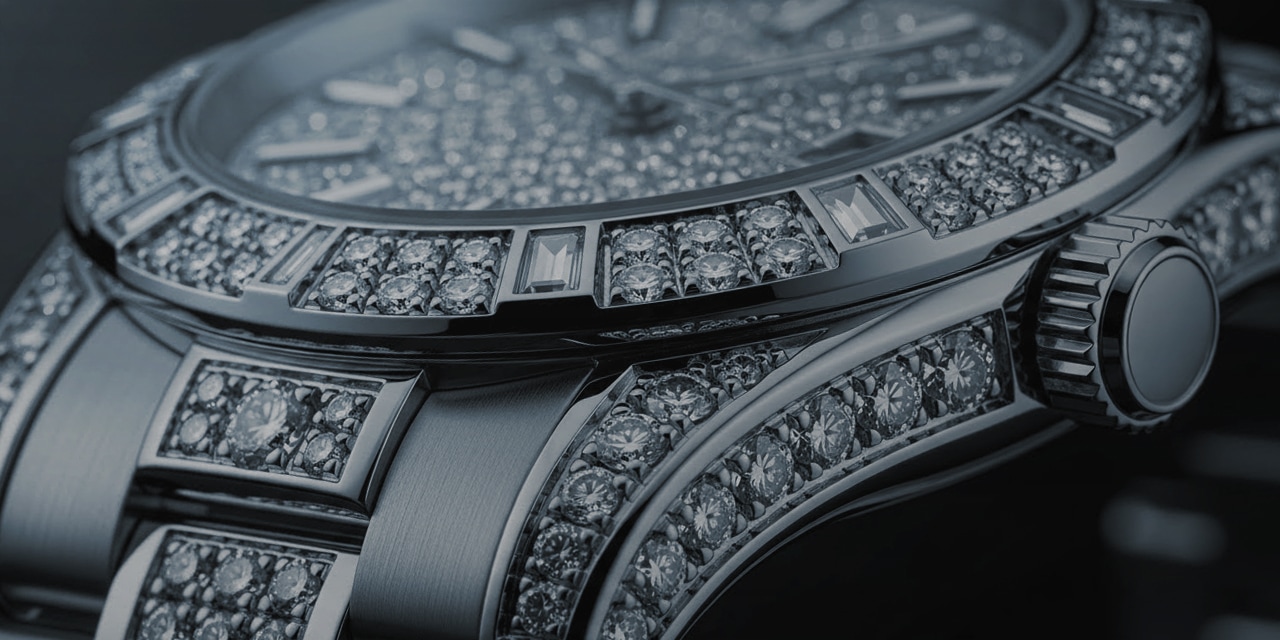
A world away from the utilitarian, lab-grown movement jewels, we get to the stones Rolex uses for ornamentation.
This is where the term ‘obsession’ doesn’t really do things justice. Rolex’s gem setters are renowned for their exacting meticulousness in selecting only the very finest stones available and their fastidiousness in shaping and setting said stones in the manufacture’s watches.
When it comes to diamonds, only those classified as D-F on the GIA scale, meaning colorless or near colorless, and with a clarity rated VS1-1F (internally flawless) are used. With their sapphires and rubies, these must be completely uniform in color and hue. And all of the stones are sourced from suppliers who comply with ethical mining standards.
There are a wide selection of models in the standard catalog, both in the Classic and Professional Collections, which come adorned with precious stones. The usual suspects like the Datejust and Day-Date can be had with diamond accented bezels and diamond hour markers. The President also gives the option of stunning full pavé dials, some highlighted with multicolored sapphire indexes.
But other, less obvious candidates, such as the Yacht-Master and the Daytona also come absolutely awash in bling as well.
However, it is in the off-catalog watches where we see some of the most outrageous uses of jewels.
Over the years, the likes of the Leopard Daytona have shocked and incensed as many as they have delighted; its mix of diamonds and cognac-colored sapphires, together with its leopard print dial making it an…acquired taste.
More recently, the stunning Rainbow Daytona was a no less scandalous yet slightly more wearable variant. Even those who detested its level of peacockery could not argue with the dedication displayed by Rolex’s jewelers in engineering such a perfect gradient of colored stones around its bezel and matching them perfectly to the corresponding hour markers.
But the undisputed most adorned Rolex is still the GMT-Master II ‘Ice’ ref. 116769TBR. Released in 2007, this white gold example of the brand’s world-beating travelers’ watch weighed in at more than half a pound and was, at close to $500,000, the most expensive Rolex ever created. Enveloped with more than 30 carats of flawless diamonds—79 just on the case and lugs and with a wave pattern of stones across the dial—this was an outrageous demonstration of pure opulence and the gem-cutter’s art. No one knows how many of the ‘Ice’ were made, but the most recent one to go to auction (selling for $444,500) was the first one seen in 16-years.
Not for everyone, in so many ways, it remains a magnificent achievement
Featured Photo: Mixed art by Oriol Mendivil for BKT Archive.