
 Sign In
 (817) 503-2334
 Contact Us





 By:
Which Unsung Rolex Watches Make the Best Potential Investments?
There are a number of reasons people get into watch collecting.
Some just fall in love with the design or the mechanics. Others enjoy the tacit status elevation that goes along with them. For many it just sort of creeps up on them; maybe they inherit a decent watch and it goes from there. And then there are those for whom the thrill of the hunt is the whole thing—if they weren’t collecting watches they would, and frequently do, collect something else.
For all of those separate groups, thoughts of a particular watch’s future investment value is often a secondary concern. That’s not to say it isn’t considered at all, it’s just it’s rarely the thing which will seal the deal on its own.
However, while we would never advocate buying a watch solely with financial potential in mind, there is no getting around the fact that some—and to be honest, there aren’t as many as you might think—which can increase in value a huge amount given enough time. And the brand responsible for the majority of them is Rolex.
The Flipper Paradox
It can be incredibly easy to make money on Rolex watches. Regrettably, it’s a bit like that line from Steve Martin’s book; ‘How To Make A Million Dollars.’ “Step 1: have a million dollars.”
If you’re the kind of person your AD gives first refusal to when the hottest new watches come through the door, and you have the funds to buy it, you can instantly turn around and sell that watch on the grey market. And if it’s one of the most in-demand models, you will find a buyer willing to stump up an exorbitant premium over the retail price you paid.
Obviously, that sort of business practice involves two things: 1. a lot of money, and 2. an excellent relationship with your AD, which you will only get by spending a lot of money.
Happily, there is another way. And that is identifying the unsung gems.
Away from the likes of the Paul Newman Daytonas or the Bond Submariners, there are still a few underrated would-be classics which may (or may not) appreciate mightily in the future. The trick is spotting them early.
What Gives a Watch Good Investment Potential?
There’s a reason more people don’t attempt this; in the world of inexact sciences, this is up there with the most inexact-est.
That being said, there are some markers which can point to a possible investment watch. Perhaps the most potent being if the watch is discontinued.
This one is fairly self-explanatory. Few things make the value of something increase more than a finite supply. Rolex has been trading off this for years, even with their current watches. The reason you can’t buy a new Daytona at retail is because there aren’t enough in circulation—partly because Rolex can’t make them quickly enough, but mostly because their allocation is tightly controlled. Any luxury good is made more valuable by exclusivity. If everyone is able to get hold of it, it becomes less appealing.
It is the same story with limited editions, although that’s something Rolex has never really gone in for. They have, however, made certain references for only short periods in the past, either due to that model’s unpopularity or else because it was quickly upgraded enough to warrant a new reference number. Those short lived references are usually referred to now as transitional pieces and can make excellent targets for investors.
Another factor which can affect future value is a unique or unusual dial. Those aforementioned Paul Newman Daytonas are probably the best example of this. Fitted with so-called Exotic dials back in the 1960s, they were so disliked (as was the Daytona itself, believe it or not) that only about one in 20 leaving the production line had one. Now, of course, you won’t find any worth having for less than six-figures.
Then there’s historical significance. The Paul Newmans fit this bill nicely too, with the great actor lending the watch his patronage and…well, the rest is history. But there are others.
Oftentimes the most significant Rolex watches turn out to be the debut reference of a modern great—the Submariner ref. 6204, for instance, or the GMT-Master ref. 6542. Unfortunately, these also now tend to be prohibitively expensive. That’s not to say they won’t continue to increase in value in the future, but we’re looking for a more attainable buy-in.
For that we have to look for our last factor; growing demand. This takes a bit more work, but can pay dividends.
The first thing to look for is price movement on the secondary market. Check platforms such as Chrono24 or WatchCharts where you can see real world rates. eBay is also surprisingly effective for this. Look at completed sales rather than asking prices to see what the watches actually sold for, and if a model which used to stay pretty flat is now demanding 10-30% higher year-over-year, that’s evidence of real demand. You can also filter by reference, condition, year and even by region—sometimes a watch is hot in the US but pretty stagnant in Europe or Japan.
You can also haunt internet forums. Collector communities are a bit like early warning systems; they can give you the lowdown before anyone else. If you notice a certain model is suddenly getting talked about by real collectors, either trading, buying or even restoring, that can be a great signal.
Make sure you keep up-to-date with Rolex’s contemporary line-up too. New additions are made every year and, crucially, others are retired. A new movement, a dial update or a case size adjustment tends to boost interest in the older version. Collectors like end-of-production references because, again, they become finite. That leads to a retroactive rise in demand for older ones.
And lastly, you can compare supply and demand metrics. If you study a secondary platform and notice the number of listings for a particular model or reference is shrinking but sold prices are rising, there are few better indicators of increasing demand.
In short, if you track a watch’s actual market behavior over time, it can give you a clear indication of an underappreciated treasure.
Things To Consider
If you’re buying a watch only for investment, you need to think about a few other things over and above the watch itself.
Understandably, the condition is all important—although not necessarily in the way you might think. The thing has to work properly, of course. But features such as a faded ‘ghost’ bezel or a cracked ‘spider’ dial can actually add to the model’s appeal because of that all-important uniqueness they imbue. Imperfections are not automatically bad news and can even be extremely prized.

The original box and papers are good bonuses to have as well, and can bump up the price you are able to sell the watch on for in the future. Also, just as when buying a used car, a well-documented service history is another bonus. Servicing mechanical watches, and especially vintage ones, is not a cheap undertaking and future buyers will want to see what has been done and when.
And, it should go without saying, that a completely original model will always be worth more than one with replacement parts, service dials or, heaven forbid, Frankenwatches.
Finally, it is also worth keeping in mind the cyclical nature of the watch market. It is an industry dominated by hype and what is undervalued today could become the next must-have tomorrow.
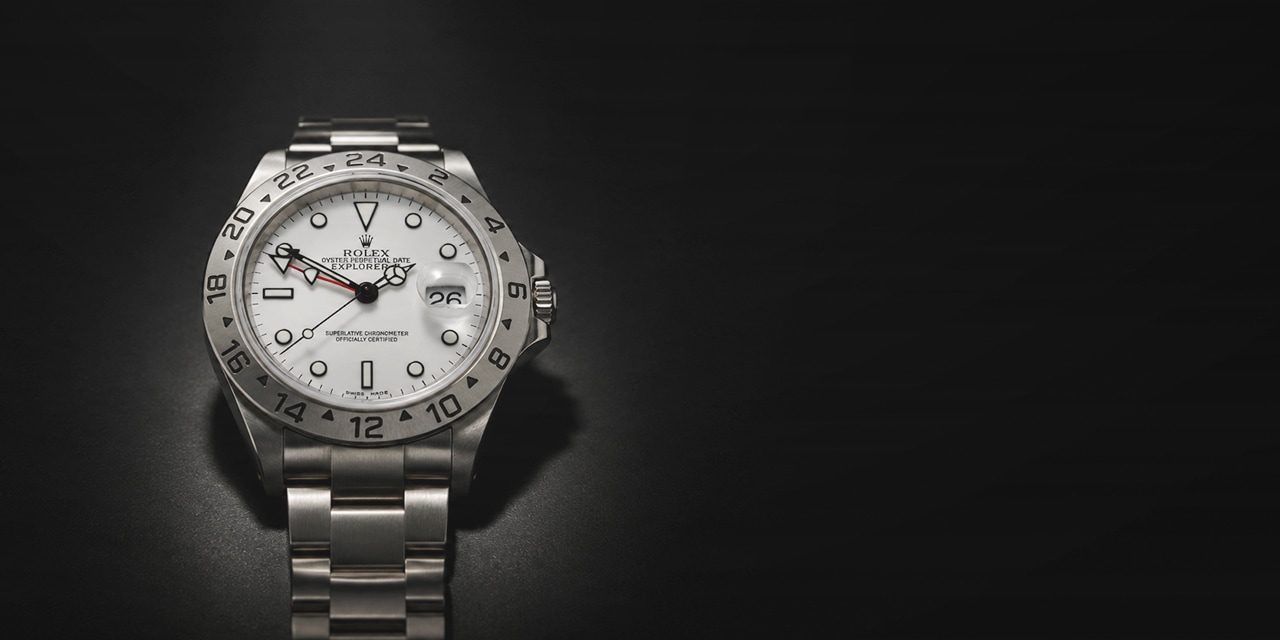
In our follow-up articles, we’re going to be exploring what we believe are the 10 best underrated Rolex watch targets for investors, starting with the Rolex Explorer II Ref. 16570, specifically with the black dial.
Featured Photo: Mixed art by Oriol Mendivil for BKT Archive.