
 Sign In
 (817) 503-2334
 Contact Us





 By:
The BeckerTime Guide to Stainless Steel Rolex Watches
Pound for pound, there really doesn’t seem to be a better, more suitable material on this planet from which to build high quality watches than stainless steel.
In fact, just looking through its laundry list of attributes makes you wonder why manufacturers use anything else.
Not only is it highly durable, with an inherent resistance to tarnishing and corrosion, it is also far more difficult to scratch than, say, any of the precious metal alloys frequently used. On top of that, it is extremely versatile and has never gone out of fashion in the same way that yellow or rose gold tend to flit in and out of favor. Add on the comparative ease of maintenance required and the value for money aspect, and it is easy to see why it is the most commonly employed metal in the entire industry.
Rolex Steel Watches
Rolex has been making steel watches for almost as long as they have been making watches. It was the perfect material to help fulfill founder Hans Wilsdorf’s ambition of popularizing the wristwatch as a male accessory. Before then, so-called wristlets had been little more than items of ladies jewelry containing rudimentary dials and calibers and usually cast in gold. Delicate and far too fragile for men, steel alternatives really came into their own following the early 20th century’s two global wars.
By the 1950s, after Rolex had already revolutionized the world of horology with both the Oyster case and Perpetual movement, they continued to force progress with their invention of an entirely new genre of timepiece, the tool watch. These, far from being purely for show, had a job to do and as such required an intrinsic, fundamental strength.
Models such as the Turn-O-Graph, the Explorer, the Submariner, the GMT-Master and the Milgauss all emerged within a few short years of each other, all in steel and all relying on a form-following-function rationale. Yes, they were beautiful to look at, with many going on to become icons in their own right, but they were first and foremost rugged implements designed to withstand a life of punishment.
Since then, just about every collection in the Rolex chronicles has had a steel version, sometimes nothing but. (Not including the Day-Date, the old Cellini range and its current replacement, the 1908).
The Explorer II, for instance, has been cast exclusively in stainless since its debut in 1971; the just-retired Milgauss for even longer than that. Others have only deviated from an entirely steel-based history in very recent times. The Sea-Dweller and Explorer both received Rolesor versions in 2019 and 2021 respectively, adding a dab of 18k gold to their makeup. And we can’t forget the solid yellow gold Deepsea (however hard one might try).
Of course, not all steel is created equal and Rolex being Rolex, the type they use is different to 99% of the rest of the industry. From 1985, the manufacture began the process of moving away from the traditional 316L steel alloy to 904L. Containing a higher proportion of nickel and chromium, along with the addition of copper, 904L has been a staple of the aerospace and chemical engineering spheres for decades. For Rolex’s interest, the alloy is not only more resistant to corrosion, making it ideal for the brand’s range of class-leading dive models, but it also holds an exceptional shine, allowing their watches to stand out visually in a saturated market. On the downside, 914L is roughly 2-3 times more expensive than 316L and far more difficult to machine, compelling Rolex to make an enormous outlay in new machinery and tooling.
Since 2018, the manufacture has renamed their proprietary metal as Oystersteel and described it as belonging ‘to the 904L family’. What that means and how it differs from standard 904L, no one seems to know. But what is certain is that it does indeed look different to that used by most other watchmakers, with an unmistakable gleam which is almost unique.
Today, stainless steel is still easily the most abundant metal in which you will find Rolex’s watches, whether current or vintage. But which is the one for you?
If You Want Something Even Tougher Than the Submariner
The Rolex Sea-Dweller ref. 16600
There’s no doubt that Rolex’s legendary Sub is the most popular, lionized, emulated and wearable of the brand’s underwater trio. But what do you do if you want something just that little bit extra?
That was the question French commercial diving authority COMEX approached Rolex with in the 1960s, an era when fresh oil fields discovered in the North Atlantic gave rise to a new breed of subaquatic professional, the saturation diver.
This highly specialized and extremely dangerous occupation brought with it a whole slew of challenges, among them the problem of safeguarding the crews’ watches.
Saturation divers can spend days or weeks at a time living and working in underwater habitats, at great depth and under extraordinary pressures. In those environments, the tightly regulated gases they breathe contain, out of necessity, a high percentage of helium. And with helium being made up of some of the smallest molecules of any gas, it was found that it could leach inside the divers’ watches. Upon ascent back to the surface, the helium would expand due to the reduction in pressure, often popping the crystal off the case and in some instances, destroying the movement.
Rolex’s solution, contrived with fellow dive watch manufacturer Doxa, was to outfit a Submariner with a one-way valve which would allow the gas to escape before it reached the critical point. With the efficacy of this HEV (Helium Escape Valve) thoroughly tested, Rolex created a dedicated model around it—a tougher, thicker-cased Submariner with an enhanced version of the Twinlock winding crown called the Triplock.
Altogether, this newly christened Sea-Dweller was rated safe down to an unheard of 2,000ft and, before its first decade was done, it had doubled that to an incredible 4,000ft.
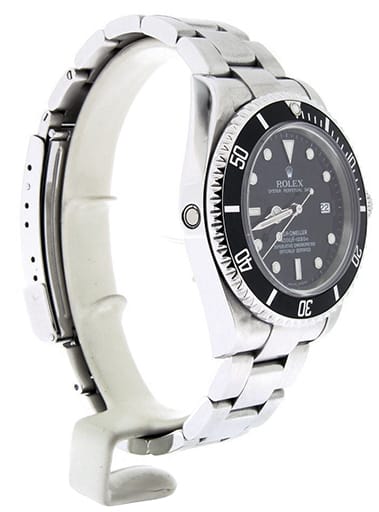
The ref. 16600 was the third generation of this remarkable diver, released in 1989 and subject to the longest run of any of the model’s iterations, not being replaced until 2009. At first glance you would have trouble distinguishing it from a Sub; the size, bezel, all the dial furniture and the bracelet are virtually identical. But the lack of a Cyclops lens over the date window would be your first giveaway, something which has long split opinion amongst fans and one of the factors which drove many to choose the Sea-Dweller over its stablemate.
It is also a heavier, more substantial piece, a watch designed less for desk diving than actual underwater exploration and just about as indestructible as you could realistically expect any luxury timepiece to be.
However, even with its prodigious abilities, prices for the ref. 16600 are still comparable to Subs of the same period. Around $10,000 will secure you an excellent example of perhaps Rolex’s best-of-all-worlds diving maestros, and you won’t find many other watches offering more for less.
If You Want a Robust But Stealthy Travel Companion
The Rolex GMT-Master II ref. 116710
They might share several visual cues, but the difference in their originally intended usage means that the GMT-Master has always erred more towards the luxury end of the market than the Submariner.

It was a model designed for the world of international jet setting—a more genteel, watch-nurturing environment than adventuring below the murky depths and so precious metals made their way into the GMT range far sooner than they did on the Sub (1955 versus 1969, to be precise).
That being said, it is still very much a tool watch and as such, there have always been steel models in the collection and they have long been the bestsellers.
The ref. 116710 is among the newest generations of the GMT-Master II series, released in 2007 and going on until 2018 when the current range came in.
It is an interesting reference for a couple of reasons, both centered around its bezel.
The GMT-Master is a model defined by its colors. From its origins, Rolex employed a two-color surround as both a signature styling point and as a practical exercise. Engraved with a 24-hour scale, the rotatable bezel is used to track a second time zone. In order to differentiate easily between daylight and night-time hours, the brand used different colors for each, giving rise to iconic versions such as the blue and red Pepsi, the red and black Coke and the brown and gold Root Beer, among others.

But, in 2005, Rolex developed a new ceramic they called Cerachrom from which to craft their bezels, replacing the old aluminum inserts. Incredibly tough, fade resistant and scratchproof, it appeared a perfect material. Except, on its launch, they had not yet discovered a way to add two colors to it and were limited to issuing them in one solid shade.
Why they chose the GMT-Master II as the watch to debut Cerachrom is therefore a complete mystery, but the ref. 11671X was the range with which they did it. So, the ref. 116710 was the first steel Rolex with a Cerachrom bezel and the last to have an all-black one.
Until the contemporary collection, the GMT series has nearly always had a fully black bezel option and it has proved a highly sought-after alternative to the more eye-catching bicolor variants. What it loses in at-a-glance convenience, it makes up for with an understated covertness which appeals to those happy not to draw attention to themselves or their watches. Coupled with the black dial, the ref. 116710 is about as clandestine as the GMT gets, with only little dashes of green on the seconds hand and text to break up the full-on special forces look.
It is also, for such an important milestone in the development of such an important watch, something of a bargain. You can get your hands on a model for which there is no current equivalent for around $14,000.

If You Like Your Steel Watches With Just a Little Opulence
The Rolex Datejust ref. 16234
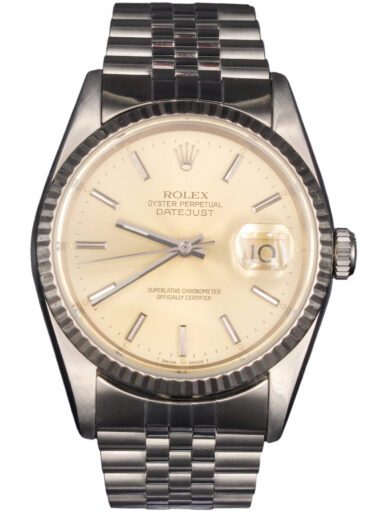
Proof that steel isn’t all business.
The Datejust, like its dress watch compatriot the Day-Date, was initially released only in gold. Unlike the Day-Date, however, within the first few years of its production, Rolex brought out both full steel and Rolesor versions, lending the model a more down-to-earth, less establishment vibe.
It has been that way ever since, with the brand’s most profitable creation ever cast in just about every metal available at one time or another, but with the stainless references usually the top sellers.
The ref. 16234 came from the generation unveiled in 1988, superseding the short lived ref. 160XX range due to the upgrades made to the movement—the former Cal. 3035 was replaced with the Cal. 3135, although in the real world there was not a huge amount to choose between them.
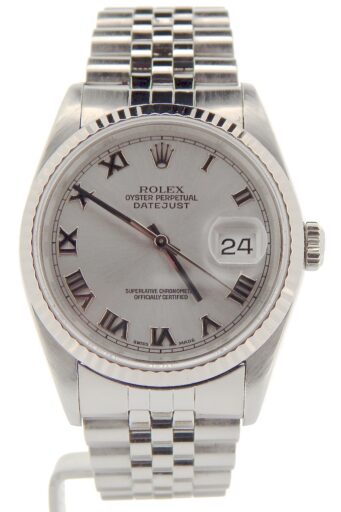
By this time, 40-years after its introduction, the Datejust’s aesthetics had been set in stone for some time and there was very little to do visually. Along with the improved engine, Rolex garnered the ref. 16234 with an even greater selection of dials, not that it was lacking in that department already.
Up front and represented by the ‘3’ in the reference number, the model was fitted with the brand’s highly recognizable fluted bezel, which is where the watch deviates slightly from its purported only steel construction. One of the oldest styles of surround, the fluted bezel evolved from the vintage coin-edged type which were a necessary addition to the earliest Oyster watches as their striations provided a surface for watchmakers to grip as they tightened the component on to the cases. These days, the ridges are purely decorative but one thing that has remained constant throughout is that Rolex’s fluted bezels have always been made of gold. So it is with the ref. 16234. The bezel is cast in white gold and makes this so-called steel watch a Rolesor model of sorts.
The ref. 162XX collection went on for more than 20-years and so there is no shortage of them on the preowned market. That in turn leads to prices you might not believe, with perfectly good examples easily found for as little as $6,000. You can, of course, spend more and most of the extra money will come down to the type of dial. Keep an eye out for the wonderful mother of pearl specimens, either with or without diamond indexes if you like your watches with a dash of excess. Even with those additions, you can still expect to only pay in the region of $10,000 or so.
They don’t call it the everyman Rolex for nothing.
Featured Photo: BeckerTime’s Archive.