
 Sign In
 (817) 503-2334
 Contact Us





 By:
By:
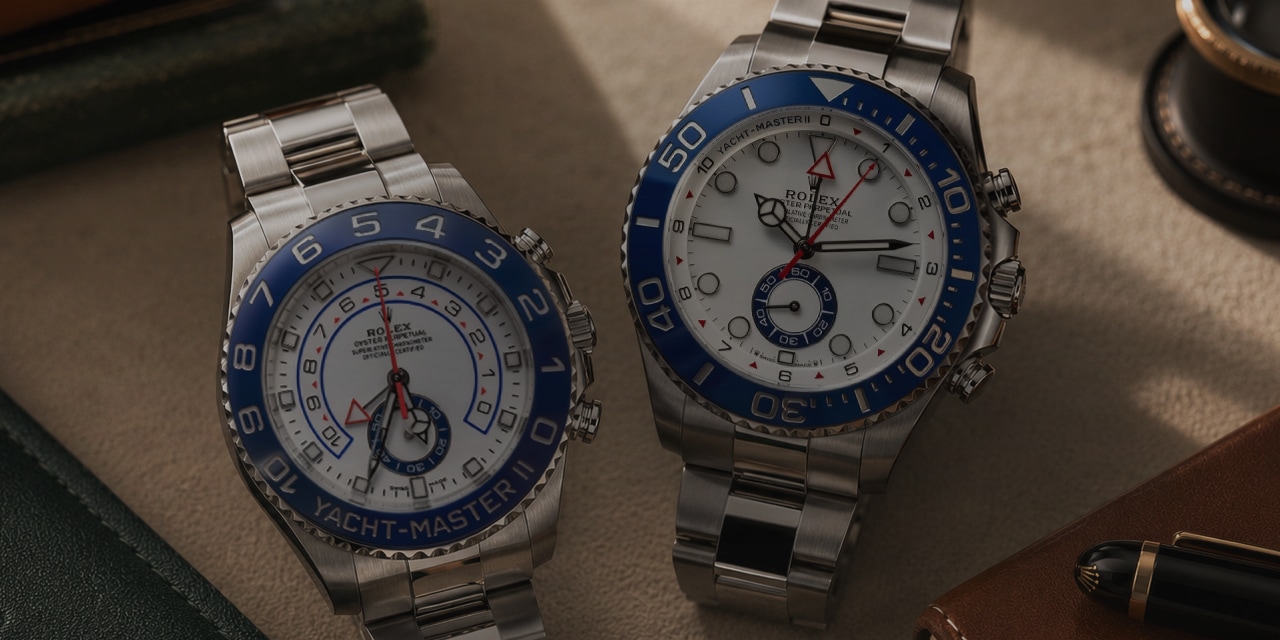
Side By Side: The New Yacht-Master II Versus the Old
The original Yacht-Master II, first released in 2007, updated on its 10th anniversary and discontinued in 2024, was always a divisive figure.
Those against it hated its big, in-your-face brashness, its incredibly niche audience and its all-around un-Rolexness. Those who loved it loved it for those exact same reasons.
It was, however, always an outlier and so it didn’t come as a huge shock a couple of years ago when it was quietly withdrawn from the catalog.
What did comes as a surprise was its return at this year’s Watches & Wonders show.
Rolex, of course, have a vested interest in a watch designed specifically for sailing events being the title sponsor or official timekeeper of more than 15 of the world’s most prestigious regattas and offshore races.
And unlike the original Yacht-Master line, which is essentially a glamorous Submariner, the Yacht-Master II was a bona fide tool watch, providing invaluable assistance to boat crews via one of the most impressive complications the manufacture has ever created.
So its reinvention perhaps should have been expected. The question is; how does it differ from the one that came before? And is it better?
Out With The Old
The previous Yacht-Master II from 2007 came out first in full yellow gold (the ref. 116688) and white gold with a platinum bezel (the ref. 116689). Therefore, as well as being somewhat challenging in the looks department, buying one was also prohibitively expensive. Those were followed up with the release of an Everose Rolesor version in 2011 (the ref. 116681 and slightly cheaper) and, eventually, the least-expensive-but-still-not-exactly-given-away all-steel model in 2013 (the ref. 116680).
Each variant shared certain characteristics, as you would expect, the main one being they were very difficult to miss.
At 44mm, they were the largest watches Rolex ever made, and coupled with their extrovert styling, they did tend to stand out on the wrist. Most noticeable was the bezel. On all but the Rolesium model, the Cerachrom surround came in a vibrant blue, with a 10-minute scale in huge numerals engraved around three-quarters of it and YACHT-MASTER II taking up the whole of the lower quadrant—just in case you were wondering what it was.
Coupled with that, their white lacquer dials almost rivalled the Navitimer for busyness. Squeezed into it came a small seconds subdial at the six o’clock, above which came the horseshoe-shaped regatta countdown scale, above which came square minute markers and the whole thing was served by four hands including a sword chronograph hand and an arrow-tipped regatta hand.
The Internals
All told it was a bold look (yeah, let’s use that word) and it was one which split opinion. But what was not up for debate was the functionality of the watch nor the engineering expertise which made it happen.
The Yacht-Master II became the first conventional wristwatch with a programmable regatta countdown with a mechanical memory. It was designed explicitly to help time the complicated flying start to a yacht race, where the boats jockey for position in front of the start line. Competitors are given a 10-minute warning where they must maneuver as close to the line as possible and time their start to cross over exactly as the gun goes. That was the whole reason for the existence of the Yacht-Master II and its party piece.
Key to it was the Ring Command Bezel (a different version of which was later seen on the Sky-Dweller) which acted as an actuator for the complication. Turning it 90° counter-clockwise unlocked the functions and allowed the countdown to be set with the crown for between 1-10 minutes. Rotating it back set and locked the countdown which could then be started and stopped with the pushers. Should you misjudge the buildup, the timer could be synchronized on the go, so it was really a modification of a flyback chronograph. Nevertheless, it was brilliant.
So, What’s New?
The original Yacht-Master IIs got a new movement in 2013, the Cal. 4161 replacing the Cal. 4160 (basically the same but with the addition of the Parachrom hairspring).
The 10-year anniversary in 2017 saw a few cosmetic changes as well. The main hands reverted from pencils to the more recognizable Mercedes style and the applied hour markers gained an inverted triangle at the 12 and a rectangle at the 6. The rest of the watch, including the reference numbers, remained exactly the same and it was those which took the model up to its brief retirement in 2024.
Now it’s back—and what’s changed?
Well, just by looking at it you can see this is a much altered watch. It is still big, measuring 44mm again, but this time out there is a far better balance to the whole.
Starting with the dial, that previous chaotic layout has been vastly cleaned up, mainly by moving the regatta gauge onto the newly introduced sloped flange around the perimeter. It runs from 0-10 again, with small red triangles at each half minute. That has left plenty of room for the more traditional Maxi-style dot and baton indexes, increasing readability. The Mercedes hands have been carried over too.
The bezel, likewise has been toned down. The color is now simply blue instead of BLUE! and the 10-minute engraved numerals have gone in favor of a divers’ 60-minute scale. The YACHT-MASTER II has disappeared from it as well and can also be found on the lip around the dial.
Interestingly, that bezel is just a humble bidirectional surround now. While the watch’s functionality has not changed, there is no longer a Ring Command, with everything controlled on the pushers only. The lower button sets the length of the countdown, with each press adding another minute as indicated by the arrow hand on the 0-10 scale. The upper pusher starts the timer, sending the central seconds hand running backwards (it is a count down after all). And, like before, should you mess up the timing, you can press the bottom button again and it will reset to the nearest minute. So not only has the bezel been taken out of the equation, so has the crown on this new generation.
Inside runs the Cal. 4162, the next wave of movement, complete with the Chronergy and 72-hour reserve, Paraflex and Parachrom and all that jazz. And, just like the Daytona’s engine, the Cal. 4162’s chronograph is column-wheel-controlled with a vertical clutch.
But, is it Better?
Hand on heart, I never really took to the original Yacht-Master II. I was one of those who thought it too unRolexy, too big and too—oh, I’ll just say it—plug ugly.
None of which would have had any bearing on me buying one or not, because it was always too expensive as well.
This new one though? Well, it’s certainly an improvement; for my tastes anyway. It definitely would not be my first choice still, even though I have, for my sins, begun getting involved in regattas in the last couple of years (I’ve started crewing on the safety boats for my local yacht club, god help them).
I’m a big fan of the amount of complication it has packaged in a more unassuming case though. Well, the steel version is unassuming, the ref. 126680. The other variant, the full yellow gold ref. 126688 is still flashy as all get out.
But it is an unarguably extraordinary feat. The amount of complexity Rolex has managed to engineer out of the original is a marvel and sure to be appreciated by overwhelmed skippers, who have enough to do at the start of a race other than unscrew crowns, twist bezels and push buttons. Graduating to the just push buttons part is only going to be good for them.
I would expect then, for this generation to be more successful than its predecessor. Not only is it more user friendly for its intended target, it is a more everyday wearable beast for those with no sailing bent at all.
Expect to see it around for a good while, and plenty of other options added soon too.
Featured Photo: Mixed art by Oriol Mendivil for BKT Archive.