
 Sign In
 (817) 503-2334
 Contact Us





 By:
By:
Watches & Wonders: The Best From IWC
While they haven’t necessarily stolen the lion’s share of the headlines from this year’s event, IWC have actually had a brilliantly successful Watches & Wonders show.
The Schaffhausen-based manufacture came to the expo loaded down with 17 new references, among them a massively innovative timepiece destined for outer space, what is undoubtedly the most luminous watch ever made, an anniversary collection hailing two decades with one of children’s literature’s most celebrated works and a new perpetual calendar movement which should solve a lot of anguish.
Below we take a closer look at our three favorites.
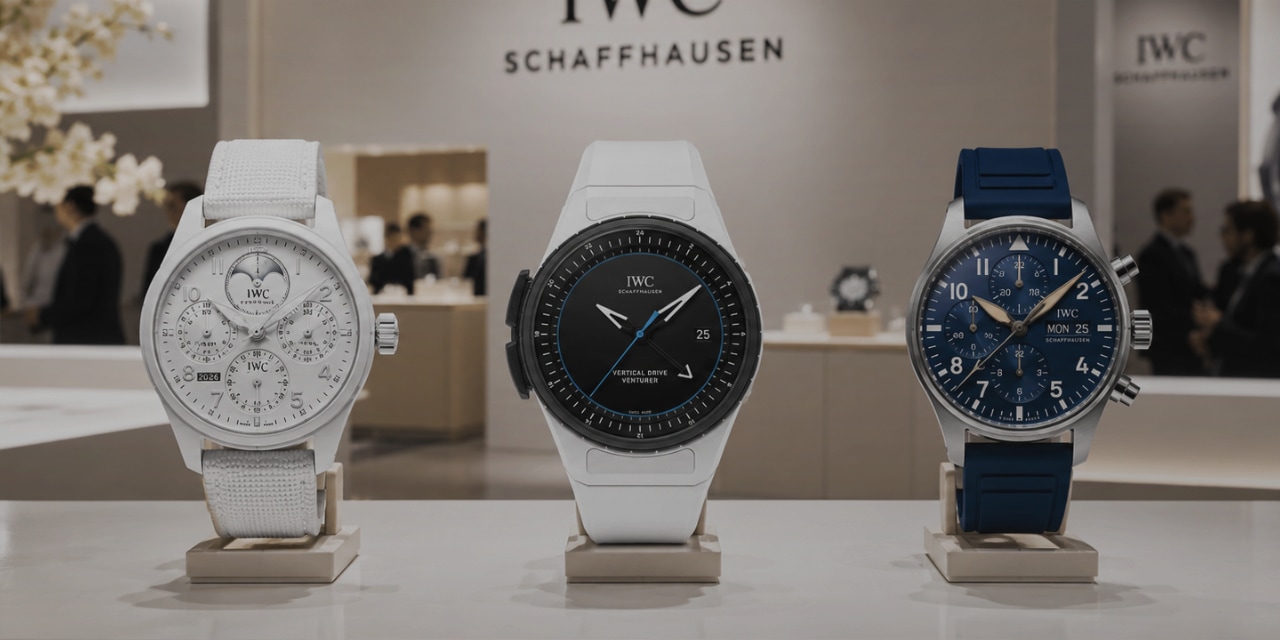
IWC Pilot’s Venturer Vertical Drive
Looking as if it had been taken straight off the set of 2001: A Space Odyssey, IWC’s mission-ready astronaut’s watch was the undisputed star of the show for the brand this year.
Developed in conjunction with Vast, the private American aerospace company creating Haven 1, the world’s first commercial space station, the Venturer Vertical Drive is officially part of IWC’s Pilot’s Collection—but it is very much a standalone model.
With a white ceramic case, and a bezel and case back in Ceratanium, the 44.4mm wide, 16.7mm thick piece is definitely not short on wrist presence. But the materials and size have, of course, been specially chosen for the mission. Both the ceramic and IWC’s proprietary Ceratanium have matte finishes to minimize reflections and each have low heat absorption. On top of that, they benefit from excellent scratch and shock resistance.
As for the not inconsiderable bulk, this has been designed to be worn by astronauts on EVAs (spacewalks to you and me) and so needs to be able to be operated while wearing gloves.
Speaking of which, thanks to IWC’s novel Vertical Drive mechanism, there is no call for a winding crown; something which has always represented a weak spot in any watch design and is also fiddly to operate with gloves on. Instead, a clutch system allows for the bezel movement to be translated to the winding stem. Additionally, a rocker switch on the left side of the case toggles between various functions—such as winding the movement or setting the second time zone.
That’s right, where chronographs are the more usual choice for going into orbit (the Speedmaster most famously) the Venturer is a GMT. The first time zone is read on the main hands, while around the outer edge of the dial is a 00:00 to 24:00 scale with its own hand. While normally synchronized, the two can be separated to work as a dual time.
So, while space is normally the sole preserve of Omega, IWC are not new to the challenge; SpaceX used four of their specially-made chronographs for last year’s Polaris Dawn mission. And the Venturer symbolizes the next (small) step for a brand on a streak of form.
IWC Big Pilot’s Watch Perpetual Calendar Ceralume
If something’s worth doing, it’s worth overdoing is what, I expect, the motto in the IWC Ceralume department states.
The brand has something of a lover affair with ceramic and now, having mixed it with the industry’s favorite luminescent material SuperLuminova (typically only found on indexes and handsets) have created a proprietary material they can make whole watches from where the entire thing glows in the dark.
Eagle-eyed spectators may have seen Lewis Hamilton, former IWC ambassador, wearing a fully luminescent Big Pilot prototype in 2024. Well now, there’s one available to the general public—so long as that general public has a spare $76,300 to spend.
Now, that is a lot of money. And especially when you notice the entirely white model (seriously, everything is white; the dial, sub dials, hands and hour markers. Even the strap) is almost illegible in the daylight.
However, once the sun goes down you might well find people dancing around your watch having mistaken it for a nightclub.
At 46.5mm, this is another large venue and houses the domestic 52616 caliber, complete with Pellaton self-winding system (also heavy on the ceramic to prevent wear in the components) and a formidable 7-day power reserve. The movement drives the brand’s legendary perpetual calendar complication, developed originally by Kurt Klaus in the 1980s. As well as automatically compensating for the varying number of days in the months and adding another to the end of February every four years to account for leap years, it also powers the trademark Double Moon display which shows the moon phase from both the northern and southern hemispheres, deviating by just one day every 577.5 years.
Up front, that means four sub dials at the cardinal points, with some being roped in to pull double duty in order to display all the information required. There is a tiny window at the 7:30 position for the year too.
This is one of those ‘I wonder if we could’ watches more than a ‘I wonder if we should’. Certainly an innovative step forward, the 250-piece limited edition is obviously aimed at those who only go out at night.
IWC Le Petit Prince Collection
2026 marks the 20th anniversary of IWC’s collaboration with the estate of beloved children’s author Antoine de Saint-Exupéry.
His novella, The Little Prince, was released in 1943, since when it has sold over 140 million copies worldwide and been translated into more than 600 different languages and dialects—second only to the bible in translations.
With Saint-Exupéry also being a renowned aviator, the Le Petit Prince collection has centered around IWC’s Pilot’s Watch models, and this revamp carries on that tradition.
There are nine new watches in the latest series; two 40mm Mark XXs (in steel and 18K 5N gold), a 36mm Automatic, two steel chronographs in 41mm and 43mm and another 41mm in white ceramic.
The remaining three models are even more special.
For the first time, the line goes beyond aviation with the release of the Portofino Automatic Day & Night 34 Le Petit Prince. This slim model from the brand’s dress watch line features diamond hour markers and a rotating disk at the six o’clock decorated with the sun and moon.
And the final two pieces are both perpetual calendars, but with a revolutionary new take on the complication. As impressive as they are, perpetual calendars do have the potential to be a nightmare as well. If the watch stops or the wearer sets it incorrectly, fixing it again can call for a lengthy process usually involving manuals and hidden pushers or even a trip to your local watchmaker.
Now, IWC have introduced the ProSet function into the portfolio, including on to the steel and white ceramic models of the new Le Petit Prince collection. Highly practical, it allows for the calendar to be set bidirectionally via the crown for the first time ever. Praised as foolproof, it means that a watch with a perpetual calendar could now legitimately count as a practical everyday wear rather than a delicate, high-strung piece only brought out on high days and holidays. It might actually count as one of the most significant breakthroughs in watchmaking in years.
Each example in this new series wears the trademark lush blue sunray dial with bright white, high contrast handsets and indexes. Turn them over and you will (usually) find the little prince on the case back too.
With prices ranging from $5,500 to $41,600, this is a charming and well-loved assembly of watches from a fantastic manufacture.
Featured Photo: Mixed art by Oriol Mendivil for BKT Archive.