
 Sign In
 (817) 503-2334
 Contact Us





 By:
By:
The Luxury Watch Sizing Guide: How to Find the Perfect Size For You
Few things are as important when it comes to choosing a watch than getting the right size.
However, it is not as simple as you might think; there are several factors to take into consideration. Below we are going to take a look in some detail and hopefully help you make a considered choice when searching for your next luxury watch.
It’s Not Always About the Millimeters
A lot of people (me included, I’m sorry to say) have an ‘ideal’ diameter range in mind when looking for a new watch.
I ‘know’, for example, that anything under a 39mm case size is too small for my wrist and anything above a 42mm is too big. But is that accurate? Well, not always.
When choosing a model, it is important to take some other aspects into account. Most influential is the shape—of both the case and the lugs.
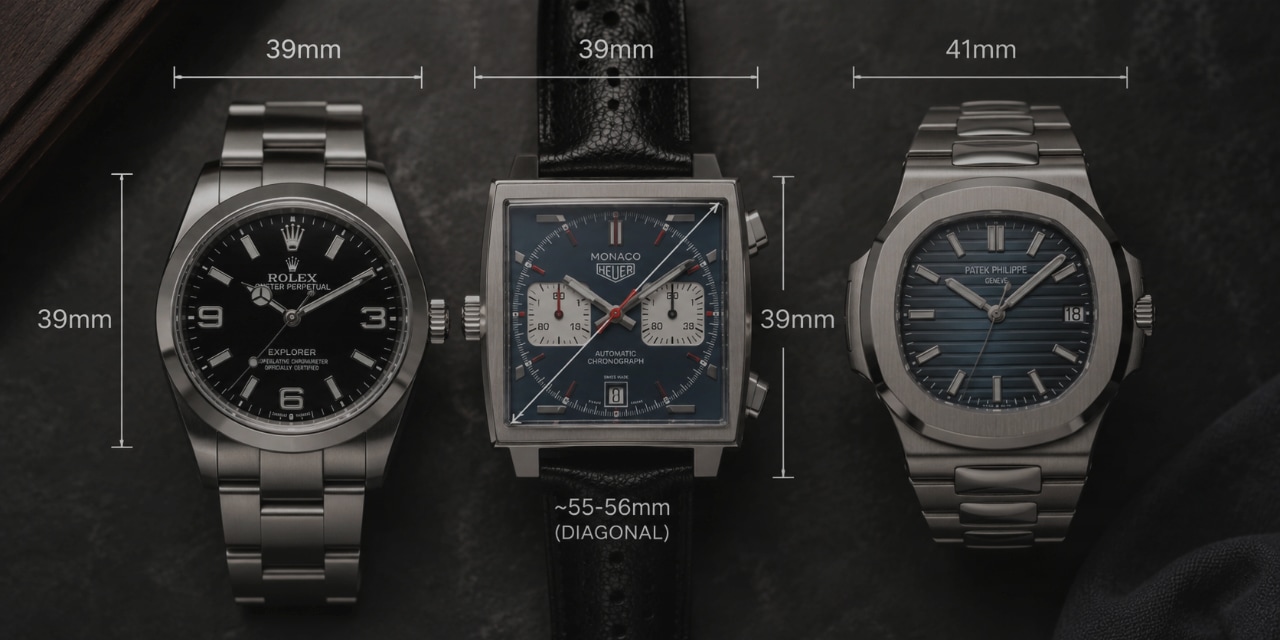
If you take my Rolex Explorer, which measures 39mm in diameter, and the square-cased TAG Heuer Monaco, also 39mm, you will find the TAG wears much larger than the Rolex. The reason is simple geometry. The round faced Explorer is measured across the widest part of the case, whereas the Monaco will measure 39mm across AND 39mm tall, so it occupies more visual area. On the diagonal, the TAG will be around 56mm while the Rolex is still 39mm, giving the Monaco far more presence on the wrist.
As a very general rule of thumb, a 39mm square watch will wear like a 40-42mm round watch, 40mm square will seem like 42-44mm round and a 42mm square watch will look and feel enormous.
Of course, that’s only half the story; you also need to think about the lugs. Taking the Monaco again as a good example, this year’s redesign has angled the lugs down more than the previous version, reducing some of that bulk and hugging the wrist better. As a result, it does wear very slightly smaller than before.
On the whole, shorter lugs will reduce the perceived size of any watch, so it is something to be aware of.
The Shoes Matter Too
Just about every component of a watch has some influence on the apparent dimensions. The bracelet is one such factor and often overlooked.
A model with an integrated bracelet, for instance, where the strap flows directly into the case, makes the watch appear as one continuous object. So a Patek Nautilus measuring 41mm can look as much as 1-2mm larger. That might not sound like much but in horology a difference of a millimeter or so is about as significant as 1/10th second is in Formula 1—it has a huge effect.
Similarly, a standard metal bracelet usually makes a watch look larger than if it was on a leather strap. A bracelet carries the visual mass of the case out across the wrist whereas a leather strap narrows immediately. Anyone who has swapped a Rolex Submariner’s Oyster for a strap will know the change often makes the watch feel smaller (and certainly lighter).
Some manufactures aim to get around the issue by tapering their metal bracelets. A band which starts at 20mm across the lugs that reduces to 16mm or 18mm at the clasp draws the eye inward. As a result, the watch feels and looks more elegant.
And, believe it or not, the color and finish of the bracelet or strap play their part too. Polished center links on a metal bracelet catch attention and increase visual presence, whereas a brushed finish is quieter and more stealthy. Likewise, a dark strap makes the watch head stand out more than a lighter one.
Put on a Happy Face
Dial design has a huge bearing on the perceived size of a watch. Essentially, the more dial you can see, the larger the model appears. So, a 40mm watch with a wide open dial and a thin bezel will seem bigger than a piece with the same dimensions but with a thick bezel.
As for colors, a light dial will generally look larger than a dark dial; the same optical illusion that makes light-colored objects seem bigger than dark ones.
And the amount of information on the dial makes a difference too. A clean minimalist face will look more expansive than one displaying things like chronographs or world timers or perpetual calendars.
Even the placement of the hour markers affects the visuals. Indexes near the outer edge of the dial make the whole thing seem larger than if they are clustered more towards the center.
So, How Do You Choose?
Having a range of ‘ideal’ sizes in mind (like my self-imposed 39-42mm) is a decent starting point when choosing your next watch. But it is important to keep an open mind for others outside that scope which might surprise you.
There’s also the matter of taste, of course. Some folks like their watches big. This was certainly the trend for the first part of this century, but these days you will find many brands are actually scaling back their models to reflect modern tastes.
If you want a good rule of thumb, measure your wrist.
Take a flexible tape measure (a piece of string or strip of paper work too) and wrap it around your wrist just above the bone. Ensure it’s snug but not tight. Read off the number (or mark where the string meets if using that method then measure that section).
The very best advice? Actually get your hands on the watch you want to buy and do a thorough check on its size. What you might find is that the model you’re after wears much larger or smaller than its numbers suggest, due to the factors we listed above. Getting it right has an enormous sway on your enjoyment of the watch—both in its looks and your overall comfort in wearing it.
Featured Photo: Mixed art by Oriol Mendivil for BKT Archive.