
 Sign In
 (817) 503-2334
 Contact Us





 By:
By:
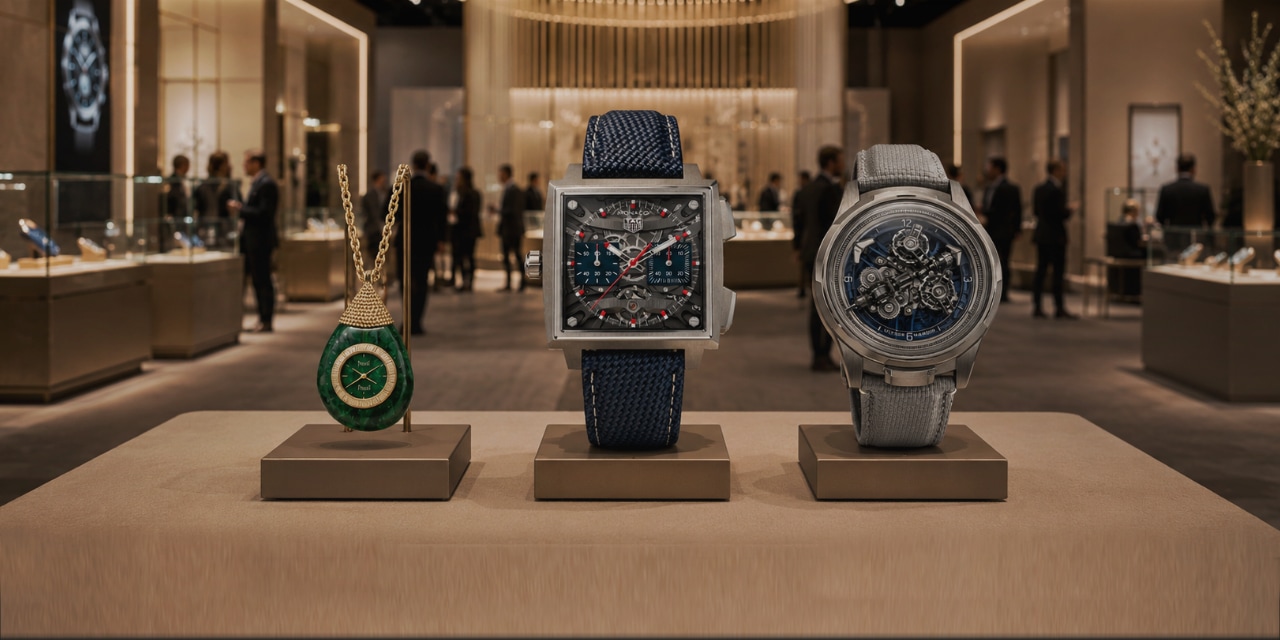
The Best Novelties From Watches & Wonders 2026
Much like with the car industry, if you want to know the direction a particular watch brand is set on taking, you have to look at its novelties.
Every year, the biggest and best of horology rock up to the various expos (Watches & Wonders being the most significant) with armfuls of new pieces to entice the public. But away from the more mainstream fare, there are usually one or two oddities packed in there as well. And while these sometimes fall into the fantasy category of ‘this is what we can do if budget restraints weren’t a thing’, if you look objectively past all the wonderment, you can see the future trends for that manufacture.
Below we have picked out three of the most interesting outliers from this year’s event.
The TAG Heuer Monaco Evergraph
The Evergraph presents two massive surprises for the price of one. Firstly, it gives an all-new take on the chronograph complication—something which has been around since 1816, so you would have thought all the innovations would have been taken care of by now. And secondly, this breakthrough, described in some quarters as a ‘quantum leap’ in chronograph technology, comes from TAG Heuer.
Now, that’s no disrespect to TAG. They are a fine brand, but they are one which sits in the snottily titled ‘attainable luxury’ bracket. For the true revolutions, we are used to looking to the more stratospheric end of the watchmaking spectrum.
But no, here we have TAG’s own in-house Calibre TH80-00, an automatic movement in possession of a 70-hour reserve and beating at 36,000vph and featuring what the manufacture calls a ‘compliant chronograph mechanism’.
Now, that sounds good already. If you’re going to have a chronograph mechanism, a compliant one is probably the one to go for. But what does it actually mean in context?
What TAG have done, essentially, is discard the plethora of springs and levers which control the start/stop and resetting of a traditional chronograph (the bits that are most in danger of wearing out) and replaced them with what are basically a pair of flexible leaf springs.
The start/stop spring is held flexing in one direction until activated by the 2 o’clock pusher. At that point, it snaps the other way to engage the chronograph gear train.
The reset is a little more involved, needing three of the leaf springs (still acting as a single component) which strike a set of internal heart cams to recenter the chrono hand.
Like all successful innovations, it is brilliantly simple and negates the most pressing problem with chronographs; the intense forces caused by the striking mechanism and friction to surrounding parts. TAG reportedly assessed the movement by simulating 10-years of use and found zero visible wear.
Best of all, it is housed inside the iconic Monaco square body, redesigned for this year with a wider, sportier look, the case now angling down to hug the wrist. The Evergraph comes in grade 5 titanium with an octagonal sapphire case back to let you peer in on that new chrono working. The bits you can’t see from the back are visible through the skeletonized dial up front.
As you might imagine, TAG are not giving this away. And while $25,000 for a TAG Heuer might sound excessive, how many times can you say you’re wearing a genuinely avant garde watch?
Ulysse Nardin Super Freak
It’s been 25-years since Ulysse Nardin launched their Freak collection. And it has long lived up to its name.
A complete break from convention, the first watches came with no crown, no hands and no dial. Instead, the movement acted as the minute hand, the entire caliber completing a full rotation every hour while a separate rotating disc indicated the hours. It was wonderfully inconvenient as well. To set the time you had to unlock and turn the bezel and to wind it you needed to (naturally) turn the caseback. It was also the first commercially available watch to use silicon escapement wheels meaning it had fearsome antimagnetic abilities, was highly resistant to wear and needed virtually no lubrication.
There are now 23 different variations in the collection including the newest entry; the celebratory 50-piece limited edition Super Freak.
The 44mm white gold piece is what Nardin are calling the most complex time-only watch ever made. The flying carousel movement, the Caliber UN-252, contains some 511 components including two 10°-inclined flying tourbillons, two silicon balance wheels and balance springs and two DIAMonSIL® escapements.
Here, the time is displayed by broad wing-shaped hour and minute hands which aren’t really hands at all but more protuberances stuck at the end of the movement carousel. The seconds are displayed by a rotating cylinder at the tip of the minute ‘hand’.
The winding mechanism, the unfortunately named ‘Grinder’ system, transfers energy to the caliber via four spring-loaded levers in as low impact a way as possible and precision is controlled by those twin tourbillons interfaced with a patented gimbal system.
All in all, this is a great example of those ‘money no object’ creations which only happen when horology’s nerdiest nerds are given free rein. And to prove it, the Super Freak is going to retail at $393,600 (sorry, only one per customer).
Piaget Swinging Pebbles
I’ve included the Piaget Swinging Pebbles not because they are somehow highly innovative or extraordinarily forward-thinking but because they may indicate a shift in how people wear watches in the near future.
Piaget launched their legendary 21st Century Collection back in 1969, consisting almost entirely of cuff watches and necklace watches. The long-chain pendant pieces became known as the Swinging Sautoirs (literally, ‘long necklace’).
Very much jewelry first and timepiece second, Piaget was one of the few brands capable of creating something like the Sautoirs due to their proficiency in making ultra-thin movements. Their revolutionary Caliber 9P, for example, came out in 1957 and measured just 2mm high.
So the Swinging Sautoirs came to represent all that was fashionable and countercultural about the ‘60s and ‘70s, found round the exalted necks of the likes of Salvador Dali, Andy Warhol and Sammy Davis Jr.
Cut to 2026 and we now have a modern version of this wearable art. The Piaget Swinging Pebbles take the concept a great leap forward; where we once had a watch face inserted into a necklace, here, in a choice of either Tiger’s Eye, Verdite or Pietersite, both the case and dial are carved completely from stone.
Inside the hollowed out pebbles lies an in-house quartz movement, the 355P, and each is suspended from a delicately twisted gold chain; the Verdite on rose gold, the Pietersite on white and the Tiger’s Eye on yellow.
So, why are these significant? Well, the other big news from W&W 2026 all focused on a collaboration between Swatch and Audemars Piguet. And what did that produce? The Royal Pop, a cheap, fun little timepiece also meant to either hang off a bag or be worn around the neck. Now, I’m not saying that the necklace watch is going to replace the wristwatch; of course not. But the fact there were two high profile examples of the type in one event does hint at a shifting fashion trend.
What do you think? Would you be interested in wearing a necklace watch? Let us know in the comments.
Feature Photo: Mixed art by Oriol Mendivil for BKT Archive.