
 Sign In
 (817) 503-2334
 Contact Us





 By:
Understanding the Rolex Sea-Dweller Part 1: Vintage
With the Sea-Dweller, Rolex’s uber-Submariner developed for those going far beyond the average recreational diver, we run up against the same issue as with the Explorer II when discussing the vintage versus modern versions—that issue being its relatively late inclusion in the portfolio leaving us just one vintage reference to talk about.
Introduced in its civilian guise in 1967, the original model had only a comparatively short run before Rolex started developing the all-important techniques and materials which experts use as the demarcation point between old and new.
However, while there may only be one ‘vintage’ Sea-Dweller, that watch is split into two very distinct forms; with correspondingly diverse levels of price and desirability.
Nevertheless, it remains one of the most interesting of all the Rolex sports watches; a definite, top down, form following function mainstay built for some of the most demanding professionals on or under the planet.
The Rolex Sea-Dweller Origins
The sport of Scuba diving stemmed from equipment and methods developed out of necessity during World War II, the first major conflict to utilize underwater combatants. As a pursuit, it progressed exponentially after the end of the hostilities, with one side effect being the explosion in popularity of the dive watch itself. In the days before such things became rarely submerged status symbols, a reliable underwater timer could be the literal difference between life and death. That prerequisite led to the production of, among many others, the legendary Submariner.
With a depth rating on some references of an astounding 200m, the Sub was all the watch most hobby divers would ever need. However, as with all things, the human compunction to go ever further soon led to the abilities of the Submariner being outstripped by the speed, or rather the depth, of progress.
The concept of saturation diving, a far more gritty and demanding world than that of the sport diver, came about at the end of the 1950s. Dealing with the likes of the oil and gas industry, subsea pipelines, underwater construction, etc., regular Scuba equipment was simply not up to the job. But when U.S. Navy physician George Bond demonstrated that crews could stay at high pressure and great depth long enough for their body tissues to become saturated with inert gases, it meant divers could make one long decompression stop at the end of a work period rather than having to decompress after every dive.
The first major practical demonstration of his theory happened in 1962 with the launch of SEALAB 1, with four aquanauts living and working in an underwater habitat off Bermuda at around 192ft for 11 days. SEALAB II the following year saw that extended to 30 days and 205ft.
On both of those expeditions, the dive crews wore Rolex Submariner ref. 5512s which, with a rating of some 660ft, were well within limits. However, the plans were already being drawn up for SEALAB III, the most ambitious project yet. The goal was to anchor the habitat at 450ft, with the divers working down to a depth of 600ft for as long as 60 days. That was considered too close to the Sub’s stated abilities and so Rolex was brought in to come up with something with a bit of added oomph.
The Single Reds
What Rolex came up with, essentially, was a Sub fresh from the gym. It was good fortune for the brand that the Submariner had been such a success, because at the same time as the saturation diving community was collaborating with them for a new watch, they were also in cahoots with Omega for the same reason. And Rolex was still smarting from being shut out of the space race by Omega when the Speedmaster became NASA’s go-to.
But, where Omega had to set about designing an entirely new watch to meet the demands of diving companies like the emerging COMEX, eventually settling on the bizarre PloProf, Rolex did not have to go to quite the same reinventing-the-wheel levels of invention.
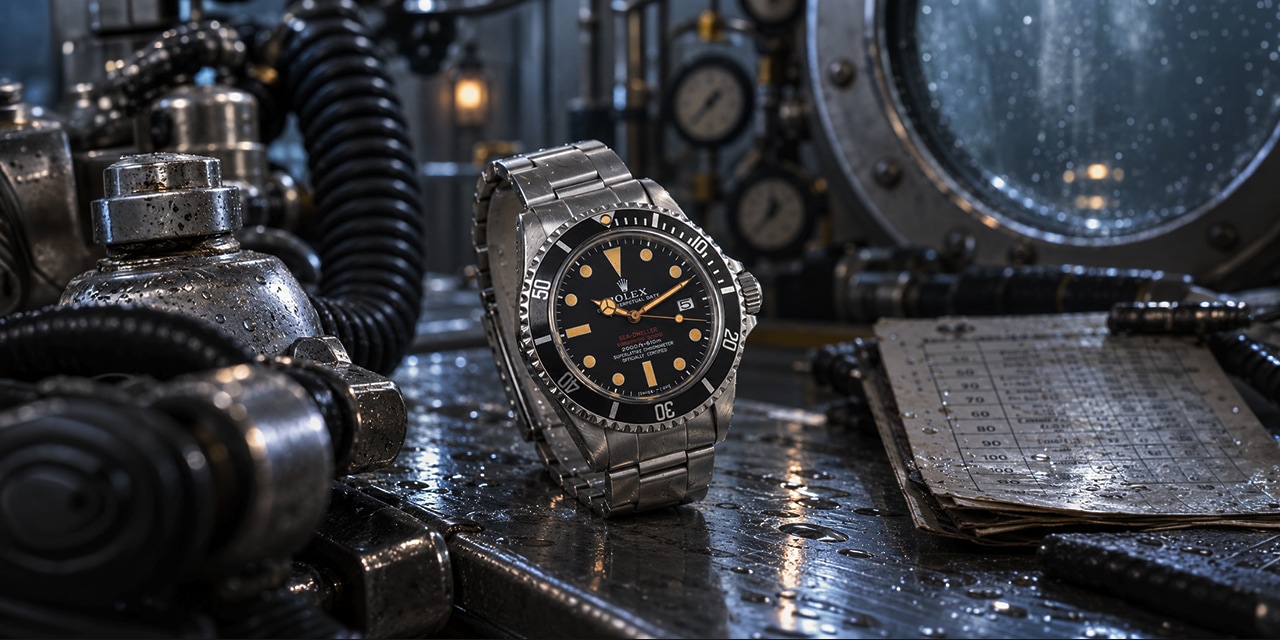
Between April and June 1967, Rolex made around 40 examples of their ref. 1665, a watch they dubbed the Sea-Dweller. Looking at first glance exactly like the Submariners of the era (the ref. 5512 and ref. 5513), it was, on closer inspection, significantly heavier and thicker. Its crystal, still acrylic at the time, was also extremely thick and domed to displace the enormous pressures pushing down on it. And it had a date function, something the Sub would not inherit until 1969 but considered a necessity for saturation divers who might spend weeks underwater.
Up front, the standard black dial with contrasting details differed too. Under its one line of red text, ‘SEA-DWELLER’, leading to its ‘single red’ nickname, came the unusual ‘500m-1650ft’ depth rating.
Made specifically for SEALAB III, this first batch of watches were delivered to the project’s Aquanauts. But there was one omission from most of them which was to become extremely important.
The Helium Escape Valve
The problem of exploding watches had been known since 1962 and the SEALAB 1 mission.
The key to saturation diving lies in the breathing gases used by the divers. At great depths and enormous pressures, regular air becomes deadly due to the partial pressures, with pure oxygen toxic beyond 0.5 ATA. As a result, crews living and working in the underwater habitats breathed helium-rich gas, with as much as 95% helium and just 5% oxygen.
That was not the issue. The problem was in the size of the helium molecules. Among the smallest of any, helium molecules could easily slip inside even Rolex’s watertight Oyster cases. At depth and contained by the ambient pressure, this did not present any difficulty. It was only when ascending, with the pressure lessening and the molecules expanding, that it became troublesome. With no way to escape the case, the swelling bubbles had only one way out—blowing the crystal off the watch, often with extreme force.
Interestingly, Omega was also aware of the problem and decided to take the brute force approach. The PloProf was built from one solid block of steel, so impermeable the helium could not get in in the first place, but with the downside of the watch being on the verge of unwearable by anyone not saturation diving for a living.
Rolex, on the other hand, buoyed by the success of the Submariner and the brand’s growing reputation as the purveyor of aspirational lifestyles, believed there would be a commercial market for a watch that outdid even its own diving legend. In order to make the Sea-Dweller both fit for purpose and attractive to those with no intention of using it for that purpose, they needed something with a bit more élan.
Enter André Zibach. Formerly of Patek Philippe, Zibach was the man who came up with the idea of the Helium Escape Valve, or HEV. As with many of Rolex’s most important innovations, the key to the HEV lay in its simplicity. A one-way valve set into the side of the case at the 9 o’clock, external pressure pushed the valve stem against its gasket, creating a waterproof seal. But when the expanding helium inside pushed out, the valve opened and allowed it to escape before it could do any damage.
Rolex patented the HEV on November 6th of 1967, after the first batch of Sea-Dwellers had gone out for field testing, but did retrofit a number of Submariner ref. 5513s with them and distributed them to professional saturation divers to trial. After reports came back positive, the Sea-Dweller had its solution.
The Double Red
Although the Sea-Dweller existed in its final form in 1967, it was available only to a select few; mainly pro divers and dealers. The first production models for general consumption did not emerge until 1971.
They kept the same reference number, the ref. 1665, but thanks to a second line in red—‘SUBMARINER 2000’—below the Sea-Dweller name, these marketable examples became known as the Double Red Sea-Dwellers, or DRSD for short.
The look was familiar, down to the dot and baton indexes and Mercedes hands, but the beefed up body, the HEV and that ‘2000’ script told their own story. Here was a watch for the toughest of jobs, safe to 610m (2,000ft) and with a case back proudly exclaiming ‘ROLEX PATENT OYSTER GAS ESCAPE VALVE’, a rarity for Rolex which, as a rule, tends to avoid any sort of engraving.
The handsome face and formidable talents made it a fairly successful release; not in the same league as the Sub by any means (which could be said about every other dive watch of the era, and even now) but at a time when the Sub was getting rapidly gentrified with gold versions and diamond accents, the DRSD appealed to the avowed purist.
The original Sea-Dweller went on until 1977, going through five different main dial marks and a further three service dials, all of which now add or subtract huge sums of money on the preowned and vintage market.
It was followed up with, in essence, the exact same watch but with slightly different text colors. The Double Red was replaced with the Great White in ’77, losing the ‘SUBMARINER 2000’ script and picking out the ‘SEA-DWELLER’ name in white instead of red. All else was identical, including the movement. The Cal. 1575 came from Rolex’s massively popular 1500 series, a time-and-date workhorse beating at 19,800vph and offering a 42-hour reserve. A certified chronometer, as have been all of the Sea-Dweller’s engines, the one thing it did lack was a Quickset function. That meant spinning the hands eternally to change the date.
The Great White was the last Sea-Dweller to wear an acrylic crystal and was still in production up until 1983. However, the first of the modern examples ran alongside it from its introduction in 1978. A major leap forward in many respects, we’ll cover the first of the five digit references and everything which came after in our next article.
Featured Photo: Mixed art by Oriol Mendivil for BKT Archive.