
 Sign In
 (817) 503-2334
 Contact Us





 By:
By:
The Best Vintage Rolex Watches for $5,000 and Under
If you’re a regular to our little corner of the internet, chances are you’re already someone with both a great interest and a substantial amount of knowledge, in luxury watches in general and Rolex in particular. As such, I feel there’s not as much call to point out the benefits and appeal of the brand’s vintage models to you than if this were a less focused website. You already know.
I mean, we could talk about their uniqueness, mechanical elegance, their historic significance. There’s their relative scarcity making them inherently more valuable, their potential investment strength, the possibility of finding that elusive undervalued treasure, the fact they don’t look like everyone else’s Rolex, their fascinating imperfections or the fact that they’ve lived a life written in their faded bezels or their spiderwebbed dials or their yellowed luminescence. It’s all old news to you.
Let’s simply state the one irrefutable fact and be done with it: vintage Rolex watches are just cool as hell.
One thing we possibly can help with, however, is narrowing down the vast universe of choice out there into what we feel are the best targets to aim for at a variety of price points. Therefore, welcome to the first in a new series of articles where we do precisely that.
What Can You Realistically Get for Just $5K?
Currently, the least expensive model in the Rolex line-up comes from the Oyster Perpetual line. Traditionally the entry level offering from the marque, prices start at $6,200 for the 28mm piece and go up from there. That means you cannot get a contemporary Rolex of any description for our $5K and under budget. Doesn’t matter. We’re not interested in the box fresh examples right now, we’re looking for something with a bit of built-in character and the good news is, there’s masses of them available in our price range. In fact, there may not have been a better time to spend light on a vintage watch in decades. Why? In one word; size.
Present tastes are very much harking back to retro dimensions. After years of chasing the record for who could make the largest watch, trends have reversed, with 36mm and even smaller now decidedly en vogue.
It’s the reason Rolex and others have been scaling back their offerings recently, most notably binning the 39mm Explorer in favor of a return to its roots.
Back in the day, of course, watches were just smaller by default and so there’s now a wealth of options just waiting to be snapped up.
What To Watch Out For
Any article about buying a Rolex, whether vintage or brand new, which doesn’t mention the trap of buying a counterfeit is not worth the bandwidth. We all know it is a huge problem and a massive business worth, by some estimates, in the region of $2 billion a year—with 20%-30% of that reportedly being Rolex’s share.
But, there’s some cautiously good news here for models in the $5K and below bracket.
Making fake watches still involves a significant amount of work and expenditure. Anyone putting in that much effort and money wants to earn a good return, which is why they tend to stick with the higher end pieces. Those vintage models in the $5,000 range will generally be seen as not worth the trouble, and so there is more chance of the example you buy being genuine.
*That does not mean, of course, due diligence can just be tossed out the window. Research is still definitely advised and crucial, in both watch and seller.
Depending on just how vintage the watch you have your heart set on is, be aware that, as with older cars and older houses, you are likely going to have to take extra care with them. More frequent servicing is a must and you should factor that in to your budget. Most vitally, seals break down over time and compromise an Oyster case’s famed waterproofness. As a rule, it might be best to avoid taking a particularly old model into the water at all, especially the non-dive examples.
Also be aware those Rolex watches made before the end of the ‘70s will not have solid link bracelets. This is not automatically a bad thing and many collectors favor the older style for their charm and trademark ‘rattly’ feel. But it is something to be aware of if you’re used to the modern day solidity and heaviness. You will definitely feel the difference.
We’ll go into a few more things to be on the lookout for throughout this series of posts, but for now, let’s explore what $5K will buy you in vintage Rolex.
The Rolex Datejust ref. 1601
We’ll kick off with an absolute beauty.
The Datejust is Rolex’s longest uninterrupted running offering, coming into being in 1945 to commemorate the company’s 40th year in operation and heading up their bestseller list almost ever since.
The reason is simple; adaptability. When it first arrived, the Datejust was a revolution. The first automatically winding, waterproof wristwatch with an instantly changing date display, it catapulted the young company into the biggest of big leagues overnight.
As time went on, with its talents seeming less awe-inspiring as they were copied by others, it got around that by offering a simply bewildering amount of personalization. An apparently endless array of different size, dial, bezel, metal and bracelet combinations means whatever your particular tastes, there is a Datejust tailor made just for you.
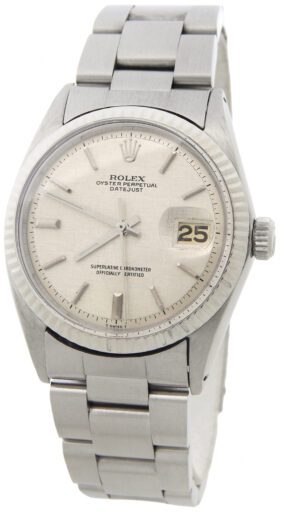
The 36mm stainless steel ref. 1601 stems from 1959 and marks, in many ways, the start of the watch’s finished look. This is where things got standardized after a decade and a half of finetuning, and here Rolex hit on the perfect case shape, bezel styles and handset design.
But there are still plenty of wonderful vintage touches. The dials are pie-pan, with the outer edges leading down and giving the whole thing some dimension. The lines are more svelte and the lugs noticeably thinner than later generations, with the simple elegance of another era.
Inside, pre-1965 models ran on the Cal. 1565 beating at 18,000vph. After that, the Cal. 1575 took over, upping the frequency to 19,800vph and a smoother seconds hand. Rolex also introduced a hacking function in 1972 but neither movement had a Quickset and so changing the date involves some crown spinning.
There are, as you’d expect, a plethora of dial colors and types to choose from, but a personal favorite are the silver faced pieces, matching perfectly with the steel body and giving an understated but still unmistakably cool aura.
You can find ref. 1601s for under $5K, on either a leather strap or even the five-link Jubilee bracelet brought in expressly for the watch’s debut. One of the real vintage Rolex bargains, this is all the watch you could ever need.
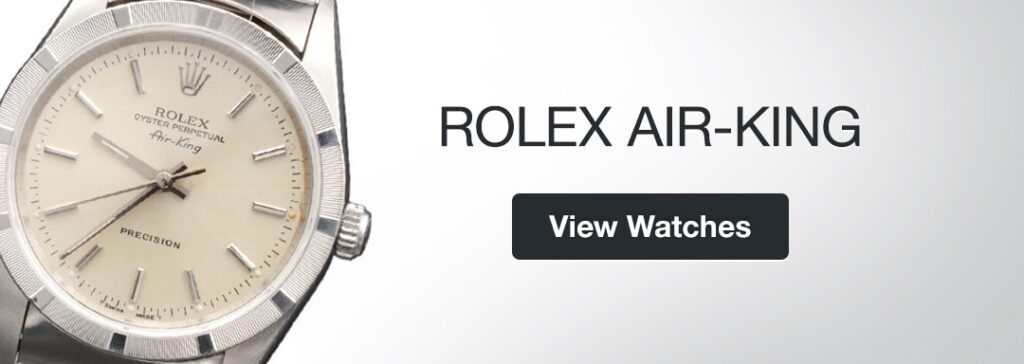
The Rolex Air-King ref. 5500
Born the same year as the Datejust, with almost as long a production run (sat out 2014-2016 for a well-earned rest), but nothing like the same recognition factor, the Air-King has always lived its life in the shadows. Today, however, its appeal is enjoying a resurgence, and the once-dubbed Warrior’s Watch is seen as something of a cult hero.
It was created in 1945 as a commemoration piece for the heroics of the British RAF and their triumph over the Luftwaffe during the Battle of Britain. An extremely simple, time-only model, the Air-King did not even get its first self-winding movement until 1953, long after the rest of the range went automatic.
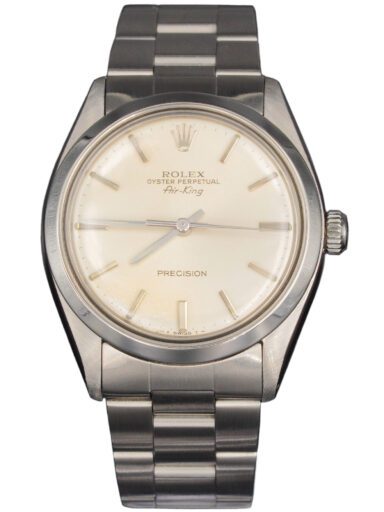
That level of overlooked, second tier status is summed up neatly by the ref. 5500. Brought in in 1957, the reference would not be superseded until as late as 1989—a 32-year run with very little upgrading taking place.
This is, for many people, the archetypal anti-Rolex. There’s nary a bell nor a single whistle involved. The case is a very modest 34mm, the choice in metals is one—steel, the bezel is smooth and domed, hands and indexes are simple sticks and batons and the movements (either the Cal. 1520 or Cal. 1530) don’t have a chronometer certificate among them. Everything about the watch seems designed to keep costs down and the dial choices are limited to the bare minimum; black, silver, blue, white and grey.
But there is so much charisma wrapped up in this diminutive package it’s hard not to fall for it. Some watches scream for attention, this one whispers. It might actually be the ideal watch for the present era. Humble, unassertive, classy without trying. And an absolute bargain to boot.
The Rolex Prince ref.1879
We mentioned this was vintage Rolex, right?
Before the Oyster case and before the Perpetual movement, the Rolex Prince range was one of the brand’s most important developments. The rectangular, Art Deco-soaked style was an experiment in making a true high precision timepiece, powered by a purpose-built Aegler movement designed specifically to fit in the unorthodoxly shaped case.
With the barrel and the balance at opposite ends, the setup allowed for a larger balance wheel that improved timekeeping and a correspondingly larger mainspring for a longer running time.
Up front, the so-called ‘Doctor’s Watch’ layout divided the dial in two, the upper section displaying the hours and minutes and the lower portion given over to a comparatively huge running seconds sub dial. With it, doctors could more easily count a patient’s pulse or respiration rate and so the designation stuck.
The ref. 1879 is actually one of the lesser known and documented examples of the Prince line with, understandably, the near-century ago timeline muddying the waters somewhat. It is believed to have originated around 1928 and been made up until the 1940s. Typically it measured 20mm x 30-35mm and came in steel or gold, either 9 or 14k.
That ingenuous rectangular movement was a manually wound engine and could be supplied as either chronometer or non-chronometer adjusted. It played its part in establishing Rolex’s reputation as the makers of not just extremely sophisticated but also highly accurate timepieces. At a time when all the headlines were focused on the robustness of their waterproof models, it reminded the public that the manufacture really did have all the bases covered.
Incredibly, some of the steel examples of the ref. 1879 fall within our budget. That’s despite their age, historical significance and genuine rarity. Unlike now, Rolex could just not make such finely tuned models quickly or in large quantities and so the supply on the preowned market today is sparse. However, look around and you’ll find the occasional piece for sale and be bowled over by its century-old magnetism.
Featured Photo: Mixed art by Oriol Mendivil for BKT Archive.