
 Sign In
 (817) 503-2334
 Contact Us





 By:
The Best Vintage Rolex Watches for $10,000 and Under
We opened our account on the ‘best vintage Rolex you can buy for various budgets’ series last time out with a $5K ceiling. For that we found we could easily secure some fascinating if underappreciated models, with the likes of the cult hero Air-King or the quirky doctor’s watch, the Prince.
This time out we’re doubling our allowance and seeing what $10,000 might get for us. And I’ve gotta say, the news is good.
For that kind of money, we move onto the pieces even non-watch folk (if you’re unlucky enough to know any of those) will recognize. Here we find the names which put Rolex on the map in the first place, illustrious models which conquered the deep, the untamed wilderness and even the boardroom.
One caveat however; while $10K will certainly get you an example of some of these icons, it won’t necessarily be one of the very special or particularly scarce versions. By that I mean a variant hardcore collectors lust over, with a rare font anomaly or attractively faded bezel or a short lived dial Mark. What you will get, on the other hand, is an elite level timepiece from the world’s leading luxury watchmaker which will last you several lifetimes.
Sounds like a good deal to me. Let’s dive in.
The Rolex Explorer II ref. 16570
There are many things in life I just don’t understand, and the third generation of Rolex’s wonderful spelunker’s watch remaining so consistently affordable is one of them.

There was a time, up until quite recently actually, that the Explorer II floundered in that group of unfashionable Rolexes. Today, it has become a genuine target.
The original ref. 1655 emerged in 1971 and did nothing but confuse a lot of people. It had a bezel engraved with a 24-hour scale and an additional hand like the GMT-Master. But the bezel did not rotate and the two hour hands were mechanically linked, so the watch couldn’t be used to track a second time zone. Instead, it was little more than a fancy day/night indicator aimed at the ultra-niche demographic of cave divers. With Rolex presumably envisioning the watch spending the majority of its life in pitch darkness, they absolutely swamped the dial in luminescent paint, leading to its early nickname of the Disco Ball. But that led to it being just too busy-looking for most and the second iteration scaled it all back. The ref. 16550 adopted the more standardized Rolex tool watch approach, with simple dot and baton indexes, and the extra hour hand was lifted directly from the GMT. The rather uninspiring thin pencil style topped with a small triangle replaced the so-called Freccione of the debut reference, a thick, bright orange hand which had been practically the only element the public actually liked.
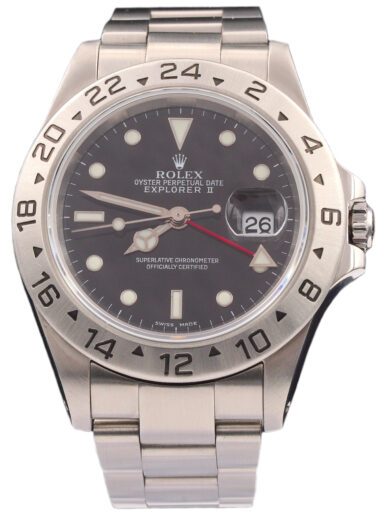
Despite the ref. 16550 transforming into a true dual time zone watch thanks to its new Cal. 3085 caliber allowing the two hour hands to be set independently, it turned out to be a short-lived transitional reference. The movement was quickly superseded by the improved Cal. 3185 which was fitted into the third generation model from 1989, the ref. 16570.
40mm, stainless steel and built like a brick outhouse, the ref. 16570—as has remained the same throughout the Explorer II’s life—is a tool watch in the truest sense. Unlike other members of the Rolex Professional Collection, which have softened over time to include precious metal versions and fancy bejeweled offshoots, this is a model which fully understands the mission and our sub-10K example is arguably the best all-rounder.
Even its options list is decidedly no-nonsense. There’s two dials to choose from, black or white. The choice in metals is even easier. And because it stayed in production all the way up to 2011, there’s plenty out there. These days you can pick one up for a long way south of our self-imposed budget and it’s hard to argue that you shouldn’t.
The ref. 16570 is a ruggedly handsome, effortlessly cool offering, sort of the Tom Hardy of watches, if you will. But significantly cheaper.
The Rolex Submariner ref. 14060
The world had to wait an awful long time for the Submariner ref. 14060.
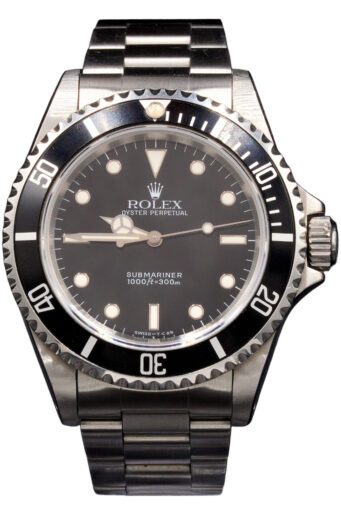
Launched in 1989, it was the successor to the now-legendary ref. 5513 which came into being all the way back in 1962.
That reference was the non-chronometer—and therefore cheaper—companion piece to the ref. 5512 released a couple of years prior, the first Sub to grow to 40mm and include crown guards. In many ways, it was the blueprint the watch has stuck to ever since, the one which nailed down all the salient details after a decade of finetuning.
So the ref. 5513 really took the watch right through its vintage period, with the ref. 14060 being described more often than not these days as neo-vintage. What does that mean? In this case, it means there are equal helpings of old and new elements embedded within it. It was, for example, the first no-date Sub cast in 904L steel, the first with a sapphire crystal, the first to have a unidirectional bezel and the first to tick at 28,800vph. Conversely, it was also the last example with an aluminum bezel insert, the last to have lugholes and the last to go without an engraved rehaut—all factors we now consider modern.
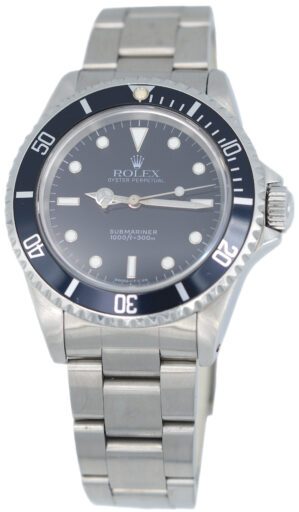
Visually, however, things really carried on as usual for the simple reason there was no tangible way to improve on them. The Submariner remains, even after all this time, arguably one of the most successful instances of industrial design ever created, up there with the likes of the Porsche 911 or the Lego brick. It arrived, spent a few years getting honed and refined and finessed and was then left alone. While it may be several decades since the last one was purchased for its original purpose, it is still the ultimate form following function dive watch; it’s just that the form happens to be perfect.
The ref. 14060 was only made for 10-years before its Cal. 3000 movement was upgraded to the Cal. 3130 and the watch was redesignated the ref. 14060M (for Modified). That engine brought in a full balance bridge and laser welded balance cock but, regardless, the Cal. 3000 was still a fine engine.
The watch itself is often described as the last of the best. Purists decry the direction the date versions have strayed from their roots, with different golds in their cases and their variety of color schemes. The no-date models have only ever been made in steel and only ever with the same black and white livery. Moreover, that lack of a date display and cyclops leaves the watch with impeccable balance, and its non-chronometer status, meaning no need for the additional ‘Superlative Chronometer Officially Certified’ text, makes the dial less cluttered and far cleaner.
The ref. 14060 is the gateway into Rolex Submariner ownership, and a beautifully judged one at that. It is not often you find something which cannot be improved upon, and if you were looking for the ultimate icon within our $10K budget, you’ve just found it.
The Rolex Day-Date ref. 1803
One of the biggest surprises with vintage Rolex is how much Day-Date you can get for your money.
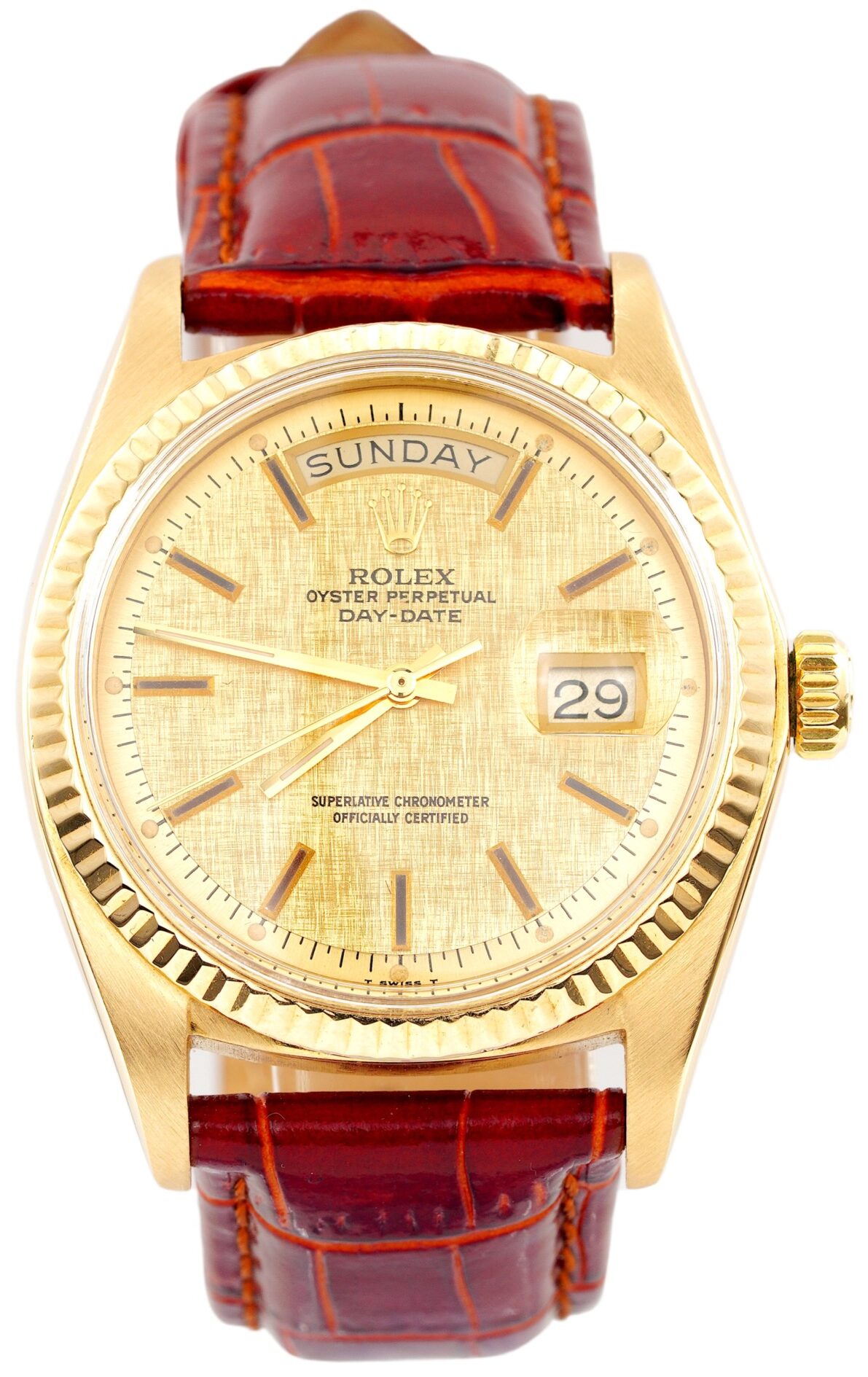
Let’s not forget, this is the brand’s flagship, the absolute top of the pile creation and a watch which has graced the wrists of more captains of industry, leaders in just about every field of endeavor and bona fide commanders in chief than any other.
In our $5K article we covered the ref. 1601 Datejust. The ref. 1803 is the President equivalent except, true to form, here the stainless steel is swapped for solid yellow gold (there’s never been a steel Day-Date; not one sold to the public, anyway).
As with the classic Datejust, the ref. 1803 generation of the President was where the details got locked in. Debuting in 1959, this third iteration ran for nearly 20-years, hugely increasing the number and variety of different dials available but retaining a whole raft of vintage quirks that make it a charming piece to own.
Those dials, for example, are all pie-pan style, their outer edges sloped downwards in a way Rolex sadly just doesn’t do anymore. The crystal is high domed acrylic, immediately identifying the watch as a period piece. The lugs are slimmer than on today’s models but they do not have lugholes, despite the era.
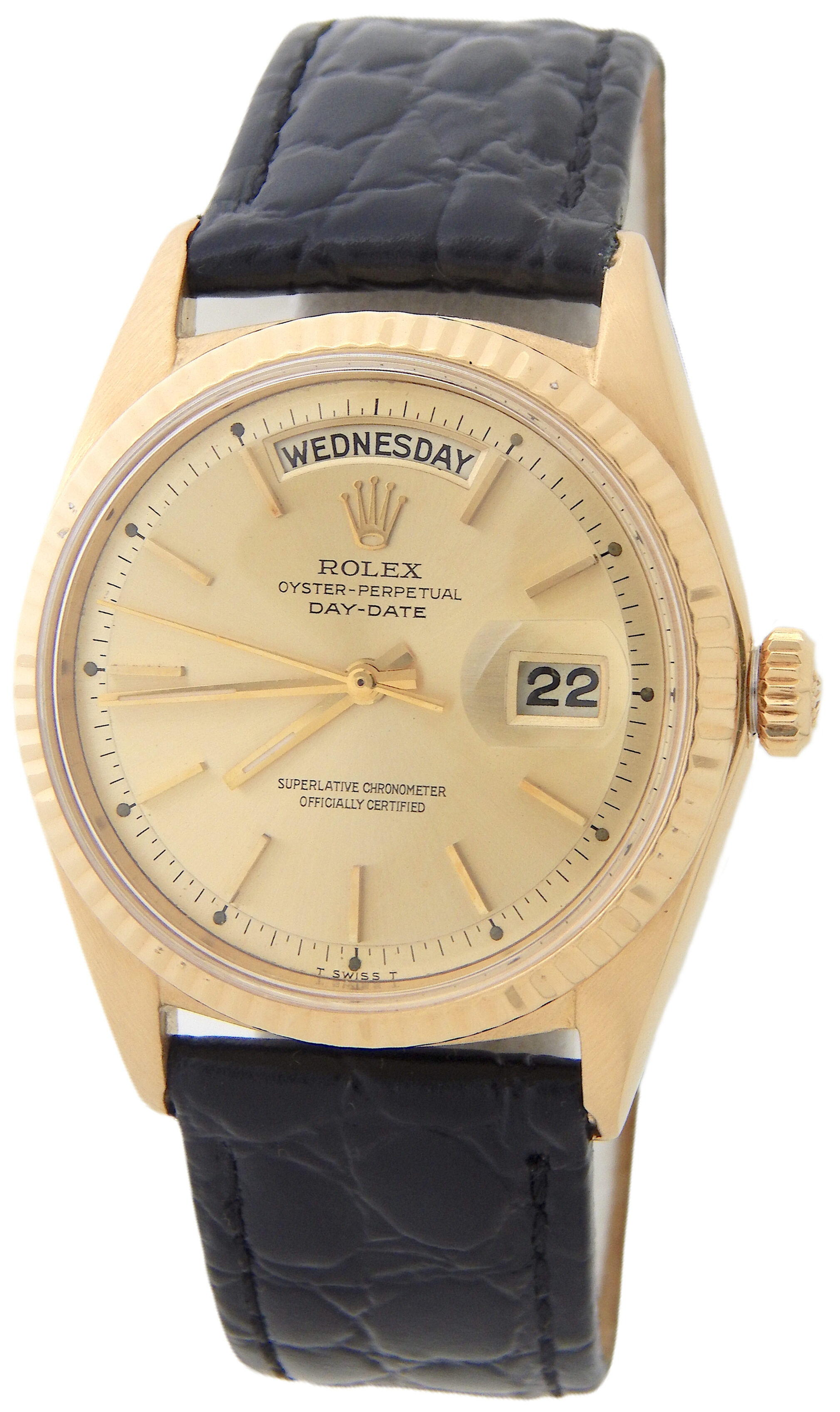
But its party piece is the key, the first self-winding, waterproof wristwatch ever made to display both the date and the day of the week spelled out in full. The ref. 1803 was powered by two different movements during its life. Starting off with the Cal. 1555, it switched to the Cal. 1556 in the mid-‘60s which, along with a handful of other improvements, upped the balance frequency from 18,000vph to 19,800vph. You might notice the seconds hand gliding a little smoother on the later models. One thing neither caliber had, however, was a Quickset, for either the date or day. That means it takes some work to adjust either but that interaction with the watch is something collectors love.
For our $10K, you might struggle to find an example on the President’s eponymous bracelet, the beautiful three semicircular-linked halfway house between the Oyster and Jubilee. Complete with its unique Crownclasp, the President bracelet gives the impression of a single unbroken band. However, it has always been an expensive addition and so for our budget you will have to settle for a leather strap. That lends an overall more casual, almost sporty countenance which is no bad thing, giving the watch a deal more versatility.
It is also a small concession for wearing one of the most accomplished watches from any manufacture. There is very little out there which compares with a Rolex Day-Date and the ref. 1803 is a fine example which sits within relatively easy reach. A true bargain in a business which doesn’t offer all that many.
Featured Photo: Mixed art by Oriol Mendivil for BKT Archive.