
 Sign In
 (817) 503-2334
 Contact Us





 By:
The Best Vintage Rolex Watches for $15,000 and Under
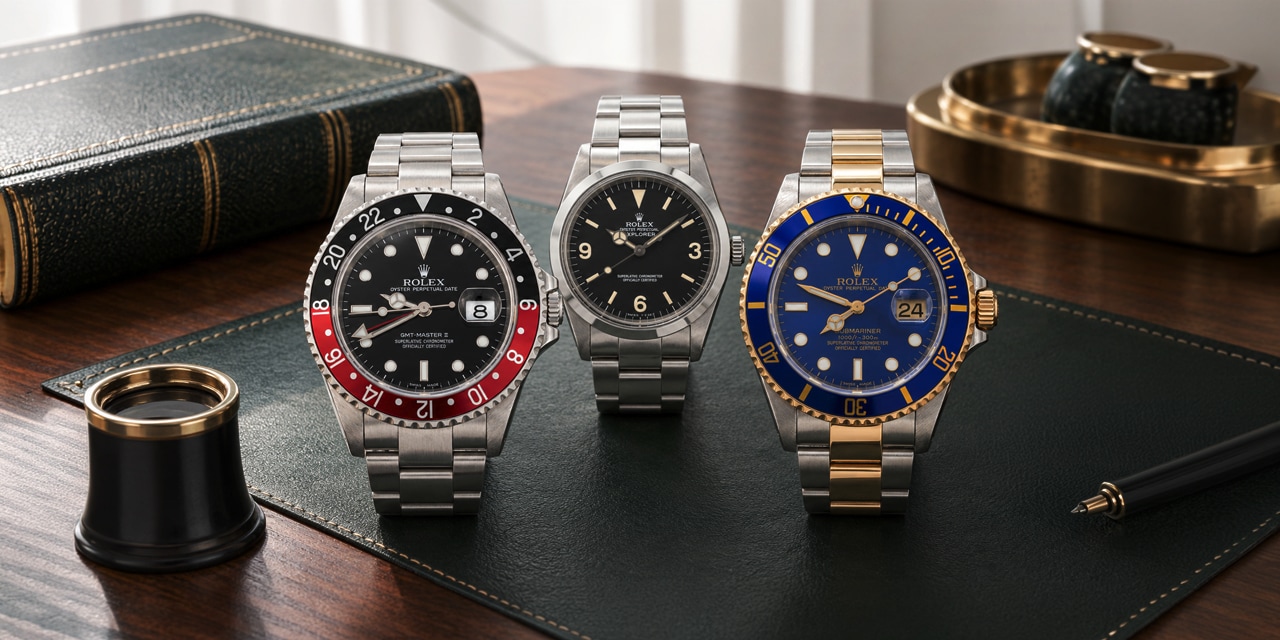
When you start expanding your Rolex buying budget to around the $15K mark, deciding to go vintage is a conscious choice. By that I mean, it’s the sort of money which gains entry into the brand’s current collection; you could easily afford, theoretically at least, a brand new steel Submariner Date or GMT-Master II, an Explorer 40 or a Rolesium Yacht-Master, or even a his and hers duo from the Oyster Perpetual line.
You are no longer constrained by price to the preowned market, as has been the case with earlier installments of this series when we looked at what, for instance, $5K would get you.
So, why would you forego the box fresh option in favor of a watch with a bunch of previous owners and some miles on the clock?
One word: character. And history. And collectability. And rarity. And individualism. And the cool factor. And potential investment value. And I’ve lost count of how many words that is. But you get my point. Increasingly, a vintage Rolex is a one-off. The older models wear their aging on their sleeves—a touch of creamy patina, a bleaching of the bezel, a fading of the dial. No two mature in the same way, leaving you with a unique specimen as opposed to the newer equivalents where Rolex has gone out of their way to ensure they stay looking the same for eternity, with lossless Cerachrom inserts and corrosion-resistant gold on the indexes.
Vintage Rolexes have stories to tell, and are waiting for you to add your own chapter. So let’s find some beauties.
The Rolex GMT-Master II ref. 16710 Coke
I missed this reason out in my list of vintage advantages above, so I’ll mention it now. Sometimes the best incentive for buying an older Rolex is because it is the only way to get a version of a watch they simply don’t make anymore.
The GMT-Master II really needs no introduction, so let’s introduce it. Born out of necessity in 1954 to help airline pilots and their passengers stave off the worst effects of jetlag, the GMT’s party piece was a brilliantly simple method of displaying two time zones simultaneously; the wearer’s ‘home’ time and that at their eventual destination. In doing so, tests had proven the body and mind were better able to regulate themselves against the debilitating condition.
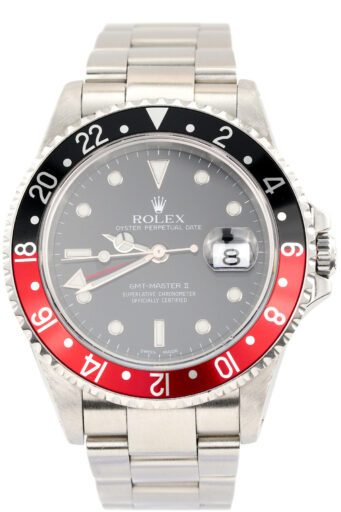
A combination of an extra hour hand and a rotating bezel marked with a 24-hour scale took care of the mechanics but the watch’s biggest selling point was always its selection of twin-tone surrounds which quickly picked up a variety of nicknames.
The most famous will always be the inaugural blue and red, dubbed the Pepsi by fans. Others followed, such as the brown and gold Root Beer and, more recently, the likes of the blue and black Batman, black and grey Bruce Wayne and green and black Sprite.
But arguably the second most beloved is one we haven’t seen since the demise of our subject here. Released in 1989 and retired in 2007, the ref. 16710 was the final appearance of the black and red Coke bezel.
The ref. 16710 was actually only the second iteration of the GMT-Master II. The original GMT-Master series was limited by a movement which did not allow its pair of hour hands to be set independently of one another. It meant the bezel always had to be turned to meet up with the GMT hand to display the second time zone. The sequel, the GMT-Master II, fixed that, starting in 1983 with the ref. 16760. Also known as the Fat Lady, the ref. 16760 contained the new Cal. 3085 which delinked the hour hands so they could be set individually. Not only did that mean it was no longer necessary to rotate the bezel, it also meant that, if you did, the watch could now track three time zones.
But the movement was a bulky affair, leading to a correspondingly thicker case (hence the nickname) and so the reference was discontinued after five short years to make way for the ref. 16710 (no, I don’t know why the reference number went backwards).
This returned to the GMT’s usual proportions, thanks to the upgraded and slimline Cal. 3185, and was available with either a Pepsi, all-black or Coke bezel.
Staying in production for nearly 20-years led to some variation over its lifetime. The tritium lume was swapped for Luminova in 1998, then swapped again for Super Luminova the following year. Solid end links (SEL) were brought in for the Jubilee or Oyster bracelets (it was offered on both) in 2000, and the lug holes disappeared in 2003.
Those seemingly minor differences add up to a wide spectrum of prices on the preowned market, but our $15K will secure us a beautiful late ‘90s example with no trouble at all.
Every April, we enthusiasts hope Rolex are going to announce a return of the Coke bezel, but so far they’ve avoided it. Fortunately, there are still plenty of ref. 16710s around, and it remains a wonderfully versatile and genuinely useful luxury sports watch.
The Rolex Submariner ref. 16613 Bluesy
With 15 grand to play with for your vintage Rolex, you’ll find you’re no longer confined to just fully stainless steel models. For that kind of money, you can start adding some gleam.

When Rolex released their Submariner in 18K yellow gold for the first time in 1969, it confirmed what many had actually known for several years; the world’s favorite dive watch had graduated far beyond its tool watch origins and was now a bona fide status symbol. And while that dismayed as many as it delighted, it has stayed the same ever since. Yes, it may well be more than qualified for the job of underwater companion, but it is first and foremost a showpiece.
But if the steel watch is notionally the workhorse, and the full gold model is for showing off, what about the halfway point? Bizarrely, we didn’t get the first two-tone Rolesor Submariner until as recently as 1988, and it came in the form of the wonderful ref. 16613.
This was the beginning of the fabled five-digit Sub era, arriving at a time when the Swiss watch industry was just recuperating and licking its wounds following the drubbing of the Quartz Crisis. And while Rolex weathered the storm better than most, they had been forced to change tack dramatically to do so. Once they saw the writing on the wall and acknowledged even their own mechanical prowess was no match for quartz technology on terms of accuracy and particularly price, they pivoted and repositioned themselves as the ultimate luxury lifestyle brand.
That entailed offering more and charging more for it, and gave rise to formerly tough, utilitarian sports watches growing shinier and more opulent, with gemstones and precious metals aplenty.
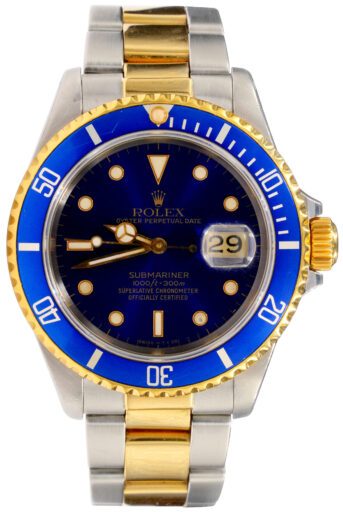
The ref. 16613 is from the generation often dubbed the ‘last of the best’, and is the perfect meeting point between old and new. The bezels are pre-Cerachrom and the cases pre-Maxi. Early models in the 21-year run still used tritium and the lugs still had holes. But all wore sapphire crystals and all ran on the Cal. 3135, still considered one of the most accomplished time-and-date movements ever made, even today. What’s more, the steel components were forged from thoroughly modern 904L and the indexes came surrounded with yellow gold to prevent tarnishing.
There were some options offered too. The standard black dial and bezel is what many have described as understated luxury, although any version of the most famous watch ever made can hardly be called understated. It was, however, more discreet than the Serti dials. These, available in either slate, champagne or silver, switched out the standard hour markers for factory-set jewels, typically eight round-cut diamonds and three baguette-cut sapphires at the cardinal points.
But possibly the most favored is the Bluesy. These, holders of the least imaginative Rolex nickname of all time, featured a blue aluminum bezel insert and a blue sunburst finished dial which changes color in different lighting. It has remained probably the most popular non-steel variant of the Submariner since it was introduced and still in its current guise is a heavily sought out model.
The ref. 16613 has that late 20th century elegance to its lines, reinforced with industrial strength engineering for the best of both worlds. A very special reference of a very special watch, our budget covers plenty of excellent examples.

The Rolex Explorer ref. 1016
To paraphrase a commercial from my youth; if only everything in life was as reliable as a Rolex Explorer.
Here we see the brand as, in many purists’ view, it was supposed to be; the quintessential designer of form following function watches—but watches that just happened to be imbued with an absolutely impeccable sense of style nonetheless.
It was the Explorer which really kicked off Rolex’s first great Golden Age, unveiled in 1953 and inspired by one of the greatest human achievements of all time, the ascent of Everest. The manufacture supplied the expedition with timepieces, Hillary and Norgay each sporting Oyster Perpetuals during their historic climb. Both models formed the foundation of the original Explorer, and the ref. 1016 would become the third generation, launched in 1963.
As with other Rolex big shots which came into being around that time (the Submariner, Datejust and Day-Date just three off the top of my head) this is the iteration which settled all the model’s most identifiable details. In the case of the ref. 1016, that meant a 36mm steel case, black dial, Mercedes hands and, crucially, those 3/6/9 hour markers. In fact, the reference got all the points so well set there was apparently no need to do anything else to it for another 23-years—it wasn’t superseded until 1989.
There were a few tweaks in that time, of course. The dials changed from gilt to matte quite early in its run, around 1967. That gave the watch an even more utilitarian appearance overall. The movement went from the Cal. 1560 to the Cal. 1570 the same year, with an increase in beat rate from 18,000vph to 19,800vph. A hacking function was introduced in 1971. And there are six recognized dial ‘Marks’ for the reference, one for the gilt dial and five for the matte. These vary in scarcity and therefore premiums for buyers, and you’ll see names like ‘Frog Foot’ and ‘Gumby’ thrown about when you start researching, which differentiates some of them.
To be honest, none of that really matters. The Explorer ref. 1016, as with all Explorers, is that rarest of things; an absolutely flawless watch. Nothing about it can really be improved on. Not its dimensions nor its proportions nor its styling. If it was a car, it would be a Land Rover Defender, indestructible and as accepted parked outside Harrods as it is halfway up a mountain.
There’s a reason it was the Rolex of choice for Bond author and former Naval Intelligence chief, Ian Fleming. He wore his ref. 1016 for last few years of his life, and after his death it was placed in the family bank vault. It stayed there untouched until 1981, when Fleming’s step-daughter Fionn Morgan retrieved it after 17-years in the dark. Reportedly, upon picking it up, it started ticking; a fitting tribute to Rolex’s unassuming legend.
Featured Photo: Mixed art by Oriol Mendivil for BKT Archive.