
 Sign In
 (817) 503-2334
 Contact Us





 By:
The Best Vintage Rolex Watches for $30,000 and Under
We’re getting into serious money territory now in our series covering the best vintage Rolexes you can buy at various price points.
So far we’ve been increasing our budget by $5K with each article. However, as we passed the $20K stage last time out, we’re gonna bump it in $10K increments from now on. That leaves us, this week, with $30,000 to play with.
So, what can we expect to see from these more lofty heights? Well, there’s going to be far more precious metal watches within range than before; whether that be a neo-vintage era formal piece or a dressed up sports model. Thirty grand also unlocks the door to some names we’ve as yet not seen—one of them arguably the most famous face in mechanical stopwatches. And we can start looking more seriously at Rolex watches as investments at this level too; $30K will secure some examples of vintage pieces rapidly heading towards grail status.
It’s always fun playing with pretend money—second only to playing with other people’s money—so let’s take a look.
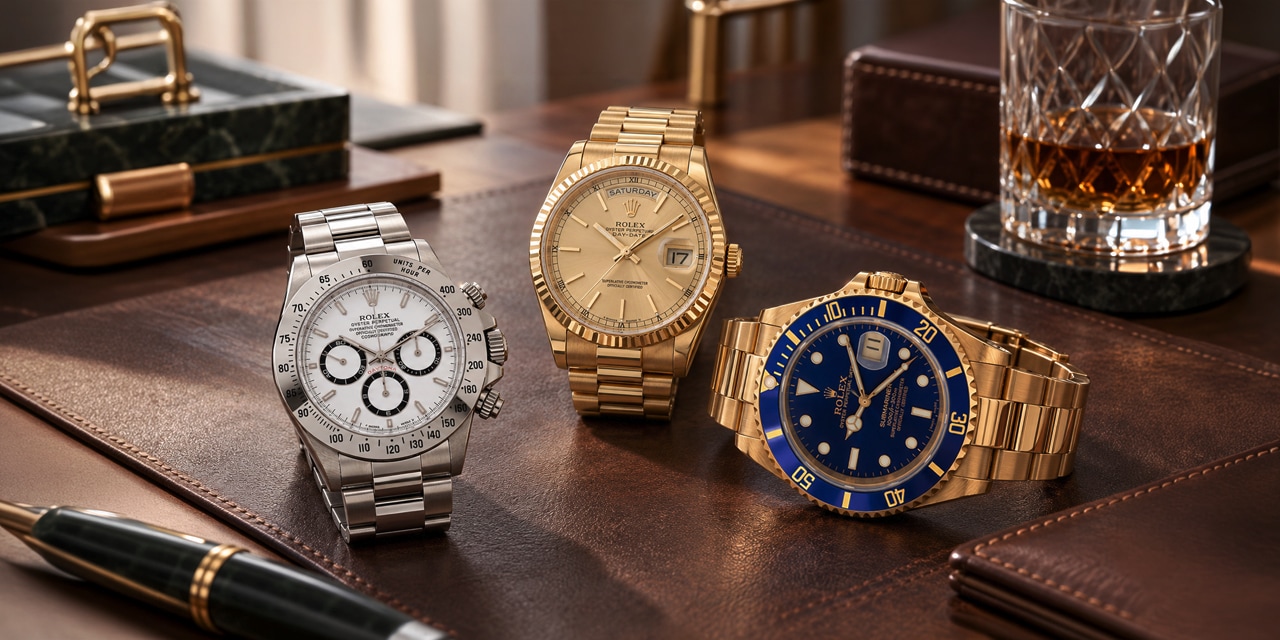
The Rolex Daytona ref. 16520
Released in 1988, the second generation of Rolex’s only chronograph was the one to put the watch on the path towards its current near-mythical status.
Launched to commemorate 25 misfiring years in production, the original iteration of the Daytona had spent the preceding quarter century gathering dust on dealers’ shelves—passed over in favor of other similarly talented but somehow more popular rivals.
Much has been said about the Daytona’s manually-wound movement being its biggest drawback. Of course, as there was no such thing as an automatic chronograph movement until 1969 (the Daytona debuted in ‘63) every other manufacture at the time suffered the same impediment, and yet continued to outperform the Rolex.
Nevertheless, they persisted, producing eight different references of the ‘watch that wouldn’t sell’—not one of which falls anywhere near our budget on today’s market!
Fortunately for Rolex, and us all, the 1960s was rife with horological innovation and, as it turned out, competition. With a self-winding chrono considered the final frontier of mechanical watchmaking, three separate entities set out to crack the conundrum. One of which was Swiss company Zenith.
While all three competitors produced a working caliber by the end of the decade, Zenith’s El Primero was the most complete and accomplished—a genuine top down, purpose-built chronograph movement rather than an existing engine with a chrono module bolted on top. It was also a high beat caliber, its 36,000vph balance frequency allowing for timing increments down to 1/10th of a second.
As good as it was, however, the El Primero was not enough to shield Zenith from the effects of the Quartz Crisis and they went into liquidation in the early ‘70s. What might have happened to the Daytona had that been the end of the story is anyone’s guess.
Happily, it wasn’t. As the public quickly fell out of love with quartz and back in love with mechanics, Zenith was revived in 1984 and production restarted on their ground-breaking caliber. And a major customer was waiting in the wings to take delivery.
In 1986, Rolex and Zenith signed the largest deal in watchmaking history until that point, worth 7 million Swiss Francs over 10-years, to bring the El Primero to the Daytona. Once Rolex’s own technicians had finished their raft of alterations—removing the date function, dropping the frequency to 28,800vph and about 200 others—the first automatic Cosmograph rolled off the line in the shape of the ref. 16520.
Today the whole of the second generation are known as the Zenith Daytonas and, despite their significance in the story of the brand and chronographs in general, still act as the entry point into ownership. They also differed greatly from the first gen models and not just in power plant.
The Zeniths increased in size from 38mm to a more contemporary 40mm and adopted crown guards for the first time. The bezel grew thicker, the crystal became sapphire and the sub dials gained contrasting outer rings. The original ref. 16520 were steel watches, offered with either a black or white dial and the tachymeter scale engraved directly into the bezel. In production until 2000, the reference went through 5 distinct dial marks, but our budget actually brings us within reach of a particularly interesting anomaly.
Known as the Patrizzi dials, named after Osvaldo Patrizzi, founder of Antiquorum and the man who discovered the irregularity, the dials were coated with a short lived organic lacquer which has, over time, changed the color of the totalizer rings on the black faced models to a warm caramel. As no two have aged the same, the defect renders each example unique.
There’s not much more to be said about the Daytona. It is, without doubt, the most famous luxury chronograph watch ever made and that is a title it simply would not have had without the arrival of the Zenith-powered range. The fact that these vital neo-vintage legends are also the least expensive on the preowned scene is more something to take advantage of than to try and understand—and if you’re looking for the perfect place to park $30K, then look no further.
The Rolex Submariner ref. 16618
You can buy a lot of Submariner for thirty grand.
Some highly fought over steel references fall within this bracket such as, for instance, the ‘Single Red’ ref. 1680, the first Sub with a date function starting from 1967. Going back still further, you could secure yourself the mother of all ref. 5513s, an early-run gilt-dialed beauty perhaps, maybe even an Explorer dial, complete with ‘eagle beak’ crown guards and faded ghost bezel. Or its chronometer-rated sibling, the ref. 5512, in a rare ‘meters first’ configuration, with pumpkin-colored hour markers.

Vintage steel Submariners are about as cool as you can get, which is not up for debate. But what if you want something a bit more…how can we put it? Eye-catching. A bit more peacockish. Something bordering on the audacious.
Well, the Sub has that covered too.
That original Submariner Date really split opinion on its launch. For two reasons. Firstly, both divers and non-divers questioned why the watch needed a date function in the first place; the former group for practicality reasons, the latter for aesthetic concerns. But the other debate which arose with the arrival of the ref. 1680 generation centered around the switch in roles for the watch in general. Because while the stainless steel reference was as hardy and mission ready as always, it was joined by another model, the first solid gold Submariner Rolex had ever made.
In fairness, the watch’s transition from underwater safety system to boardroom power play had taken place years before the ref. 1680/8 emerged; all the arrival of an 18K yellow gold example did was confirm it. And while purists continue to lament still, there has been a precious metal Sub in the collection ever since.
The ref. 1661X came out in 1988 and is part of the commonly regarded ‘last of the best’ series. This was the final iteration with the sweeping profile set down at the end of the ‘50s, the last to use aluminum bezel inserts to instill some personality over the years, and the last example with a non-Maxi dial. It marked the end of the classic, slimline Sub in other words.
But it also sat in a neo-vintage sweet spot. While all the beloved old-school attributes were there, the ref. 1661X had the benefits of a sapphire crystal, corrosion-proof 904L steel, 300M water resistance and the ultimate workhorse engine in the shape of the Cal. 3135. It really was the ideal meeting point between old and new.
And that brings us to the flagship model. The ref. 16618 is resplendent in its satin brushed yellow gold, with the polished inner links of its Oyster bracelet lending just the right amount of sparkle. Released with a choice of two colorways, the black dial/bezel combo is the more sober, low-key affair; or as low-key as a solid gold Rolex can be. But if you’re spending a chunk of change of this magnitude, surely the blue dial/bezel is the way to go.
Here, the sunburst-finished face changes tone depending on which light you happen to be standing in, while the whole thing is designed to draw as much attention as possible. This is the extrovert’s Submariner, worn by those comfortable center stage and will likely never be closer to exploring the undersea world than soaking in a swim up bar.
But while it may be a long way from its roots, the ref. 16618 is still an icon of luxury and attainment.
The Rolex Day-Date ref. 118238
From a sports watch many still believe has no business in precious metal, to Rolex’s marquee piece which has never appeared in anything but.
I’m sure there are advantages and benefits to buying a Day-Date brand new, although with the unvarying uniformity of its design and the surprising reasonableness of preowned prices, I can’t think what they might be.
The ref. 118238 is the perfect case in point. This is the archetypal President—36mm, solid yellow gold, fluted bezel—stemming from 2000 (which, as it’s 26 YEARS AGO!, qualifies it as vintage, I’m afraid!), outfitted with every modern feature and convenience and is easily available for our $30K budget. That’s about 2/3rds the price of a box fresh model and it’s difficult to see how one might justify spending the extra.

This is, in every way that matters, a modern watch. It arrived as the first of the six-digit models with redesigned, broader lugs for increased wrist presence, a President bracelet with all solid links which added significant weight and heft, an improved Crownclasp for a cleaner join and enhanced security, anti-counterfeiting rehaut engraving and the superb Cal. 3155 movement with a Double Quickset to make adjusting both day and date displays a breeze. Apart from the upgraded movement in the current range (which still adheres to the same accuracy standards) there is just about nothing to choose between the two, other than you get a lot more change in your pocket buying the preowned model.
As you’d expect, Rolex didn’t skimp on the dial options either. There’s plenty in the standard range, with champagne, silver, black, white and green granting the classic look. Then we move into the more exotic selection; mother-of-pearl, semi-precious stone, diamond-enhanced, either on indexes or the full pave, along with decoratively textured and jubilee dials. Each one lends the watch its own character and the choice always reflects the owner’s sensibilities; that’s always been the beauty of the Day-Date.
Strangely enough, we could have included a President reference in any of our articles from the $10K mark onwards. Its reputation is as the preferred watch of the 1%; the great and powerful in every discipline with the net worths to match. The reality, however, is different. The Day-Date is, pound-for-pound, one of the most realistically priced and attainable preowned Rolex models on the market. Its styling hasn’t altered in any really meaningful way for the last 60-years, and even the oldest, cheapest examples still offer huge amounts of watch for the money.
And when you have $30K burning a hole in your pocket, it’s tough to think of a better place to spend it.
Featured Photo: Mixex art by Oriol Mendivil for BKT Archive.