
 Sign In
 (817) 503-2334
 Contact Us





 By:
By:
Rolex’s New Jubilee Gold
Even after 120-years in the business, most of them at the top, Rolex still comes through with an annual surprise for the industry. Myself and other watch writers spend most of the first half of the year on our thankless ‘Predictions’ articles, trying to forecast what new developments might emerge from the world’s most successful manufacture—will the GMT get a new bezel? Will the Daytona go high-beat? Will the Milgauss make a comeback, again?
And every year we’re wrong, because we get blinkered and focus on different versions of what already exists. It’s a bit like a magician’s classic misdirection. Rolex keeps us looking over here so we don’t think to look over there.
Last year, while we were all speculating on the long overdue return of the Coke GMT, the brand launched an entirely new watch, the Land-Dweller. This year, when we were wondering which of the current catalog was going to be selected to celebrate the centenary of the Oyster case, Rolex released a whole new gold alloy.
Rolex Metals
If there’s one thing that happens even less frequently than Rolex debuting a new model, it’s Rolex unveiling a new metal.
Admittedly, their RLX Titanium came to light in 2022 and has been used very sparingly since (just the Deepsea Challenge and Yacht-Master 42 so far). But before that, you had to go back to 2005 to find an entirely never-before-seen material.
That one was, of course, their proprietary red gold, known otherwise as Everose. As with all of their metals, Rolex forges Everose gold in their own foundry, located within their main industrial campus, Plan-les-Ouates, in the outskirts of Geneva. In fact, 2005 was also the year the manufacture brought their metallurgy completely in-house, to add to all the other stages of the watchmaking process they had similarly adopted and domesticated.
The reason for making all that effort is simple and obvious; control. Whereas that pertains to alloys, and specifically gold, it means Rolex’s metallurgists can exercise full autonomy over their metals’ color consistency, its durability and its corrosion resistance. It leads to an absolute uniformity in the whole process and its outcomes.
And it also means they can quietly and secretly work on totally new alloys without having to rely on outsiders.
Jubilee Gold
But what do you do when you already have your yellow, white and rose gold formulas sewn up? Well, Rolex’s answer for 2026 seems to be to combine the three into something which houses the best features of each.
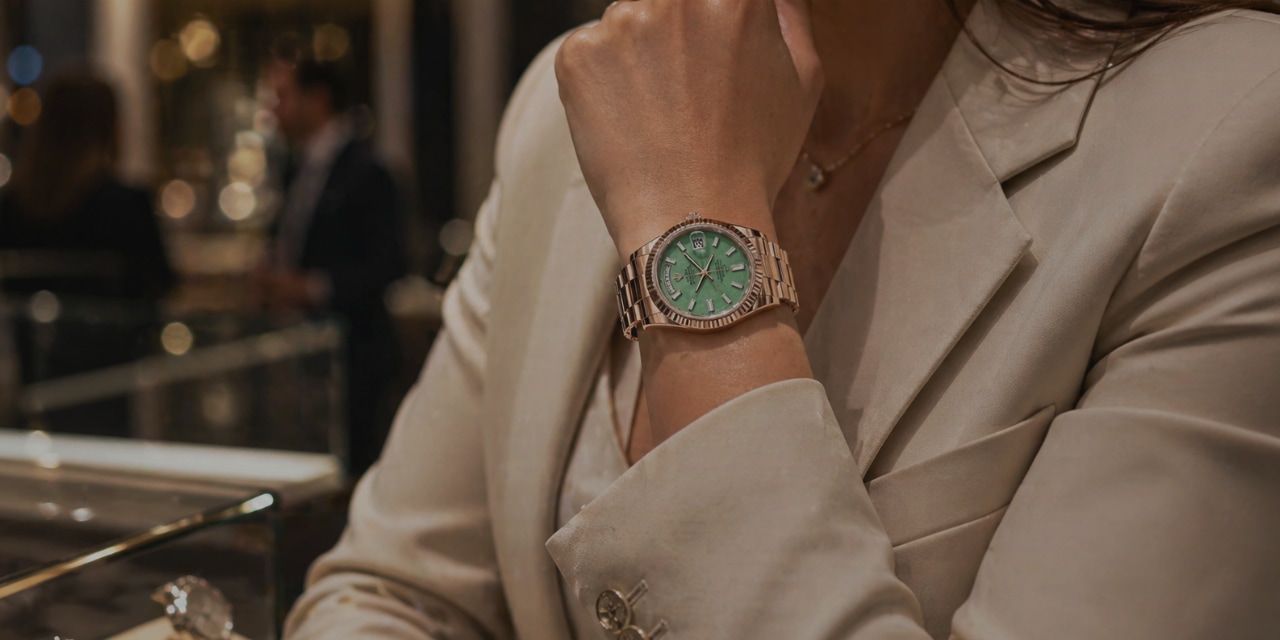
Jubilee gold launched at this year’s Watches & Wonders show, used on the latest example of their flagship offering, the Day-Date. And not just any Day-Date. The ref. 228235JG, a 40mm piece with a stunning green aventurine stone dial, is an off-catalog model only found on Rolex’s ‘Exceptional Watches’ website page. In real terms, that means you’ll be lucky to even see one in the world let alone buy one.
Which is a shame, because not only is it a beauty, it might be the perfect watch for right now.
The thing the best luxury purveyors do, if they want to stay in business, is carefully mirror the prevailing global climate. At the moment, with the economic mood as it is, ostentatious displays of wealth are very much out. What’s in is a quieter, old money sort of understatement.
That rules out purely yellow gold. Even though Rolex toned down the bling factor on their yellow precious metal when they started producing it themselves, making it paler overall, it could still be seen as a little too bling for this day and age.
Jubilee gold, as Rolex themselves describe it, is a mix of yellow gold’s warmth, white gold’s restraint and rose gold’s softness to end up with something which sits in-between all three. The metal has a tender yellow tone, mixed with elements of grey and pink which is at once refined and muted.
Viewed in various lights, the alloy changes character but never has a ‘look at me’ presence; it’s more pastel than bold, especially when satin finished, as it is on the outer links of the new Day-Date’s President bracelet.
It is a fascinating aesthetic evolution from Rolex, yet another thing unique to the brand and looks set to become a staple of their portfolio.
Where Else Will We See Jubilee Gold?
As of yet, there is just that one model in the collection in this new metal. It was the ideal specimen, of course. Firstly, it is fitting that it has debuted on Rolex’s top-of-the-line watch, their gold standard (pun intended) showcase for the last seven decades. Secondly, with it being a celebratory year, commemorating the Oyster case’s anniversary, the choice of a green dial is trademark Rolex.
But where will it be rolled out next? If I was a gambling man, I would say the Daytona could well step up. It is the most well populated and luxurious piece in the Professional Collection. It is also the only model offered in absolutely every different metal and metal combination Rolex has—even Rolesium since this year’s W&W, along with Rolesor, yellow, white and Everose gold as well as platinum.
The Sky-Dweller might see it as well. The watch is essentially a Day-Date with an annual calendar and so could be a likely recipient in the future. A Jubilee gold Sky-Dweller on an Oysterflex would be interesting.
And the Yacht-Master is often a playground for new metals too. The yellow and Everose gold models are highly popular, so a Jubilee version, with either a metal or Cerachrom bezel, is not out of the question.
It will also be interesting to see if the brand decides to use it in a two-tone setup. Will we see a Jubilee gold version to go along with the other Rolesor blends?
Chances are we are going to have to wait until next year’s event to see any new Jubilee gold watches, although Rolex does sometimes surprise us, albeit rarely, with releases at other times of the year. If that happens, be sure to check in with us again for the full rundown.
Featured Photo: Mixed art by Oriol Mendivil for BKT Archive.