
 Sign In
 (817) 503-2334
 Contact Us





 By:
The Best Vintage Rolex Watches for $20,000 and Under
Bar a classic sportscar, I suppose, if you’re spending 20 grand on any luxury item, you have every right to expect something special.
In the case of vintage Rolex, that sort of money should secure not only one of the brand’s true icons, but should also buy you a particularly fine example of said icon. We’re talking original dials, period-correct bezels and unpolished cases at a minimum. Throw in box and papers and a documented service history and it all adds up to an outstanding package.
And although $20K might seem like a lot for a watch (and it is) by the time your budget reaches these levels, we get into that strange but welcome stage where the model you acquire isn’t actually expensive at all, in real terms. While we would always encourage you to purchase what you love first and foremost, the fact remains that those Rolexes selling for this sort of money tend to hold their value extremely well. In some cases (not all by any means) they can even appreciate over time, meaning that, at worst, you can recoup your outlay at some point, or even make a profit should you decide to sell.
The even better news is that vintage Rolexes at this level aren’t some delicate antiques only retrieved from the safety deposit box for high days and holidays. These are genuine daily wearers, watches which will serve you the rest of your life and then be handed down to do the same for the next generation.
In my view, you can’t really ask for more than that, so let’s dive in.
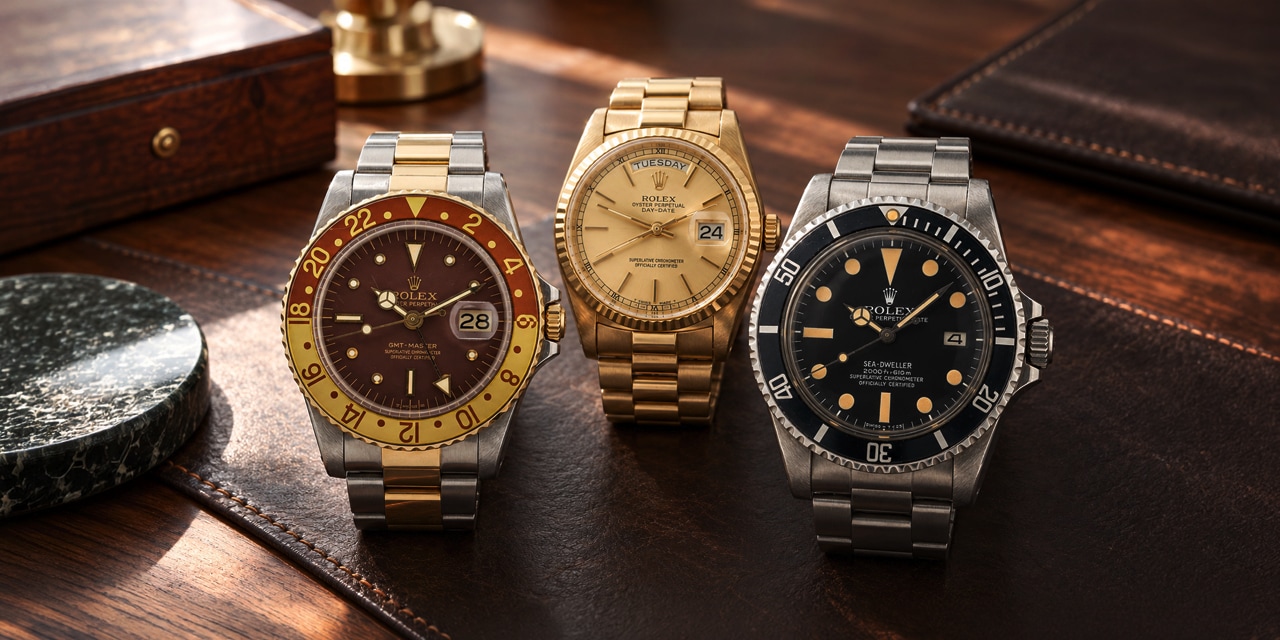
The Rolex GMT-Master ref. 1675/3 Root Beer
In our last article in this series we talked about the wonderful GMT-Master II ref. 16710, one of only two references of the watch so far to come with a Coke (black and red) bezel.
Now, armed with $20K, we can delve a little further back into the archives and get ourselves a truly vintage example of Rolex’s seminal travel companion.
The ref. 1675 was the second generation of the original GMT-Master, before the range progressed to where it allowed for the two hour hands to be adjusted separately, becoming the GMT-Master II in the process.
Starting life in 1959, the ref. 1675 followed the same pattern as the Submariner ref. 5512 released the same year. It increased in diameter to 40mm over its predecessor’s (the ref. 6542) 38mm and introduced crown guards for the first time. It also came with an anodized aluminum bezel insert as standard, whereas the ref. 6542 before it had started out with a Bakelite surround which was habitually swapped for aluminum during services after it was found to be too brittle.
Just as with the Submariner, the ref. 1675 was a long-running edition, lasting up until 1980. As you’d imagine, it went through a number of nips and tucks during that time. Its movement upgraded from the 18,000vph Cal. 1565 to the 19,800vph Cal. 1575 in the mid-‘60s. A hacking function was fitted in 1971, but neither caliber had a Quickset for the date.
The dials went from gilt to matte around 1966/7 as well, and there is, of course, a whole bunch of detailing minutiae regarding fonts and markings and even the shape of the crown guards which require a series of posts on their own.
For our purposes, we want to look at something the GMT-Master hadn’t had before; a Rolesor model. The debut reference had been offered in either steel or full yellow gold, but the two-tone halfway house didn’t arrive until the ref. 1675/3 was launched in 1970.
With steel case and outer bracelet links coupled with yellow gold crown and inner links, the reference was already markedly different to any GMT thus far. But paired with a dark brown dial and a split toned bezel of gold and light brown, the ref. 1675/3 was indeed a standout. Rolex also added raised conical hour markers, giving us the so-called ‘nipple dials’, and the piece overall quickly gained the nickname the Root Beer.
The addition of the new model brought the number of available bezel color schemes up to four, alongside the red and blue Pepsi, an all-black version and the achingly rare Blueberry, with its all-blue surround. Of all of them, the Root Beer was the most ‘of its time’. Anyone around the ‘70s will testify that the entire decade was somewhat brown, but it is a look which has very much come back into fashion, as evidenced by the current Root Beer being one of today’s most popular GMTs.
But the ref. 1675/3 was the OG, and is highly collectible. $20K will get you an outstanding example, with enough weathering to tell its own story. And if you need any more convincing, I’ll tell you its other nickname; the Clint Eastwood. It was the man with no name’s personal favorite and he wore it in several of his screen outings. Beat that.
The Rolex Day-Date ref. 18038
It was something of a surprise writing this string of articles when I found out I could include Rolex’s flagship, the Day-Date, in the ‘Under $10K’ post.

The classic ref. 1803 which, like the GMT above, also emerged in 1959, has to qualify as one of vintage Rolex’s biggest bargains; you can pick up a superb specimen for that budget, provided it’s on a leather strap.
With twice as much to play with, not only can you get a President on its beautifully crafted eponymous bracelet, you can also get the next iteration in line, the ref. 18038.
This is the reference which acts as the demarcation point between old and new. The 1977 release came with the Day-Date’s first high beat movement, the Cal. 3055 ticking at 28,800vph, its first sapphire crystal and its first flat dials, replacing the pie-pan style of older generations. That new caliber also installed the first Quickset mechanism for the dual calendar, allowing for the day of the month to be adjusted with just the crown, although the day of the week still needed cycling with the hands.
What stayed the same was the dimensions, a perfectly balanced and wearable 36mm, and the exclusively precious metal construction. All three flavors of gold were accounted for as well as platinum for the ultimate flex, but the ref. 18038 stands as the yellow gold model.
The dial selection increased dramatically too. While the timeless options of champagne, silver and black made up the majority it was during this era that Rolex started to branch out (I love a pun) with materials like wood alongside exotic hard stones such as onyx, lapis lazuli and malachite. The infamous Stella dials, which had made a brief appearance on the previous references, were also carried over in their scandalously vibrant turquoises and oxblood lacquer shades.
Although the ref. 18038 is now known as a transitional reference, meaning it introduced plenty of modern features but was superseded in fairly short order (in 1988 to be exact), this is really all the Day-Date you could ever need. It has the elegant lines of 1970s Rolex, as opposed to their more muscular current stance. It has the deliciously understated satin brushed finish to the case rather than today’s high gleam polish. And it houses a superbly engineered movement known for its longevity; ask Warren Buffett, he’s been wearing the same ref. 18038 for the last 40-years.
With the possible exception of a Double Quickset, there is little here to improve on, and $20K gets you a wide selection. Definitely one to consider, whether you’re a chairman of the board or not.

The Rolex Sea-Dweller ref. 1665 Great White
The Submariner’s tougher, younger and more talented brother has a fascinating history. We’ve written about it extensively here so it’s worth searching through if you want to know more.
What you’ll find is that the debut reference, the ref. 1665, was created in 1967 and initially supplied only to a select group of underwater research pioneers, before being opened up for sale to the general public in 1971.
While very similar to the Sub in terms of looks and size, measuring the same 40mm diameter and borrowing pretty much all the aesthetics, when it came to performance there was no competition. The Submariner’s (at the time) 200m water resistance was knocked into a cocked hat by the Sea-Dweller’s 610m and the latter’s Helium Escape Valve meant it could be safely worn by professional saturation divers living and working in helium-rich diving bells for weeks at a time without risking being destroyed on the ascent back to the surface.
The first generation lasted until 1983 and went through two distinct eras, divided only by their dial text, and more specifically, its color.
From 1967 up to 1977, the script above the 6 o’clock read ‘Sea-Dweller’ ‘Submariner 2000’ across two lines, with the usual ‘Superlative Chronometer’ ‘Officially Certified’ on two lines underneath, separated by the depth rating, ‘2000ft=610m’.
Crucially, the top two lines were printed in red, leading to the ref. 1665’s most famous nickname, the Double Red Sea-Dweller, or DRSD for short. These early versions have become massively sort after in recent years, and now fall outside our catchment, with starting guide prices in the $35K-$40K range. However, post-1977, Rolex removed the ‘Submariner 2000’ line and resorted to printing the remaining text in plain white, giving us a new nickname as they did so. The watch itself was exactly the same, but just that superficial alteration makes a big change on today’s preowned market, with the so-called Great White available for as little as $16,000.
So, should you get one? Well, even though this is definitely a vintage watch—it has an acrylic crystal despite its fearsome underwater capabilities—and is the same diameter as a Sub from the same period, the Sea-Dweller has always had a more substantial build, for obvious reasons. That lends it a greater, more contemporary-feeling wrist presence that suits modern buyers while retaining a heap of retro charm. Coupled with that is a sense of an utterly bombproof construction giving you the confidence to wear a valuable piece of history every day. The Sea-Dwellers were made specifically for the harshest environments imaginable and, when properly serviced, there’s no reason to doubt they can still handle anything the casual wearer will ever throw at them.
A handsome, stylish timepiece built to endure several lifetimes, the Great White is king of the ocean.
Featured Photo: Mixed art by Oriol Mendivil for BKT Archive.