
 Sign In
 (817) 503-2334
 Contact Us





 By:
By:
Rival Timepieces to Challenge Rolex’s Finest: Submariner vs. Tudor Black Bay
The Submariner & The Tudor Black Bay
Welcome back to our series of articles on realistic Rolex alternatives.
This is a comprehensive rundown of viable replacements for a number of the brand’s most popular creations, aimed at the folk who, for whatever reason, can’t get the Rolex of their choice or who actively prefer pieces from a rival manufacture.
We kicked off last week where you might expect, possibly the most iconic watch of all time; the Submariner. We published a list of five of the Subs best subs, and now we’ll start exploring each one in a bit more detail.
The Tudor Black Bay
Tudor’s transformation from ‘what you buy when you can’t afford a Rolex’ to the undisputed cooler younger sibling was finalized years ago now. And the series they have to thank for that complete turnaround was their Black Bay collection.
For those of you new to this story, Tudor was established in 1926 by Rolex founder Hans Wilsdorf as a more affordable equivalent to his main brand. What that meant in practice was identical build quality on the outside but powered with non-in-house, off-the-shelf movements.
The reliance on third party calibers kept the price of Tudor’s watches down, but did leave them with the underserved yet hard to shake reputation of consolation prize. Despite that, the brand occupies a significant place in horology history, especially where military watches are concerned.
In 1954, just a year after Rolex’s model surfaced, Tudor launched a Submariner of their own; the Oyster Prince Submariner ref. 7922. As with the Rolex, the Tudor Sub would be refined and improved over the years, giving rise to references known today by collectors as the ‘Big Crown’ (ref. 7924) and ‘Snowflake’ (ref. 7016/ref. 9401 etc. So named for their distinctive handset shape).
As if to underline just how capable a tool watch they were, many of these references found successful service with various Navies around the world. From the 1960s to the 1980s, Argentina, Canada, the U.S. and, most famously, France’s Marine Nationale all issued Tudor Submariners to their dive crews.
And it is to these no frills, extremely robust and achingly stylish watches that the Black Bay collection would later pay homage.
The Revival
In 1996, Rolex quietly pulled Tudor out of the American market.
The withdrawal was down to an image problem rather than any issue with the quality of the product, with the brand’s ‘not quite a Rolex’ identity working against it in a big way.
For 16-years Tudor concentrated solely on Europe and Asia, producing a variety of excellent and affordable alternatives to their parent company’s offerings.
Behind the scenes, however, a major restructuring was taking place.
In 2012, all that hard work came to the fore when Tudor rocked up to Baselworld with the Heritage Black Bay ref. 79220R.
In sense of timing, it could not have gone better. The craze for all things retro was in full flow, and Tudor’s new watch—a 41mm, steel-cased mashup of all the best elements of their own vintage dive watches—sent the watch buying public absolutely nuts.
The ref. 79220R borrowed the big crown from those early ref. 7924s, the snowflake hands from the Naval issue ref. 7016 onwards, the dot and baton indexes from any number of Sub references and, crucially, left off the crown guards. That gave the piece an immediate nostalgia quotient in an industry which had decided all modern sports watch cases must have guards and left the reference with a completely clean, symmetrical design.
Topping it off was an unusual burgundy color bezel, also seen as a great decision, and it was such a hit that two further examples followed in subsequent years.
The ref. 79220B arrived in 2014, with a blue bezel which channeled the look of those 1970s Marine Nationale models, and the all-black ref. 79220N landed in 2015, with the cleanest, most ‘Submariner’ visuals of them all.
In true Tudor style all three were powered with third party movements; the ETA 2824. As such, the dials featured the text ‘Rotor Self-Winding’ across two lines, the bottom line curving upwards. Consequently, these have been christened the ‘Smiley Dials’.
Stepping Out of the Shadows
But the best was yet to come.
In 2016, Tudor released a new Black Bay model, the ref. 79230N. Still 41mm, this piece had a noticeably thicker case, a black dial and bezel and the smiley text was gone, replaced with the legend, ‘Chronometer Officially Certified’.
Inside was one of the first in-house movements the brand had ever made, the MT5602. It followed the MT5612 from the year before, found in the North Flag and Pelagos models, which signified Tudor’s entry into the rarefied realm of the manufacture. It was at this point, with the release of not only the first domestically powered but also the first chronometer-rated Black Bay, that Tudor became a true rival to Rolex.
In the intervening years, the range has expanded significantly. A 43mm Black Bay Bronze also emerged in 2016, complete with its Explorer-style 3/6/9 hour markers. The Black Bay Chrono came the year after, its movement developed in conjunction with Breitling, while the Black Bay GMT absolutely stole the 2018 show with its much-missed Pepsi bezel.
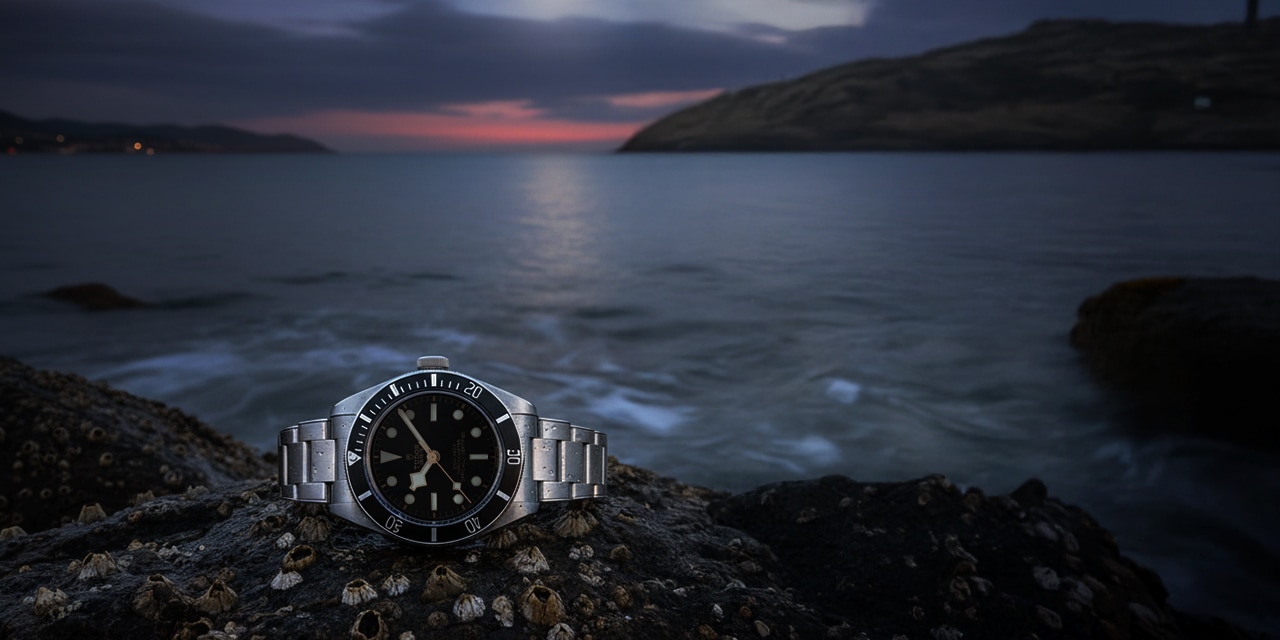
But perhaps the most successful piece of recent times has been the Black Bay 58 from 2018. With a slimmed-down 39mm case and stark white on black detailing, with just a hint of gloss around the indexes and text, here was the nearest thing to a Bond Sub the majority of us will ever have the chance of owning. An instant hit with both younger audiences and dyed-in-the-wool purists, you can see its influence spread across the output from numerous other brands.
Up To Date
Rather than rest on their laurels, Tudor have continued making intelligently thought out strides in design and engineering.
The even more retro-faithful Black Bay 54 came out in 2023 with a wholly ‘50s accurate 37mm case. They followed that up in 2025 with the latest 43mm Black Bay 68.
Yet, away from having just about every case size covered, this latest crop have upped the movement game too. Many of the most recent editions are furnished with METAS-certified movements, meaning they have passed the Master Chronometer standards issued by the Swiss Federal Institute of Metrology. Stricter than even the COSC’s criteria, METAS calibers are judged to an accuracy of 0 to +5 seconds a day, have a magnetic resistance of up to 15,000 gauss and pass a further battery of tests in 6 positions and two temperatures.
Today, you will find Master Chronometer movements in a variety of Black Bay models including the latest 41s, 58s, 68s and the newest set of GMTs.
Whichever way you slice it, Tudor now has arguably the most right of all to be held up as a genuine challenger to Rolex, and the Black Bay dive watches are authentic rivals to the all-mighty Submariner.
By drawing on everything they did best in the past, Tudor have set themselves up as a brand with a great future; one powered by Master Chronometer movements and priced to appeal to horology fans everywhere.
Featured Photo: Mixed art by Oriol Mendivil for BKT Archive.