
 Sign In
 (817) 503-2334
 Contact Us





 By:
By:
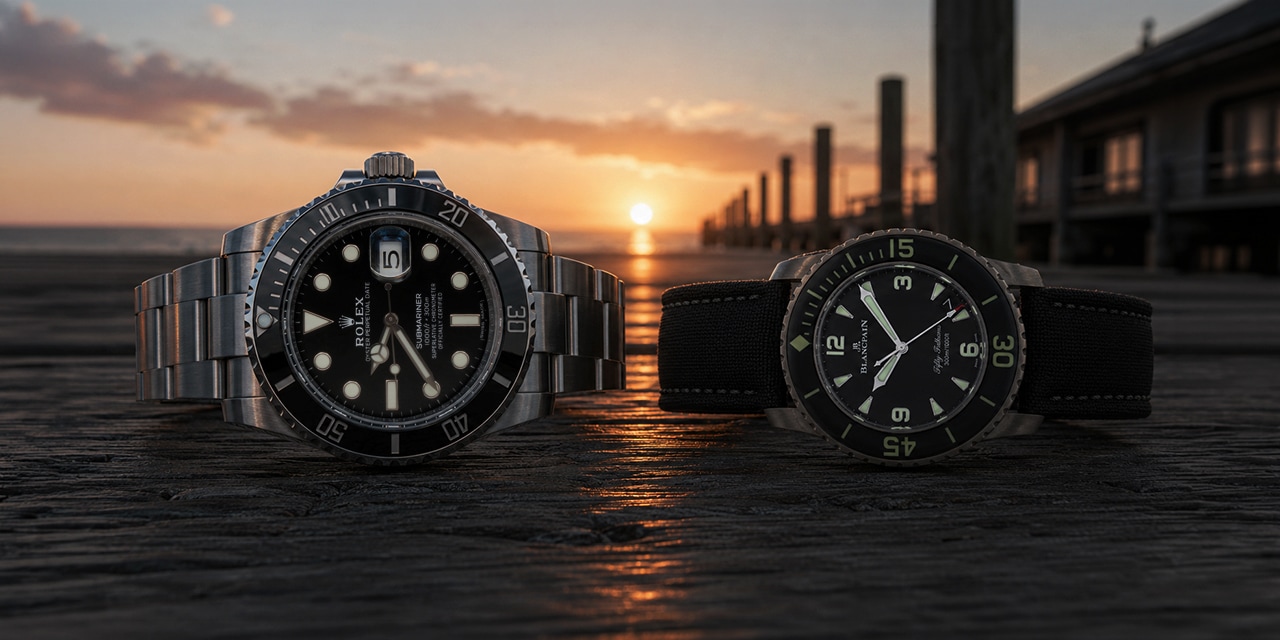
Rival Timepieces to Challenge Rolex’s Finest: Submariner vs. Blancpain Fifty Fathoms
The Submariner & The Blancpain Fifty Fathoms
For our third round of great alternatives to classic Rolex watches, we hit on a juicy vein of controversy.
Anyone who’s been around the horology world for a minute, and has picked up even a smattering of information on the dive watch genre, will know how consequential these two names are; the Rolex Submariner and the Blancpain Fifty Fathoms.
For many years it was believed the latter was the archetype model, the very first modern diver paving the way for the entire field of underwater timers—the one which put in place many of the crucial elements a dive watch must now have in order to qualify.
More recently, in-depth research has concluded that it was actually the Rolex which took the honors, beating the FF to the punch by a matter of months.
In the great scheme of things, more than 70-years down the line, I guess it doesn’t really matter that much. Especially since what the rival brands have left for us are two of the finest examples of their type to ever exist.
The question is; is the Blancpain Fifty Fathoms a realistic alternative to the all-mighty Sub?
Let’s find out.
Mother of Invention
Let’s have a little update on the story you probably know about the invention of the Fifty Fathoms. The tale which has been accepted for a very long time (and which, to their credit, Rolex has never disputed) is that the original model was scribbled down on a piece of graph paper by two members of France’s elite underwater demolition team.
Following WWII, Captain Robert ‘Bob’ Maloubier and Lieutenant Claude Riffaud, were charged by the French government with establishing a new squadron of military combat swimmers, the Nageurs de Combat. Alongside handpicking the team, the pair were also responsible for sourcing all the suitable equipment—something which was a much bigger problem in the early ‘50s than you might expect. And the biggest challenge was finding a reliable timer which could withstand the worst a Navy special forces diver could put it through.
In fact, nothing available on the market at the time even nearly lived up to the job, even though this was the dawn of recreational Scuba diving as we know it.
As such, it is true that Maloubier and Riffaud did actually pen their own watch and then start the search for a manufacture to build it for them. It is also true that they were more or less laughed out of every brand in Switzerland.
However, where the story diverts from the accepted narrative is that, practically simultaneously, a gentleman named Jean-Jacques Fiechter, the CEO of a small maison in Villeret called Blancpain, was busy designing his own watch.
Fiechter was a dive fan in a big way, and often enjoyed excursions with a friend of his by the name of René-Paul Jeanneret, the public relations director at Rolex. It is said that as early as 1951 the two went diving, with Jeanneret wearing a prototype Submariner, about four years before the earliest record of a Fifty Fathoms going on commercial sale.
What it is now thought to have happened is that Maloubier and Riffaud approached Fiechter through an intermediary, the naval supplier Spirotechnique (now Aqua Lung), with their plans for a dive watch, and they happened to match very closely with the one he was himself in the process of designing; one ‘inspired’ by Jeanneret’s prototype.
Both had a high contrast dial, with hands and numerals large enough to be read easily underwater, and all drenched in lume so they could be seen in murky conditions. They each had a rotating bezel to help track immersion times and both, obviously, were highly water resistant. The only change Maloubier wanted to add to Fiechter’s design was extra antimagnetic protection so timekeeping would not be affected by their divers’ other equipment.
The eventual upshot was that the two sides decided to team up; Blancpain got a readymade entry into military supply and the French Navy got their watch. Fiechter had even come up with the name, taken from Ariel’s song in Shakespeare’s The Tempest; the Fifty Fathoms.
Who Was First?
As we know, Rolex released their Submariner in 1953. The very first mention of the Fifty Fathoms in any industry literature did not occur until 1955.
Other clues as to who beat who to market can be found at the patent office. Blancpain came up with a unique locking mechanism for their bezel, but did not copyright it until June 19th, 1954 (a month after the world was introduced to the Sub). Additionally, the name Fifty Fathoms was not patented until 11th June ‘54, but wasn’t used commercially until August 30th.
So, logically, it seems Rolex won the race. Which leads on to another question: who cares?
What we have are two fantastic and highly capable luxury tool watches. Each has its own merit which singles it out for a particular patron. The Submariner is for those who appreciate the classics, arguably the most famous and recognizable timepiece ever made. The Blancpain is for the outlier, the one content for only other collectors to appreciate their wrist apparel.
The Blancpain Range
One area where the Fifty Fathoms does have the Sub comprehensively beaten is variety.
As we know, there is a grand total of 8 Submariner models available in the current collection, and the series as a whole has never had anything more than a date function in its complications arsenal.
Contrast that with the Blancpain and it’s a no contest. There are more than 70 models in the lineup, with everything from the scaled-down Bathyscaphe range, through some extremely faithful reproductions of several vintage icons, on up to a number of intricate flyback chronos, some haute horlogerie complete calendars and annual calendars, a bunch of big dates and day-dates, a few tourbillons (always handy in a dive watch) and the immense X Fathoms, with its mechanical depth gauge and memory.
Materials-wise as well, it’s Blancpain all the way. Alongside the usual steel, you can have red or white gold, Sedna gold, bronze gold, ceramic or titanium. And case sizes range from as small as 33mm all the way up to 55.6mm.
It is perhaps a measure of the relative popularity of both watches that their collections are so wildly dissimilar. Blancpain make their model appeal to as many people as possible by producing it in as many different guises as they can think of. Rolex really doesn’t have to. They know everyone wants a Sub so they just produce the Sub everyone wants.
So, is the Fifty Fathoms an alternative to the Submariner? Absolutely, especially if you like complications and the idea of those knowing nods from other connoisseurs. Is it better than the Sub? Nope. But it has plenty of points in its favor.
If you’re forced into choosing between the two, congratulations—you have landed in a very enviable position!
Featured Photo: Mixed art by Oriol Mendivil for BKT Archive.