
 Sign In
 (817) 503-2334
 Contact Us





 By:
By:
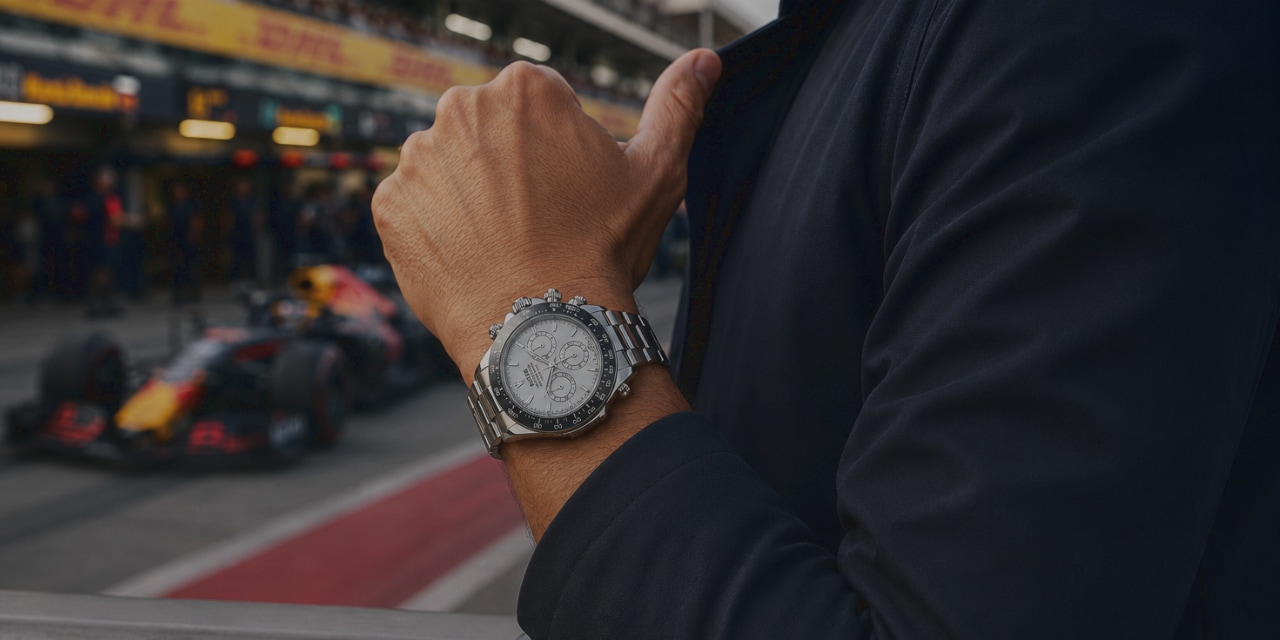
The New Rolex Rolesium Daytona ref. 126502
Admittedly it did not have a huge amount of competition, but this year’s most talked about Rolex release at Watches & Wonders was undoubtedly their new, off-catalog Daytona.
Now, a new version of arguably the brand’s most important sports watch, one of the most important sports watches of all time actually, will always generate headlines. But the buzz around the ref. 126502 has been even greater than usual due to several factors; its materials, its dial and its subtle nods to the past.
Let’s have a look in a bit more detail.
A (Sort of) Mix of Metals
We all know Rolex has always produced its timepieces in the more traditional line-up of watchmaking materials—steel, gold (yellow, white and rose) and, on special occasions, platinum. More recently they have introduced titanium very sparingly as well.
On top of that, they were the manufacture to bring about two-tone constructions; the ‘best of both worlds’ meeting of steel and gold in a concoction known far and wide as Rolesor.
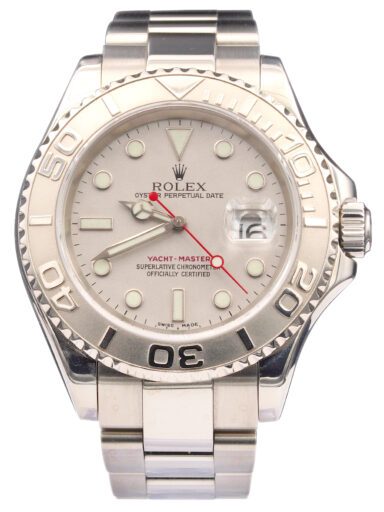
But there is another metal blend from Rolex which has, up until now, only been found on the Yacht-Masters. Unveiled in 1999, the ref. 16622 40mm Yacht-Master featured a steel case and bracelet fitted with a bezel made from platinum in a new blend called Rolesium. The Yacht-Master II got its first Rolesium model in 2007 and the makeup was restricted to just those two model lines for years.
Now, however, we have another. Well, kinda.
This year’s exclusive Daytona release, the sure-to-be-easy-to-buy ref. 126502, is basically a steel watch that’s been waved in the general direction of the Rolex platinum forge. Stainless Oystersteel makes up 90% of the weight of the watch, with the only platinum parts restricted to the ring around the bezel and another ring on the underside (you know, the bit you’ll never see) which surrounds the sapphire case back.
So, What’s the Point?
I know I’m being a bit flippant here, but it is only because of the fact that this Daytona being made in Rolesium is not actually the most interesting thing about it.
The really big news is its dial.
Throughout its history, one which stretches back to 1963, there have only really been two types of steel Daytona; those with black dials and silver sub dials and those with white dials and black sub dials—what’s known as the Panda and reverse Panda.
That was true for the underperforming, manually-winding first generation, the revolutionary automatic second generation, the world-shattering third generation with the in-house movements and the consolidating-its-place-in-horological-iconography current generation. Some came with steel bezels, some with contrasting bezel inserts (either acrylic or modern Cerachrom) but always with those same dial options. (Yes, the Paul Newman’s differed slightly with a dash of color, but on the whole they retained the black/white setup).
Enter this year’s ref. 126502. This is, for all intents and purposes, a steel Daytona. Except this one has what could legitimately be called an Albino dial. That describes a tone-on-tone dial where the totalizers are in the same color as the main dial and it is a callback to a vanishingly rare vintage look from the 1st gen ref. 6263. Only three are known to exist, the most famous once belonging to Eric Clapton which sold in 2015 for $1.4m. (There are rumors of a fourth, a ref. 6239, although these are unconfirmed).
So the newest Daytona addition would have been a showstopper anyway. To make things even more special, Rolex has gone a bit haute horlogerie with his one (again; kinda).
The brand describes the dial as grand feu—French for great fire, which is a complex and highly specialized enameling technique dating back to the 1910s. It involves applying powdered silica onto a metal base in layers and then firing at 800°C, causing the silica to melt and form a glassy and durable surface.
Grand feu is usually reserved for the highest class of artisanal watchmaking due to its expense, the degree of skill needed and its massive failure rate; about 40-50% crack in the kiln.
This is Rolex’s first attempt in about 70-years and, if we’re being pernickety, it isn’t true grand feu. For their dials, they have mixed the enamel powder with water and coated it onto four ceramic plates (one for the main dial and three for the sub dials) rather than metal. The result is then fitted to a brass base after firing. It has been done that way to reduce the amount of failure and, while it may technically be more of a glaze than true grand feu, the results are the same; i.e. a beautiful milky color which is embedded into the glass so will never fade.
That Albino look is enhanced still further with a rethought handset. Unlike with the other steel Daytonas, which have a black base shrouding the luminous insert, here Rolex has purloined the hands from the full platinum model, the ref. 126506, which uses all white. Yet despite that, the watch remains surprisingly readable.
What Else?
There are a couple of other subtle but significant changes from the standard steel models.
The case itself is the same, which means it comes with 2023’s slightly redesigned crown guards which curve more with the bezel shape. The screw down pushers, the 100m water resistance, the Triplock and the flat sapphire crystal are all carried over.
So too is the movement, Rolex’s own Cal. 4131, aligning with the updated parameters of Rolex’s Superlative Chronometer Certification which has added new criteria for magnetism, reliability and sustainability. You can see it now, through the display case back, the addition of which bumps up the watch’s thickness slightly from the normally 11.90mm to 12.20mm. You’ll notice the gold rotor and lovely Rolex Geneva stripes finishing.
But up front, the bezel has been tweaked. No longer black, it comes in an attractive anthracite color with an understated metallic effect. More than that though, the tachymeter markings are different. The scale is still to 400 Units, but now the numerals follow the bezel—that is, they are displayed horizontally all the way round. Before, the numbers were set radially, so those on the bottom of the surround were upside down but this way is another harking back to earlier generations. The font is a little different too and the triangle markings are smaller.
Is it Worth the Money?
The ref. 126502 is not listed on the brand’s website, you won’t find it in the catalogs and you certainly won’t see it displayed in boutiques. Therefore the subject of its price is, to quote the great philosopher Tribbiani, like a cow’s opinion—it’s moo. Unless you are lottery-esque lucky or incredibly influential, you won’t be buying one.
Putting that aside, is the $57,800 Rolex are asking for this piece value for money? Well, there’s two ways to look at that. Firstly, the fact that it’s about $40k more than a standard steel model for the addition of a fancy dial and a whiff of platinum would suggest not.
In the real world, however, it most certainly is. As we’ve said before, Rolex watches are not expensive. Yes, the buy-in price seems prohibitive. But that doesn’t take into account the way they retain their value. Particularly as a secondary purchase, you are very unlikely to lose much if any money on one. And if you happen to grab one of the lusted after future grail watches, you can make a ferocious profit.
The new Daytona ref. 126502 is one of those. This piece is going to be so in demand over the next few years, enthusiasts will look at that retail price and weep, wishing they could go back in time and pick one up.
Unfortunately, it is also likely to be a Raiders of the Lost Ark-type creation. As hard to find as the Ark of the Covenant and, once snapped up by collectors, likely to be stored in some dark, temperature-controlled safe for years.
Featured Photo: Mixed art by Oriol Mendivil for BKT Archive.