
 Sign In
 (817) 503-2334
 Contact Us





 By:
By:
The Rolex Innovation Timeline: The Cerachrom Bezel
Ceramic has been something of a peripheral watchmaking material ever since its introduction in 1962 with Rado’s DiaStar.
Over the years it has been used almost as a novelty in watches from the likes of Omega with their Black Tulip ‘Cermet’ models (CERamic-METal) and IWC’s Da Vinci ref. 3755, both from and very much of the ‘80s.
As a building block for wristwatches, the ceramics utilized by the horology industry do have a laundry list of benefits. To start with, they are fantastically hard and almost impossible to scratch. In addition, being completely inert (chemically unreactive) they do not rust or corrode, or cause allergic reactions in the same way something like nickel does. As well as that, they are immune to the effects of ultraviolet light so they don’t fade or change color over time, and they are extremely lightweight—in the same region as aluminum but orders of magnitude stronger.
The fact they are not more widely seen in the industry is mainly down to manufacturing costs and their potential brittleness.
But, at the turn of the millennium, Rolex decided they were happy to put up with ceramic’s downsides when they went looking for a new material for arguably the most buffeted component on a modern watch; the bezel.
And in 2005, they debuted their very own alloy—Cerachrom. Below, we take a look in a bit more detail.
What is Ceramic?
One thing which may surprise you is just how much stuff is actually ceramic, scientifically-speaking.
Brainy people divide every material on earth into four main categories; metals, polymers, composites and ceramics.
The definition of a ceramic, then, becomes anything which is solid, non-metallic, inorganic and created with heat. So, things like glass, diamonds and even graphite are lumped under the ceramics banner.
Of course, to us laymen, the word throws up images of delicate clay pots. But the types of ceramics used in many different industries, of which watchmaking is just one, are known as technical ceramics. These are formed from the purest base components and made resilient enough to withstand incredible stresses.
How is a Cerachrom Bezel Made?
As you would expect from Rolex, the costs involved in manufacturing their very own in-house ceramic were quite low down on the list of concerns. This is the manufacture, after all, which was the first to swallow the vast expense of using 904L steel, along with all its associated additional machining overheads.
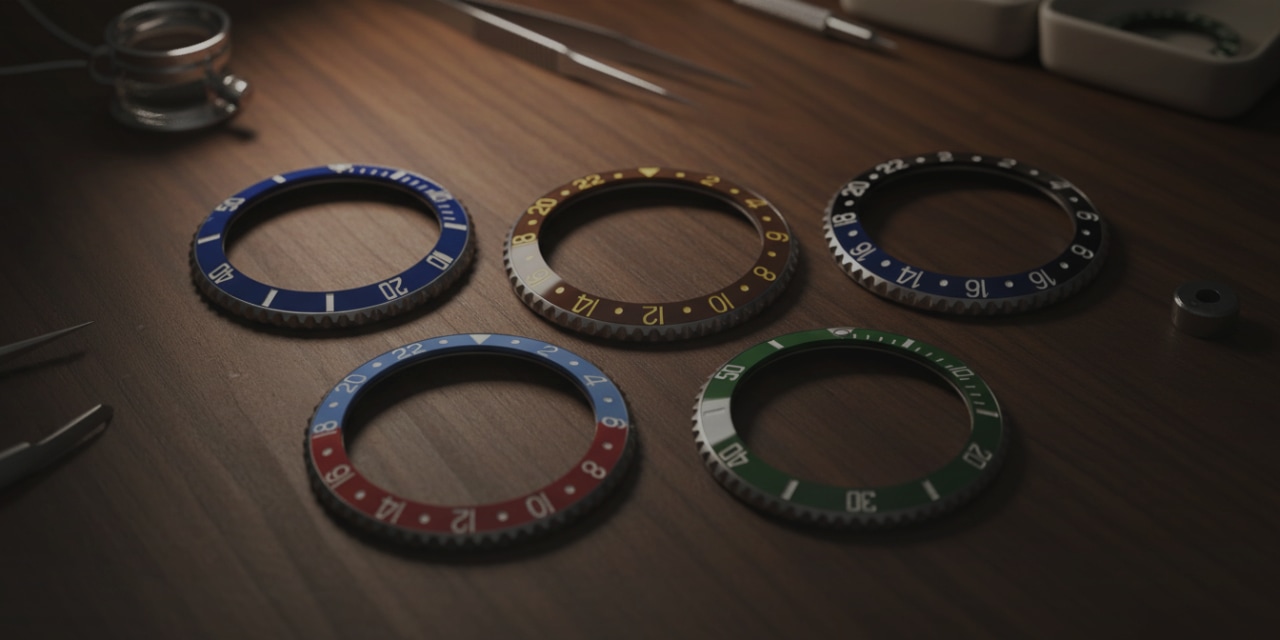
Cerachrom (from the words ‘Ceramic’ and ‘Chroma’, the Greek for color) starts life as a fine, white zirconium oxide powder.
That powder is mixed with binders and pigments before being compressed into a mould to form a rough ring shape. This so-called ‘green body’ (engineering slang for a ceramic that hasn’t been fired yet) is much larger than the desired finished product.
That blank green body is then baked in a furnace at roughly 1,400-1,500°C in a process called sintering (or, alternatively, frittage).
At those temperatures, the powder grains fuse together into a dense crystalline structure, causing the ring to shrink by anything up to 25%. When finished, the resulting material is extremely hard—about 1,200 Vickers. To give you an idea of just how hard that is, the aforementioned 904L steel ranks somewhere in the 150-200 Vickers range.
That solidity, of course, makes the next step problematic. Engraving the markings on the bezel cannot be done with ordinary steel cutters and so Rolex has to use either diamonds or lasers—neither of which are a cheap option. After that, a spot of luxuriousness is dropped in with the engravings receiving a coating of gold or even platinum in a process similar to PVD, or physical vapor deposition.
The final stage is polishing, again using diamonds. This removes any surplus material from the flat surfaces (but not it in the engraved recesses) and leaves the whole thing mirror smooth.
The insert is then mounted in a steel or gold bezel ring and fixed to the watch case.
Rolex’s Cerachrom Milestones
I’ve said this a number of times on this blog, but one of the most bewildering aspects of the whole Cerachrom revolution at Rolex was the watch they decided to use for its debut.
2005 marked the 50th anniversary of the legendary GMT-Master II, and so that was the model chosen to showcase the new bezels. Nothing wrong with that, of course; the GMT is a watch made famous by its bezels. Except, that fame came from the range of two-color schemes the brand has habitually used. Not only did it make the watches stand out, it was a practical necessity, allowing wearers to quickly differentiate between the day and nighttime hours engraved around the edge.
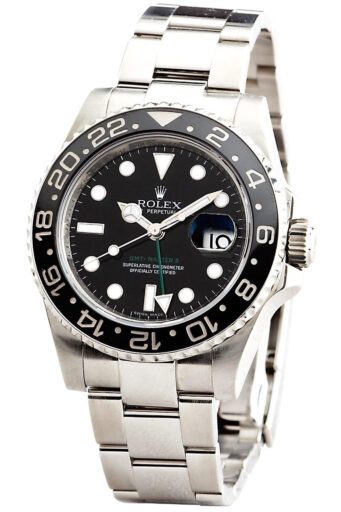
All well and good. Except, in 2005, Rolex had not yet figured out a way to add two colors to their Cerachrom-making process. And so, the 50th anniversary GMT-Master II came only with a solid black bezel.
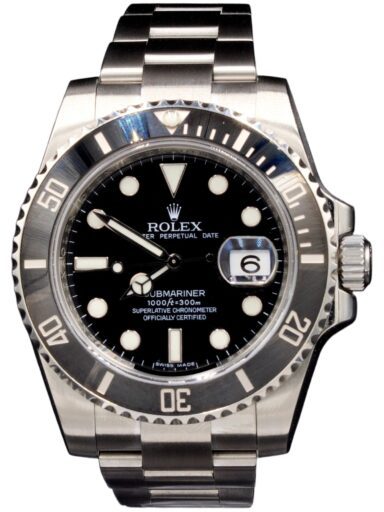
Two years later, the Yacht-Master II (now defunct) and the Submariner (very much still funct) received their new ceramic bezels. 2011 saw the Daytona get it too, but in a non-rotating, monobloc form.
Finally, in 2013, Rolex cracked the code and the ref. 116710BLNR, forever and always better known as the Batman, launched with a two-color black and blue bezel. The key, apparently, lay in soaking or coating half of the insert with a solution of chemical compounds, such as metal salts, before the sintering process. Those compounds would then react with the base material only in the treated area and change color, leaving a two-tone end product.
The Batman was followed up by the one everybody as waiting for in 2014 when the first red and blue Pepsi Cerachrom bezel landed, although it came only on a white gold case and so was somewhat price inhibitive.
The steel version came along in 2018 and remains a beloved piece among many collectors.
Yes, but…
It seems a little bombastic to describe something as comparatively trivial as a new watch material as ‘controversial’.
Nevertheless, Rolex’s introduction of Cerachrom was not welcomed in absolutely every corner of collector society.
On paper, it has everything. Fadeproof, scratchproof, as near as matters unbreakable. Basically, a Rolex bought today should stay looking like a Rolex you bought today pretty much forever. And therein lay the problem.
Watch collecting, in some ways, is the exact opposite of car collecting. A car enthusiast will spend thousands making a vintage model look like new. Paintwork, upholstery, chrome and trim, even the engine bay, every aspect will be pored over and refined to make the car concours.
By contrast, a watch collector will often spend thousands buying a watch that looks decidedly knocked about. Cracked spider dials, patinaed handsets and indexes, cases unpolished and, yes, bezels scratched or faded by the sun. Anything which gives the piece a personality or hints at a former life of excitement and adventure usually adds premiums to the asking price, and often an extensive one.
Rolex’s previous material, aluminum, and especially the briefly used one before that, Bakelite, were ideal for imbuing a story. But now there’s a material specifically designed to avoid that exact thing. Those individuals in the community who were happy with imperfection—who sought imperfection out, in fact—have not necessarily warmed to Cerachrom.
Yes, by every quantifiable metric, it is a superb innovation and one which is definitely here to stay. But has it taken away one of the most important essences of watch collecting? The heart.
Featured Photo: Mixed art by Oriol Mendivil for BKT Archive.