
 Sign In
 (817) 503-2334
 Contact Us





 By:
By:
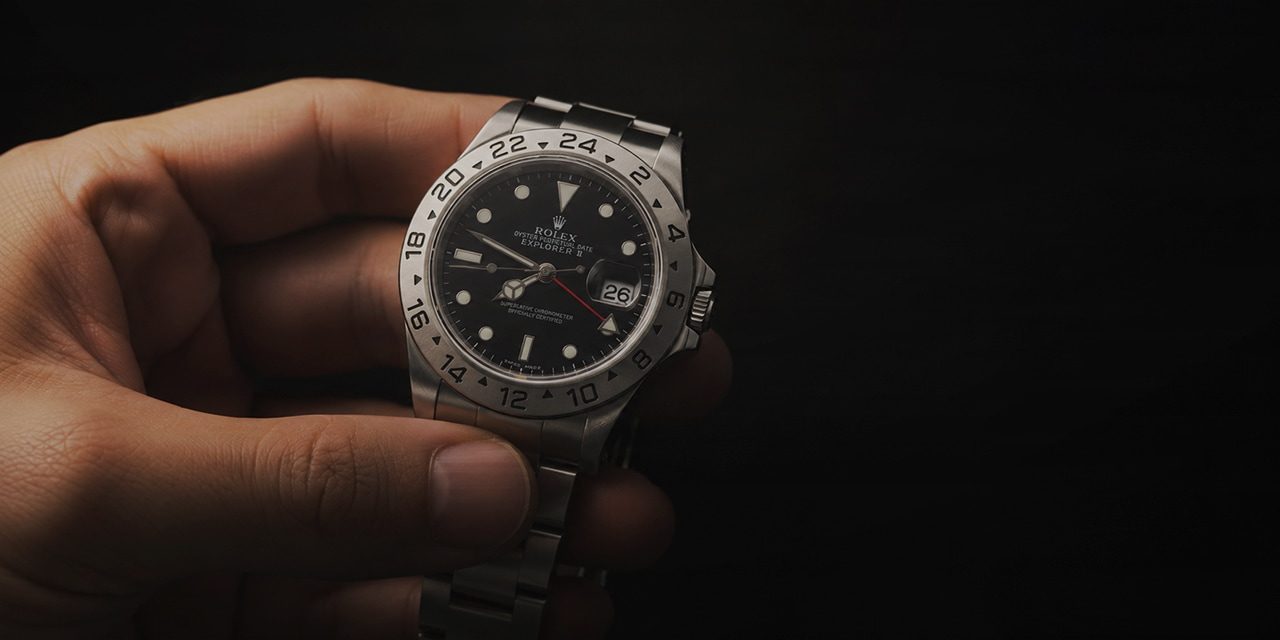
Top 10 Most Underrated Rolex Models to Invest in Right Now: Rolex Explorer II ref. 16570 Black
If you remember the first article in this latest series, we looked at some of the factors which can affect the future investment value of Rolex watches.
Among them were: the reference being discontinued (causing a natural scarcity), the watch in question having a short lived production run (for the same reason), some sort of historical significance (always adds interest from collectors), a unique or unusual dial (for the exclusivity factor) and, obviously, early evidence of increased activity on the secondary market.
We’ve pinned down 10 potential targets for you to have a look at and we’re going to be covering each one in detail over the coming weeks. To kick off, we’ll look at one of the brand’s perennially overlooked contributions, and a watch which ticks off the majority of considerations on our list; the Explorer II ref. 16570 with a black dial.
A Little History
One thing the ref. 16570 cannot claim is a short production run. As the third generation of the Explorer II, it followed the transitional reference, the ref. 16550, came with the updated Cal. 3185 movement and ran from 1989 to 2011.
That actually makes it one of the longest-running references of any Rolex which, paradoxically, contributes to its overlooked status; essentially, there are so many on the secondary market serious collectors have taken them for granted for years now.
It’s a similar story with the dials on offer. The Explorer II famously has always been a little short on options. From the second generation onwards you got to take your pick from either black or white; before that it was only black. With the ref. 16570, it is the white, or Polar, dial which has long been the most popular. Research suggests that’s on the swing now, with tastes suddenly favoring the black.
Lumes are a-Changing
The 22-year period the ref. 16570 was in production really saw the reference go from vintage to modern. As such, not all references are alike. For example, it went through three lume eras in that time.
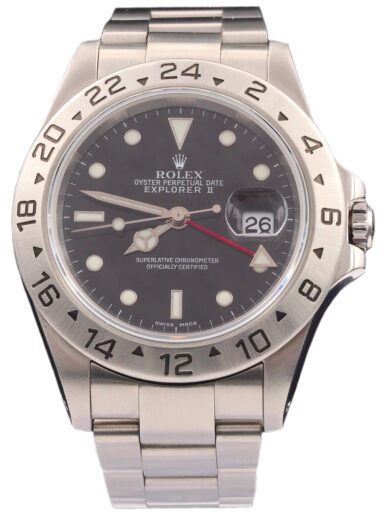
From 1989 to around 1998 Rolex was still using tritium. A replacement for the more dangerous radium, tritium was still radioactive but at a harmless level. What you will find with these first generation examples is that the lume plots on the dial have changed color as they age. And again, they do so with no uniformity at all, making each one unique—something all collectors love. As you search, you will find indexes turned brown, beige or yellow, with the most prized of all being what the Italians call ‘Chicchi di Mais’, meaning ‘corn kernels’. This refers to markers which have gone especially yellow and these will command a decent premium.
The effect is most noticeable on the Polar dials, but the black examples show their aging too. You can spot tritium dials easily enough by looking for the markings below the 6 o’clock index. They will read ‘SWISS—T<25’.
After tritium, and only used for 1-year between 1998 and 1999, Rolex switched to the color stable Luminova. A non-radioactive compound made in Japan, these dials are marked just ‘Swiss’ below the 6 o’clock and as such are sometimes called ‘Swiss only’ Explorer IIs.
Finally, at the end of 1999, Rolex changed again to SuperLuminova. This was more or less the same as Luminova but made in Switzerland. These dials are designated ‘Swiss Made’.
What’s in a Bracelet?
Another aspect which shows just how long the ref. 16570 was in production lies in their bracelets and end links. It’s also an extra plus point for those who like their watches with some retro flavor.
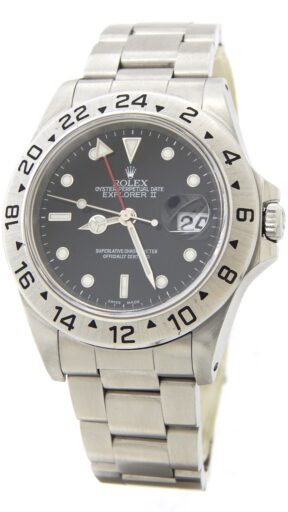
Before 2000, most Rolex watches came with lug holes. These were gradually phased out by 2003 but those ref. 16750s made before then will likely have them. Very much a matter of taste, some like them for both convenience and nostalgia reasons, while others prefer the cleaner look of the later examples.
Similarly, early bracelets will have folded end links before they were changed to solid (SEL), again around the turn of the millennium. These actually make a much bigger change to the overall watch than you might imagine. The hollow links give that rattly feel of all true vintage pieces, while the post-2000 bracelets have a more modern sensation and heft.
Two further things to note; the solid end links increase the length of the bracelet, so it is important to have it sized correctly. And pre-1998, the Oyster bracelet used on the Explorer II came without a flip-lock clasp.
The Movements
For most of its life, the ref. 16570 ran on the Cal. 3185. An outstanding workhorse of a movement, as was the entire Cal. 31XX series, it was what’s known as a ‘true’ GMT. Otherwise referred to as a traveler’s or a flyer GMT, it means the local (main) hour hand can be jumped in one hour increments, independently of the second (home) hour hand without it stopping the minutes or seconds hands. The GMT-Master II of that vintage used the same caliber.
Then, in 2007, Rolex updated the movement to the Cal. 3186. This added a Parachrom hairspring to guard against magnetic interference and temperature changes, and also fixed an odd quirk of the Cal. 3185; its wobbly hand. If you looked closely at the GMT hand when adjusting the time, it would judder just a little. It made absolutely no difference to accuracy or functionality, but was apparently enough of a bugbear at Rolex HQ that they dedicated resources to cutting it out.
So, a good way to judge the age of a ref. 16570 is to look out for the wobble or, alternatively, examine the rehaut. At the same time as the movement exchange, Rolex started laser engraving their logo into the small lip between the dial and bezel.
Which is the Best Investment?
As already stated, it has traditionally been the white dialed ref. 16570s which have been most in-demand, due to the relative scarcity of any white dials in the Professional Collection as a whole.
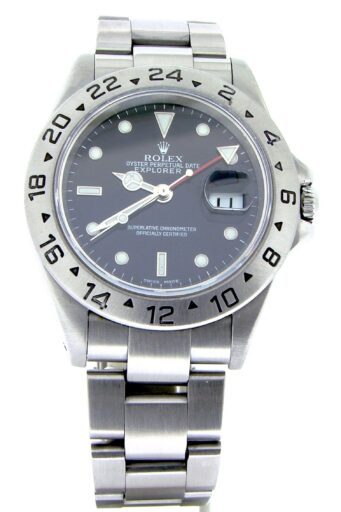
That seems to be changing at the moment, and the black dial versions are enjoying their time in the sun. The question is; which makes the best potential investment?
Well, looking back at our criteria, it is the rarest pieces which generally make the most tempting targets. For that, we should look at those Swiss Only models which were in production for only a year between 1998 and 1999. As few and far between as these are relatively speaking, you can still find examples for around $10,000.
Following that, one of the later Cal. 3186-powered, rehaut-engraved models from the final four years of production looks and feels like a thoroughly modern watch, with all the solidity and conveniences those looking for a rock solid daily driver could want.
But, of course, the most value will always be attached to the most exclusivity. And for that we need to turn to those beautifully aged, tritium-lumed first generations. Shot through with vintage charm, the hour markers and handsets will continue to change color as they mature, marking each one as utterly unique.
The good news is, you can still find excellent examples of these in the $12-$15k range. Although, with the upsurge in recent interest, maybe not for much longer.
Featured Photo: Mixed art by Oriol Mendivil for BKT Archive.