
 Sign In
 (817) 503-2334
 Contact Us





 By:
By:
Rival Timepieces to Challenge Rolex’s Finest: The Submariner
The Submariner
Welcome to the first in a new series provisionally entitled Rolex Alternatives or: How I Learned to Stop Waiting and Get a Different Watch.
As we’re all aware, Rolex as a brand stands alone; in sales, output and their position in pop culture. Ask literally anyone to name a luxury watchmaker and you can bet 99 times out of 100 they’re going to say the Crown.
As wonderful as that doubtless is for the folks at Rolex, it does make buying one of their watches fraught with a number of inherent challenges.
Firstly, availability. When you have every fan on Earth clamoring for one of your products, any manufacturer is going to face a supply problem eventually. In short, Rolex can’t make their watches fast enough to ensure everyone who wants one can get one. Or, if you’re cynical, Rolex makes sure there’s a drought of their most in-demand models to give them a sense of exclusivity.
That leads us, ironically enough, to a second point. With some people, it is Rolex’s very popularity and the ubiquitousness of their watches which puts them off. Difficult to get or not, if someone really wants a Rolex they will get them, even if they have to pay a hefty preowned premium. And a lot of people really want one. That leads to a sort of reverse snobbery where those who actually prefer to stand out choose something a bit less pervasive.
And thirdly, there’s the price. We won’t get into the whole ‘they’re not really that expensive in reality’ argument and the minutiae of value retention, but the point remains that buying a Rolex does require a substantial upfront outlay beyond the scope of many. In those cases, a less expensive substitute is the way forward.
So, that is what this series is for. We’re going to explore alternatives for each of the most in-demand names in the manufacture’s portfolio—firstly as a list and then with a separate, more comprehensive article for each.
We’ll start at the top; a dive watch so iconic that half the world wants it and the other half are making their own version—the Rolex Submariner.
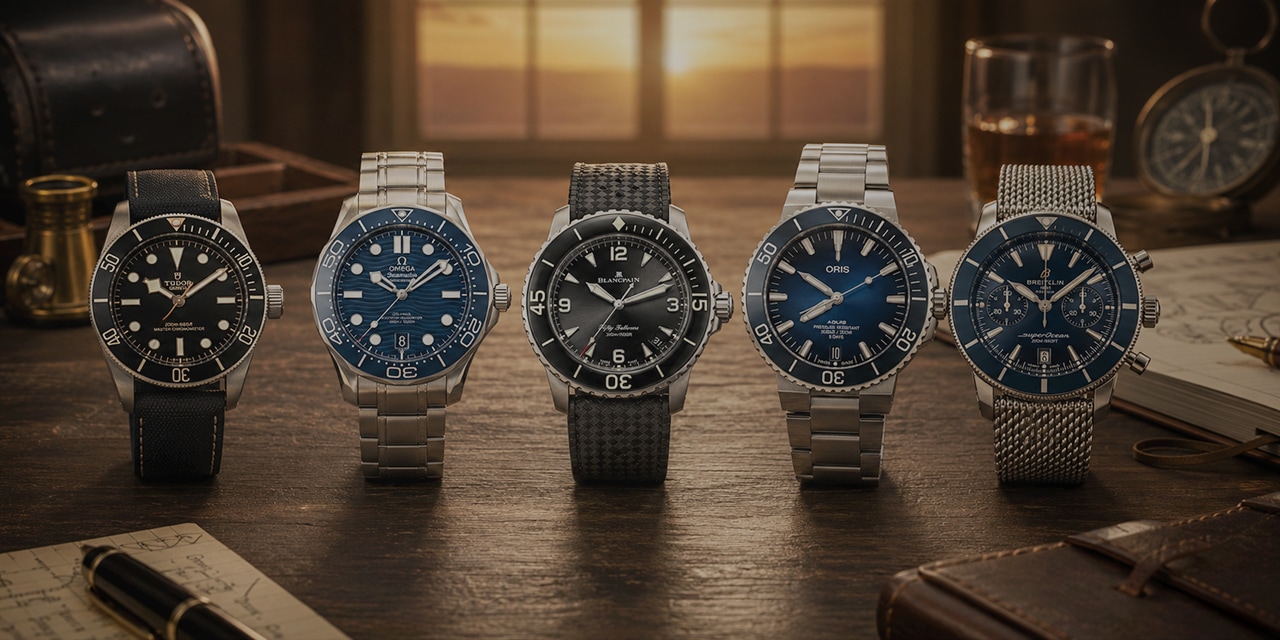
The Top 5 Rolex Submariner Alternatives
The Tudor Black Bay
Is this cheating? It might seem so, what with Tudor being Rolex’s sister company. But as anyone with a younger sibling knows, they are often the ones who come closest to outdoing you.
In Tudor’s case, they’ve done it by offering purists much of what they lament Rolex has lost. i.e. that tool watch spirit.
When the Submariner originally surfaced, it was the ultimate sportsman’s timepiece. The first model waterproof to 100m, it was not just a triumph of minimalist, high contrast design, it was built and looked like it could withstand anything. There was no doubt it was extremely stylish, but it was first and foremost a working implement for proper diving.
Over the years, much of that ethos has been lost as the Submariner became more status symbol than tool. For some it started with the introduction of a date function, for others the arrival of the gold and two-tone versions. Today, it is a rare Sub indeed found anywhere near a dive boat.
This is where Tudor have profited so successfully. Their Black Bay range is essentially styled after the Rolex watches of 70-years ago, brought up to date with modern materials and conveniences.
You can take your pick from the current catalog, depending on what size you prefer. The original Black Bay measures 41mm, while the newly-issued Black Bay 68 is a heftier 43mm. The massively popular Black Bay 58 is a nicely universal 39mm, while the most vintage-adjacent Black Bay 54 has the same 37mm diameter as the initial Rolex models.
All of them carry the same design elements which made the big brother an all-time classic; we get the perfect tonneau-shaped cases, the dot and baton indexes, the serrated bezel with dive markings and hashed first 15. And while some of the lines do come with extra colorways and precious metal variants, these are undoubtedly more underwater instrument than boardroom companion.
We’ll be visiting Tudor again as this series progresses—arguably the brand which offers the best equivalent to Rolex of them all.
The Omega Seamaster Diver 300M
The Submariner was James Bond’s first movie watch. The Omega Seamaster is his current one. That alone would put them on this list, and high on it.
How Omega pulled off that coup I have no idea (well, immense amounts of cash I would imagine, to be honest) but it cannot be overstated just how much of an image boost 007 patronage gave both the watch and the brand.
That should not detract, however, from just how good the Seamaster range is, and the Diver 300M in particular. These are the entry point into Omega’s dedicated dive models, and there are over 60 to choose from.
The vast majority are 42mm time-only and time-and-date pieces, a further handful at 43.5mm and 44mm and a few chronographs thrown into the mix as well. And, just like the Tudor, they all share a variety of design and engineering elements.
Each is equipped with a nicely scalloped bezel to make it easier to turn, along with the signature ‘plongeur’ style hands and trademark wave pattern across the dial. Additionally, manually-operated Helium Escape Valves are a constant as well no matter which version you look at, a nod toward these being professional timepieces fit for saturation diving.
The 300M is often cited as the watch that matches the appeal and popularity of the Submariner the closest, and it is certainly a design classic in its own right. It also offers a vastly greater amount of variety than the Sub too. There are many more colorways involved, a wider selection of bracelet options, as well as a larger choice in materials; the full steel models are supplemented with titanium watches, bronze, black ceramic, standard yellow gold as well as Omega’s own Sedna and Moonshine, and Tantalum.
As for price, the Omega has the Sub pipped there as well. Base level versions of each have a roughly $3,500 to $4,000 difference in the Seamaster’s favor, a stat which carries on to a greater or lesser degree throughout the range.
So, while some believe the sheer number of 300Ms somewhat dilutes the collection, it has to be said they stand as a genuine alternative to the Submariner, and with no waiting list either.
The Blancpain Fifty Fathoms
Depending on the version of events you subscribe to, you could say the Fifty Fathoms beat the Sub to the punch all the way back in 1953.
That has long been the accepted commentary and, even though it has been debunked in recent years and the Submariner unequivocally came first, Blancpain’s model is still an icon of the breed.
Invented by two French special forces frogmen, it was, like many of history’s most important innovations, created out of necessity. The pair, Captain Robert ‘Rob’ Maloubier and Lt. Claude Riffaud, needed a reliable timing device for their newly formed squadron of underwater demolition experts and, with nothing on the market up to the job, sat down with a pencil and graph paper and sketched out their own.
Together with the help of avid Scuba enthusiast and Blancpain CEO, Jean-Jaques Fiechter, the Fifty Fathoms was born and quickly became government issue not just to the French Navy but also those of Pakistan, Israel and Britain. They would eventually be used by the U.S. Navy as well, after a succession of jumping through hoops which saw the watches rebadged as Tornek-Rayville TR-900 (but we’ll look at that in more detail in our dedicated article).
The important thing is that the Fifty Fathoms was a serious watch for serious people and today remains so. There are over 70 examples in the contemporary register, ranging from 38mm ladies pieces, through the thinner, more elegant Bathyscaphe editions, a number of beautiful vintage-inspired throwbacks like the No-Rad and Barakuda, and on up to the haute horlogerie tourbillon and complete calendar watches.
Those top end pieces really exist on a different plane to the Submariner, but the other end of the scale offers a refreshingly unconventional second option.
A watch bought by those who know their watches, the Fifty Fathoms is an archetype of the dive watch genre.
The Oris Aquis Date Calibre 400
There are very few absolutes in life and virtually none in watch collecting. But if there’s one thing you can be reasonably assured of, it’s that everyone loves Oris.
In fairness, how could you not? One of the few Swiss brands which have managed to stay independent and not get swallowed up by any of the Swatch, Richemont, LVMH conglomerates, they stride through the industry with that underdog swagger. Coupled with that, you will go a long way to find another brand offering the kind of Swiss-made quality in finishing, design and even in-house movements for the sort of price Oris do it for. Their watches also have their own distinct personality when the easier option would have been to clone the successful models of other brands, and they lean into manufacturing sustainability in a big way—their eco efforts are authentic in a way giant corporations can’t match.
Mostly though, all of that has led to them being seen as a ‘watch guy’s brand’. They make the kinds of timepieces you buy because you love horology, not because you want to flex (I’m wearing my Roberto Clemente Limited Edition as I type this!)
The Aquis Date is Oris’s bestselling range of watches, even more so than their other dive series, the Divers Sixty-Five. Whereas the latter is heavily vintage-inspired, the Aquis is a thoroughly modern take on the field and comes equipped with either a Sellita-based SW200-1 (the Oris 733-1) or else the brand’s own Calibre 400, their first modern, mainstream movement.
The Calibre 400 models are available in both 41.5mm and 43.5mm, with steel cases, ceramic bezels and a selection of sunburst vignette dials. They are extremely robust, with thick crown guards, integrated lugs and 300m water resistance across the board. Better yet, that home grown engine gives a 5 day power reserve and a 10-year service interval.
As an everyday luxury tool watch, there is very little out there to touch an Aquis, with or without a domestic caliber. Honest, tough and expertly made, they have the $3,500 to $4,500 space pretty much to themselves. A huge amount of watch for a relatively small outlay.
The Breitling Superocean
Although the Rolex Submariner really set the benchmark 70-years ago for what dive watches were going to look like, there is nothing to say that’s what they have to look like.
Breitling’s sporty Superocean line is one which breaks free of convention, at the same time not taking itself too seriously. As a result, they are a breath of fresh air in a category saturated with black on white coloring and conservative stylings.
The collection, issued in everything from 36mm up to 46mm, is big, bold and chunky and, while there are plenty of monochrome models, the visuals lend themselves to the range of super bright splashes as well.
Everything about the series is substantial. The square and rectangular hour markers are enormous, as is the minute ring and its numerals around the dial’s periphery. The handset is fat and exceptionally easy to read, and the bezel has wide serrations for easy gripping. When you go up to the 46mm pieces, they even have an additional bezel lock on the left of the case which makes the whole thing look bigger still.
All in all, this is modern dive watch engineering, from a brand with a definite pedigree. Although perhaps better known for their aviation models, Breitling have been in the underwater game since the ‘50s, their first offering also called the SuperOcean. This new series brings everything right up to date, with fun visuals and sturdy movements, perfect for a day spent submerged or just lounging poolside.
Featured Photo: Mixed art by Oriol Mendivil for BKT Archive.